Printable Scholar

Brazil Country Report Kit
Everything a student needs to research and write a report on Brazil: the reading, the maps and the pages to fill in. Nothing else to look up.
- 4 reading pages: Brazil fun facts with the flag, History, Land and Work, and Culture and Daily Life
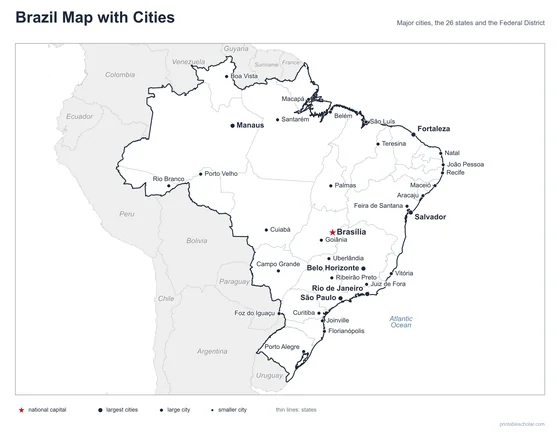
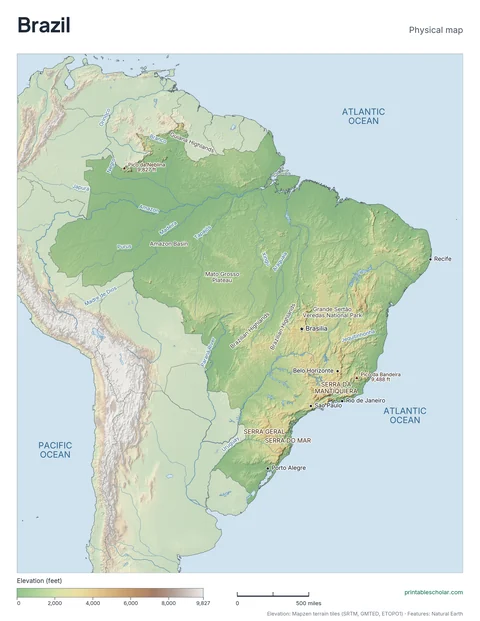
- 5 maps: landmarks, cities, Where in the World, outline, and rivers, lakes and neighbors
- A 9-page My Country Report booklet, from fast facts to a trip plan, a stamp to design and a written report
- A pennant to cut out and hang, two map skills sheets and a 10-question reading quiz
- Answer keys, a grading rubric and talking points for the teacher
- Two print-ready PDFs, 26 pages each, US Letter: color, and ink-saving black and white
Each student on a different country? Get every country kit for $24.
Look inside: all 26 pages
Read it, map it, write it.
The reading pages and maps hold every answer the booklet asks for. About one third of the booklet is looking things up. The rest asks students to choose, plan and explain.

What is in the Brazil kit
To read and study
- Brazil fun facts: six short true stories, the flag, By the Numbers and Did You Know
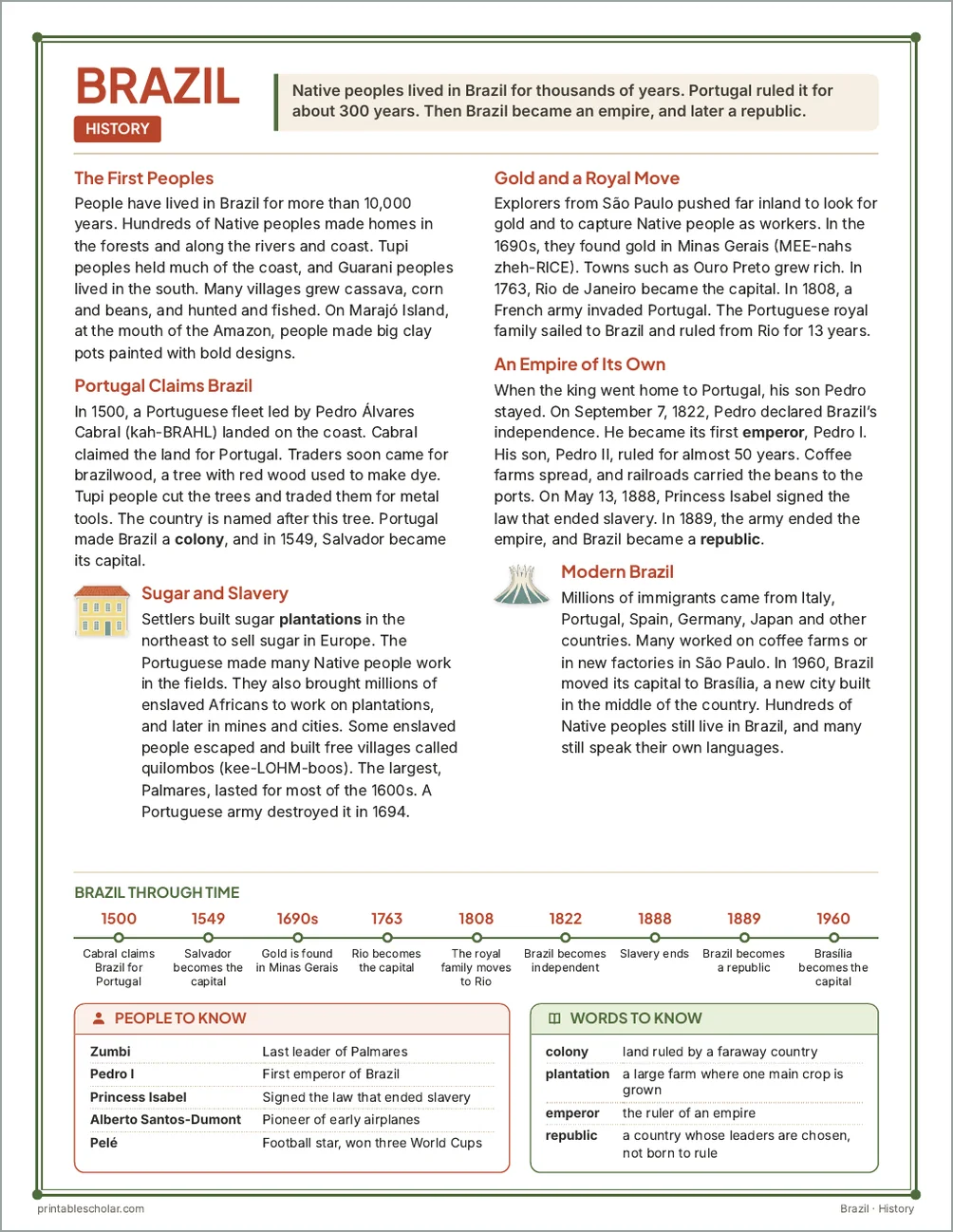
- History: the country’s story from its first peoples to today, with a timeline, people to know and words to know
- Land and Work: the land and climate, what people grow, make and mine, and how one leads to the other
- Culture and Daily Life: food, school, sports, holidays, music and crafts, with everyday words to say
- Five maps, including Where in the World with latitude and longitude, and a rivers, lakes and neighbors map with a letter key
To fill in and make
- My Country Report booklet: cover, Fast Facts, My Map, Culture and Daily Life, My Trip, Think Like a Geographer, Design a Stamp, Dig Deeper and My Report
- A pennant with the country’s name and outline, to color, cut out and hang
- Name the Cities and Name the Rivers and Lakes sheets, each with a word bank
- A 10-question reading quiz, answer keys, a rubric and talking points for the teacher
Free: the Brazil History reading page
One page on the history of Brazil for grades 3 to 5, free to print in color or black and white. It is the second reading page in the kit.
The First Peoples
People have lived in Brazil for more than 10,000 years. Hundreds of Native peoples made homes in the forests and along the rivers and coast. Tupi peoples held much of the coast, and Guarani peoples lived in the south. Many villages grew cassava, corn and beans, and hunted and fished. On Marajó Island, at the mouth of the Amazon, people made big clay pots painted with bold designs.
Portugal Claims Brazil
In 1500, a Portuguese fleet led by Pedro Álvares Cabral (kah-BRAHL) landed on the coast. Cabral claimed the land for Portugal. Traders soon came for brazilwood, a tree with red wood used to make dye. Tupi people cut the trees and traded them for metal tools. The country is named after this tree. Portugal made Brazil a colony, and in 1549, Salvador became its capital.
Sugar and Slavery
Settlers built sugar plantations in the northeast to sell sugar in Europe. The Portuguese made many Native people work in the fields. They also brought millions of enslaved Africans to work on plantations, and later in mines and cities. Some enslaved people escaped and built free villages called quilombos (kee-LOHM-boos). The largest, Palmares, lasted for most of the 1600s. A Portuguese army destroyed it in 1694.
Gold and a Royal Move
Explorers from São Paulo pushed far inland to look for gold and to capture Native people as workers. In the 1690s, they found gold in Minas Gerais (MEE-nahs zheh-RICE). Towns such as Ouro Preto grew rich. In 1763, Rio de Janeiro became the capital. In 1808, a French army invaded Portugal. The Portuguese royal family sailed to Brazil and ruled from Rio for 13 years.
An Empire of Its Own
When the king went home to Portugal, his son Pedro stayed. On September 7, 1822, Pedro declared Brazil’s independence. He became its first emperor, Pedro I. His son, Pedro II, ruled for almost 50 years. Coffee farms spread, and railroads carried the beans to the ports. On May 13, 1888, Princess Isabel signed the law that ended slavery. In 1889, the army ended the empire, and Brazil became a republic.
Modern Brazil
Millions of immigrants came from Italy, Portugal, Spain, Germany, Japan and other countries. Many worked on coffee farms or in new factories in São Paulo. In 1960, Brazil moved its capital to Brasília, a new city built in the middle of the country. Hundreds of Native peoples still live in Brazil, and many still speak their own languages.
Brazil through time
- 1500 Cabral claims Brazil for Portugal
- 1549 Salvador becomes the capital
- 1690s Gold is found in Minas Gerais
- 1763 Rio becomes the capital
- 1808 The royal family moves to Rio
- 1822 Brazil becomes independent
- 1888 Slavery ends
- 1889 Brazil becomes a republic
- 1960 Brasília becomes the capital
People to know
- Zumbi: Last leader of Palmares
- Pedro I: First emperor of Brazil
- Princess Isabel: Signed the law that ended slavery
- Alberto Santos-Dumont: Pioneer of early airplanes
- Pelé: Football star, won three World Cups
Free Brazil maps
Each of these maps is free to print on its own. The kit puts its maps in one file with the reading pages and the booklet.