 Printable Scholar
Mohenjo-daro: A Planned City
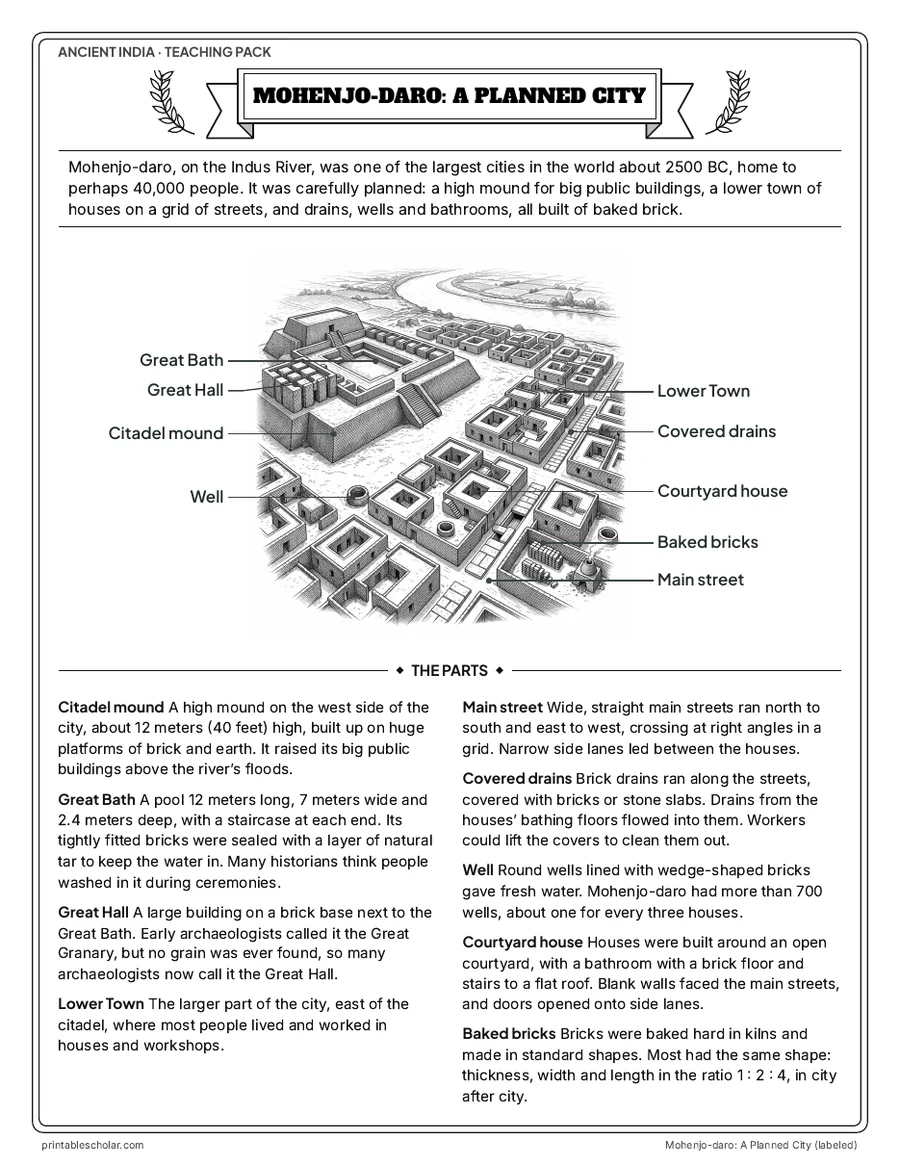
Mohenjo-daro, on the Indus River in what is now Pakistan, was one of the largest cities in the world about 2500 BC, home to perhaps 40,000 people. It was one of the great cities of the Indus Valley civilization, along with Harappa. The city was carefully planned: a high mound for big public buildings, a lower town of houses on a grid of straight streets, and wells, bathrooms and covered drains, all built of baked brick. Its people wrote with signs that no one can read today, so much about who ruled the city is still a mystery.
Free to print
A labeled picture of Mohenjo-daro and a label-it sheet
PDFs sized for US Letter paper, in color and black and white.
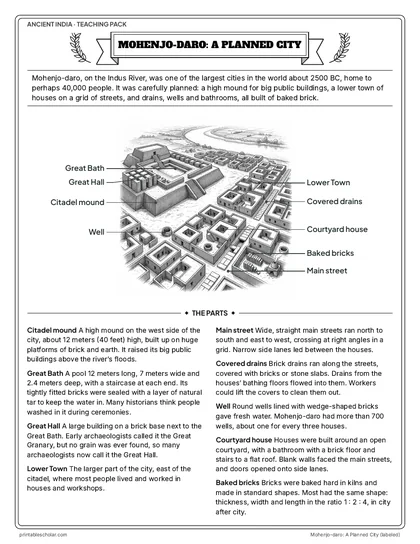
Mohenjo-daro: A Planned City, labeled
The citadel mound, Great Bath, Great Hall, lower town, main streets, covered drains, wells, courtyard houses and baked bricks, each named with what it was for.
Download PDF Black and white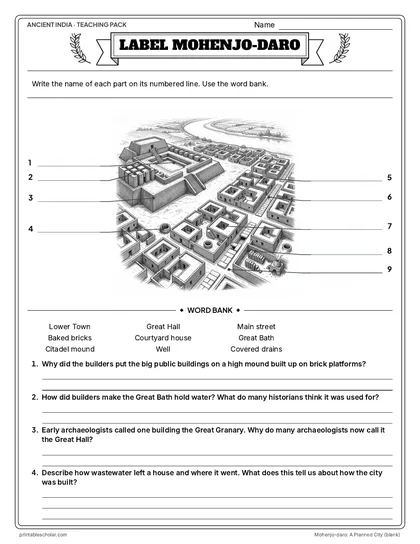
Label Mohenjo-daro
The same picture with numbered lines, a word bank and four questions.
Download PDF Black and white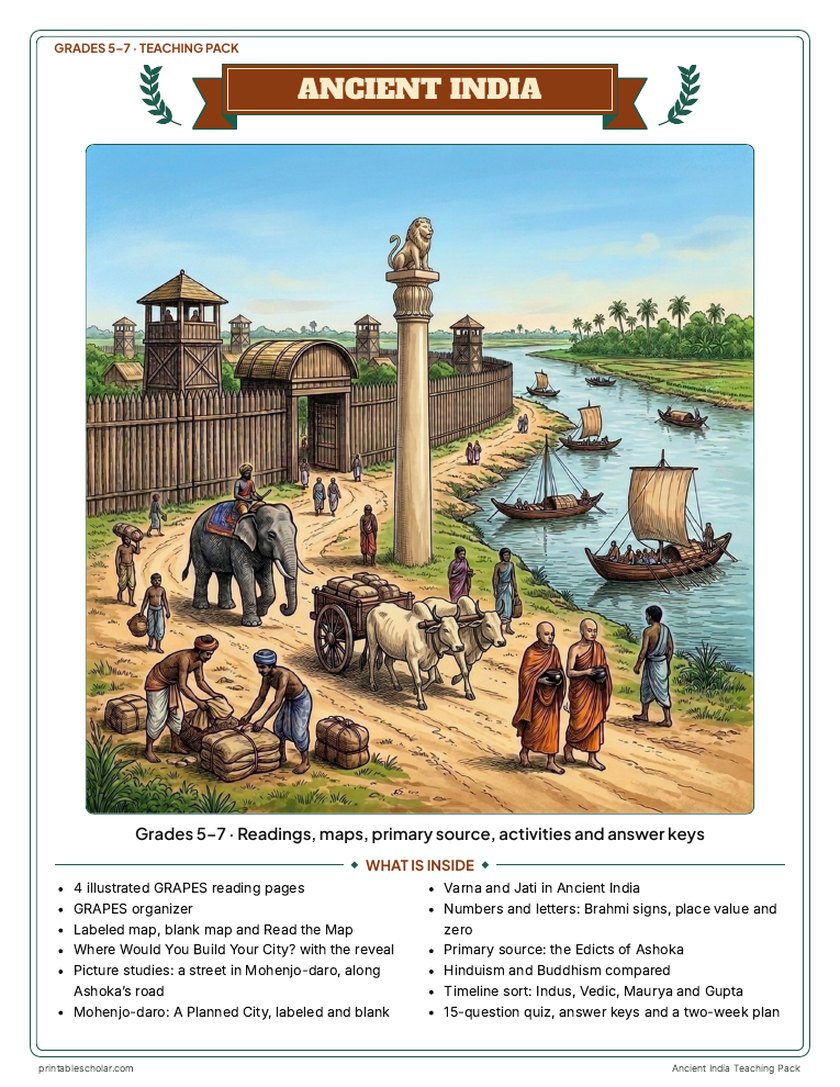
Teaching pack · Grades 5–7
Teaching Ancient India? The whole unit, ready to teach.
Two weeks of lessons in one download: slides to present, notes for students to fill in, and printable pages that use these maps and pictures.
- 34 lesson slides (PowerPoint you can edit, teacher notes on every slide) and 2 pages of guided notes
- 4 illustrated reading pages and a GRAPES organizer
- Maps: labeled, blank, Read and Measure the Map, and a "Where would you build your city?" decision with the reveal
- Activities: picture studies of a Mohenjo-daro street and Ashoka's road, Mohenjo-daro labeled and blank, varna and jati, India's numbers and Brahmi letters, the Edicts of Ashoka, Hinduism and Buddhism compared, and a timeline sort
- A 15-question quiz, a teacher guide with a two-week plan, and answer keys for everything
Every answer is in the pack. The readings, slides, maps and pictures teach everything the sheets and quiz ask, so no textbook is needed.
Get the Ancient India pack for $7Teaching more than one? Get all six ancient civilizations (Egypt, Mesopotamia, Greece, Rome, China and India) for $29: about twelve weeks of lessons.
Get all 6 packs for $29One-time purchase. Instant download. Color and ink-saving black-and-white editions. Secure checkout by Stripe.
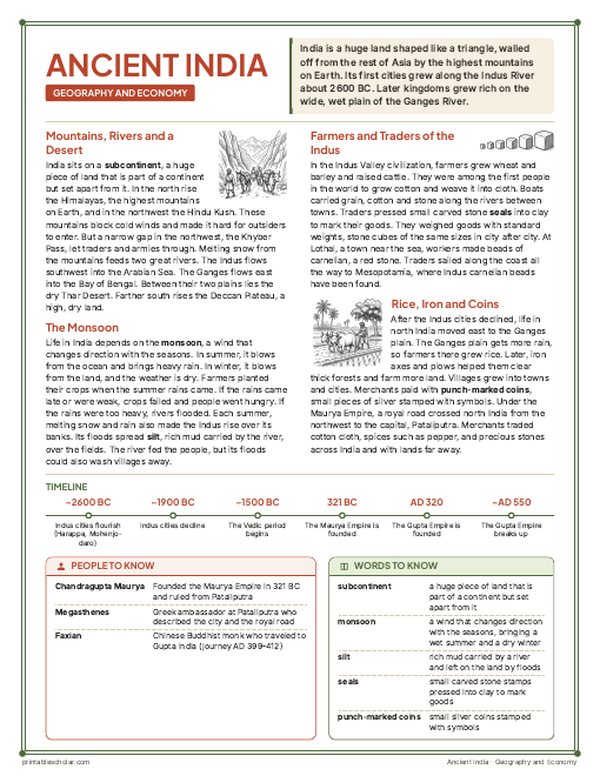
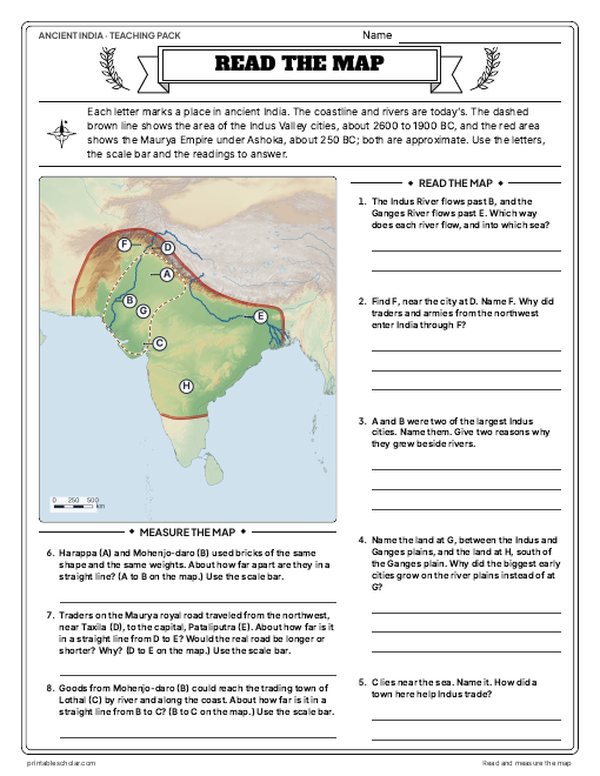
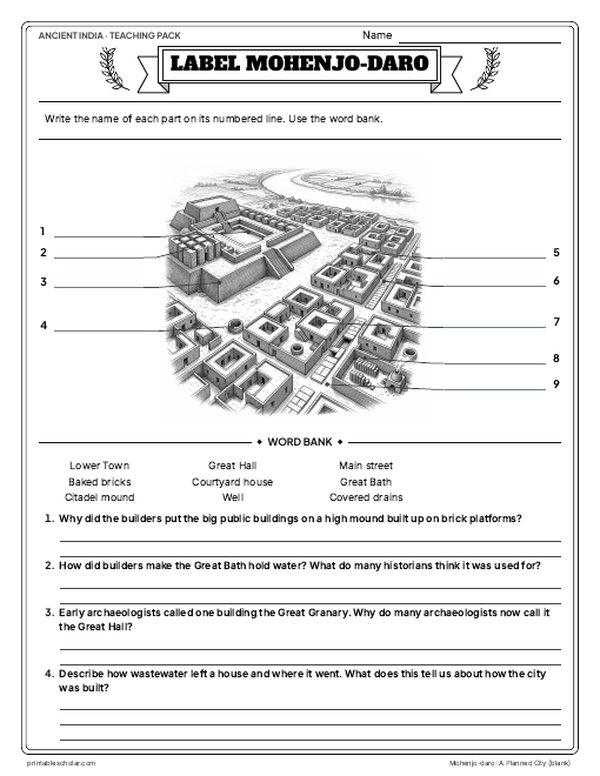
The parts of the city
Citadel mound
A high mound on the west side of the city, about 12 meters (40 feet) high, built up on huge platforms of brick and earth. It raised its big public buildings above the river’s floods.
Great Bath
A pool 12 meters long, 7 meters wide and 2.4 meters deep, with a staircase at each end. Its tightly fitted bricks were sealed with a layer of natural tar to keep the water in. Many historians think people washed in it during ceremonies.
Great Hall
A large building on a brick base next to the Great Bath. Early archaeologists called it the Great Granary, but no grain was ever found, so many archaeologists now call it the Great Hall.
Lower Town
The larger part of the city, east of the citadel, where most people lived and worked in houses and workshops.
Main street
Wide, straight main streets ran north to south and east to west, crossing at right angles in a grid. Narrow side lanes led between the houses.
Covered drains
Brick drains ran along the streets, covered with bricks or stone slabs. Drains from the houses’ bathing floors flowed into them. Workers could lift the covers to clean them out.
Well
Round wells lined with wedge-shaped bricks gave fresh water. Mohenjo-daro had more than 700 wells, about one for every three houses.
Courtyard house
Houses were built around an open courtyard, with a bathroom with a brick floor and stairs to a flat roof. Blank walls faced the main streets, and doors opened onto side lanes.
Baked bricks
Bricks were baked hard in kilns and made in standard shapes. Most had the same shape: thickness, width and length in the ratio 1 : 2 : 4, in city after city.
Frequently asked questions
Where was Mohenjo-daro?
On the Indus River in what is now Sindh, Pakistan. It was one of the biggest cities of the Indus Valley civilization, which flourished from about 2600 to 1900 BC.
What was the Great Bath?
A pool about 12 meters long, 7 meters wide and 2.4 meters deep on the citadel mound, made watertight with fitted bricks, plaster and a layer of tar. Many historians think people washed in it during ceremonies.
Why was Mohenjo-daro abandoned?
After about 1900 BC the big Indus cities were slowly abandoned. Historians still debate why; possible causes include changes in the climate and rivers that shifted their courses or dried up.