 Printable Scholar
How the Mayan Calendar Worked
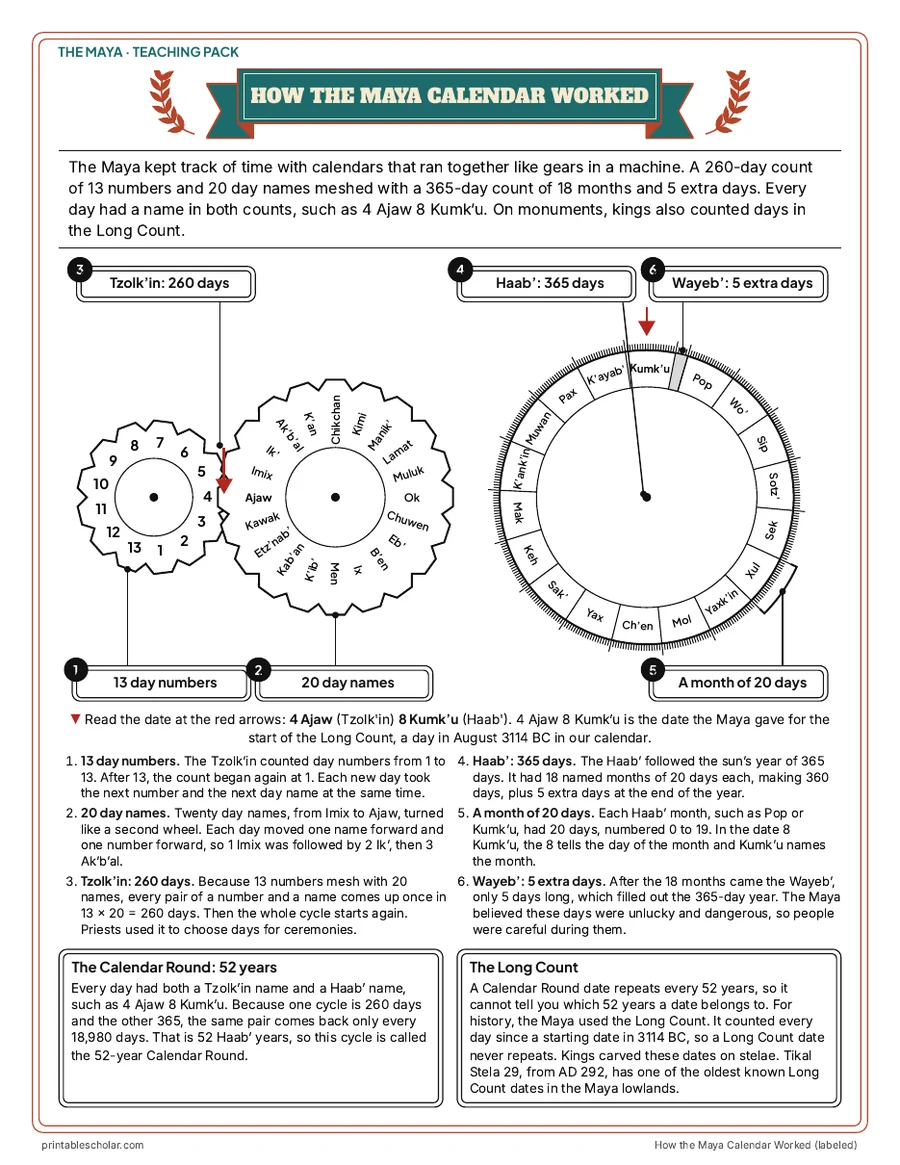
The Maya kept several calendars at once. Two of them turned together like gears. The 260-day Tzolk’in paired 13 day numbers with 20 day names, and the 365-day Haab’ had 18 months of 20 days plus 5 extra days called the Wayeb’. Every day had a name in both, such as 4 Ajaw 8 Kumk’u, and the same pair came back only every 52 years. For history, kings also carved dates in the Long Count, which counted every day since a start date in 3114 BC.
Free to print
Labeled and blank Maya calendar wheels
PDFs sized for US Letter paper, in color and black and white.
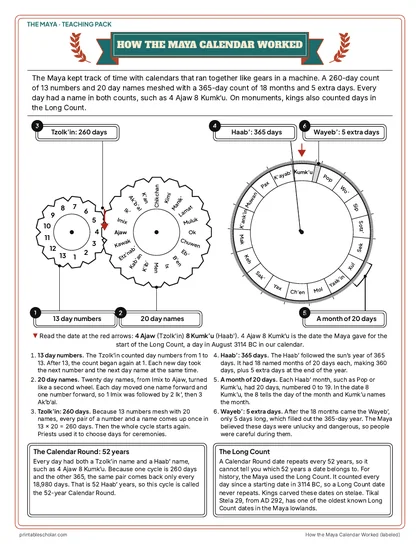
How the Maya Calendar Worked, labeled
The day-number and day-name wheels of the Tzolk’in, the Haab’ wheel with its 18 months and the Wayeb’, what each part did, the Calendar Round and the Long Count.
Download PDF Black and white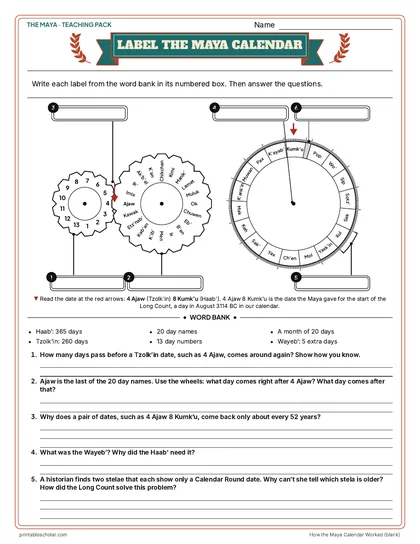
Label the Maya Calendar
The same wheels with six empty numbered labels, a word bank and five questions.
Download PDF Black and white
Teaching pack · Grades 6–8
Teaching the Maya? The whole unit, ready to teach.
Two weeks of lessons in one download: slides to present, notes for students to fill in, and printable pages that use these maps and pictures.
- 35 lesson slides (PowerPoint you can edit, teacher notes on every slide) and 2 pages of guided notes
- 4 illustrated reading pages and a GRAPES organizer
- Maps: labeled, blank, Read and Measure the Map, and a "Where would you build your city?" decision with the reveal
- Activities: picture studies of a milpa farm and the ball game at Copan, the Maya calendar wheels (labeled and blank), Maya numbers and the date on Tikal Stela 29, who was who, the Popol Vuh, the Maya and Ancient Egypt compared, and a timeline sort
- A 15-question quiz, a teacher guide with a two-week plan, and answer keys for everything
Every answer is in the pack. The readings, slides, maps and pictures teach everything the sheets and quiz ask, so no textbook is needed.
Get the Maya pack for $7One-time purchase. Instant download. Color and ink-saving black-and-white editions. Secure checkout by Stripe.
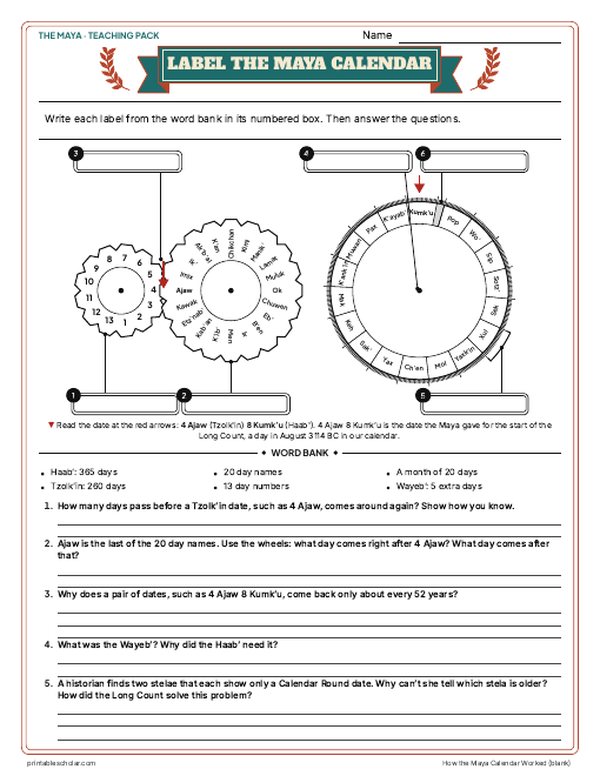
The parts of the Maya calendar
The Tzolk’in: 260 days
13 day numbers and 20 day names turned together. Each new day took the next number and the next name, so 4 Ajaw was followed by 5 Imix. Every pair came up once in 13 × 20 = 260 days, then the cycle started again. Priests used it to choose days for ceremonies.
The Haab’: 365 days
The Haab’ followed the sun’s year. It had 18 named months of 20 days each, from Pop to Kumk’u, making 360 days, plus the 5 days of the Wayeb’ at the end of the year. The Maya believed the Wayeb’ days were unlucky.
The Calendar Round: 52 years
Because one count is 260 days and the other 365, the same pair of dates, such as 4 Ajaw 8 Kumk’u, comes back only every 18,980 days: 52 Haab’ years.
The Long Count
A Calendar Round date repeats, so it cannot tell you which 52 years it belongs to. The Long Count counted every day since a start date in 3114 BC, so a date never repeats. Tikal Stela 29, from AD 292, has one of the oldest known Long Count dates in the Maya lowlands.
Frequently asked questions
How did the Mayan calendar work?
Two counts ran together like gears: the 260-day Tzolk’in (13 numbers with 20 day names) and the 365-day Haab’ (18 months of 20 days plus 5 Wayeb’ days). Every day had a name in both, and the pair repeated every 52 years. The Long Count tracked days since 3114 BC for history.
Did the Mayan calendar predict the end of the world in 2012?
No. On December 21, 2012, the Long Count reached 13.0.0.0.0, the end of a long cycle, much like a car’s odometer rolling over. Maya inscriptions name dates far past 2012.
What was the Wayeb’?
The 5 extra days at the end of the 365-day Haab’ year, after the 18 months of 20 days. The Maya believed they were unlucky, so people were careful during them.