 Printable Scholar
Food Web Builder
A living woodland. Take one thing out, or put one in, and watch what happens to everything else.
How to play
The woodland is already alive when you arrive: each living thing has a bar showing how many there are, and the arrows show who eats whom. Tap a living thing to see what it eats and what eats it, and to light up its arrows. Tap the × next to it (or the button on its card) to take it out, then watch what happens over the next few seasons. To put something in, tap it in the row along the bottom, or drag it onto the woodland. Tap the sun to block it. The woodland meter at the top shows how the woodland is doing: Thriving, Stressed or Collapsing. It goes by how many kinds of living things are surviving and how steady their numbers are, the two things ecologists look at. A woodland can bounce back from a boom or a crash, but losing whole kinds of living things is the damage that lasts. The Can you…? list has challenges: some break the woodland and some fix it. Undo takes back your last change and Start over brings back the first woodland. The populations are a simple model: real woodlands are messier and slower, but they rise and fall in the same ways.
Things to try
- Take out the fox and watch the rabbits and the grass. What happens first, and what happens next?
- Take out the grass. Which animals run out of food, and in what order?
- Take out the mushroom. What piles up, and what happens to the plants?
- Block the sun. Which living things go first?
- Make a food chain with 5 links from the sun to the hawk.
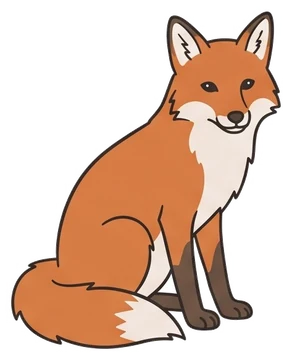
- Tap the fox. Why is it a primary, secondary and tertiary consumer all at once?
- Put in all 15 living things and keep them steady.
Teaching food chains and food webs?
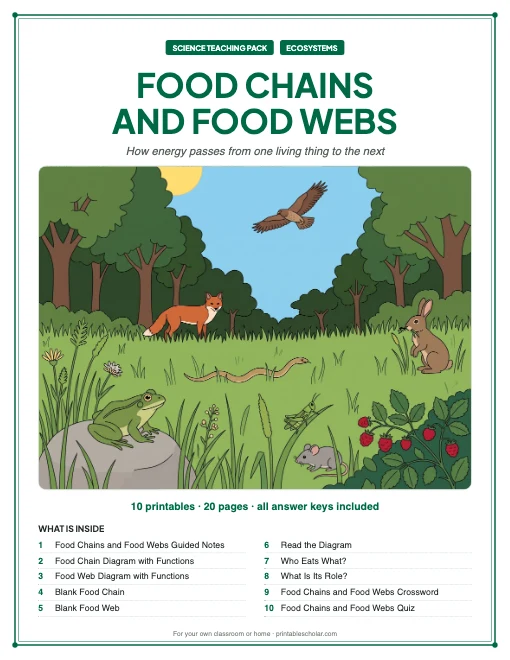
The Food Chains and Food Webs teaching pack has 26 lesson slides, guided notes, practice sheets, a crossword and a quiz, with every answer key, for grades 4 to 6. The food chain diagram and food web diagram are free to print, with the same plants and animals as the game.
Questions
What is a food web?
A food web shows who eats whom in a habitat. Each arrow points from the food to the animal that eats it, so the arrows show which way the energy goes. A food web is many food chains joined together, because most animals eat more than one thing and are eaten by more than one thing.
What is the difference between a food chain and a food web?
A food chain is one path of energy, like sun → grass → grasshopper → frog → snake → hawk. A food web shows all the paths in a habitat at once. In the game, tap any living thing to light up its own arrows.
What are producers, consumers and decomposers?
Producers are plants: they make their own food from sunlight. Consumers eat other living things. Primary consumers eat plants, secondary consumers eat primary consumers, and so on up the web. Decomposers, like mushrooms and earthworms, break down dead leaves and animals and put the nutrients back in the soil for plants.
What happens when one animal disappears from a food web?
Everything linked to it changes. Take the fox out of the game and the rabbits have fewer animals eating them, so they boom. Then they eat the grass faster than it grows, so the grass shrinks, and the rabbits come back down. Take out the grass and the grasshoppers run out of food, then the frogs that eat them.
Why do the arrows point to the animal that eats?
The arrows show the energy moving. Energy starts in the sun, goes into the plants, and moves into whatever eats them. So the arrow goes from the grass to the rabbit, meaning "the rabbit gets energy from the grass".
Can an animal be on more than one level?
Yes. A fox that eats berries is a primary consumer, and a fox that eats a rabbit is a secondary consumer. The game works out each animal's levels from the arrows that are on the board, so they change as you add and remove things.
How do I win?
There is no score. The woodland meter shows how healthy the woodland is: Thriving, Stressed or Collapsing. Try the Can you…? challenges, like bringing a collapsing woodland back to Thriving, or getting all 15 living things thriving at once.
Is this a real simulation?
The food links are real: each one comes from wildlife sources about North American woodlands. The populations are a simple model (real woodlands are messier and slower), but it shows the same ups and downs that ecologists see, like a boom when a predator disappears.
Is it really free?
Yes. No sign-up, no ads. What you have found is saved on this device.