 Printable Scholar
Utah State Report Kit
Everything a student needs to research and write a report on Utah: the reading, the maps and the pages to fill in. Nothing else to look up.
- 3 reading pages: Utah fun facts, History, and Land and Work
- 5 maps: landmarks, cities, county, outline, and rivers and lakes
- An 8-page My State Report booklet, from fast facts to a trip plan and a license plate to design
- A pennant to cut out and hang, two map skills sheets and a 10-question reading quiz
- Answer keys for the quiz, the fast facts and the map sheets
- One print-ready PDF, 23 pages, black and white, US Letter
Teaching all 50 states? Get every kit for $39.
Look inside
Read it, map it, write it.
The reading pages and maps hold every answer the booklet asks for. About one third of the booklet is looking things up. The rest asks students to choose, plan and explain.

What is in the Utah kit
To read and study
- Utah fun facts: six short true stories, By the Numbers and Did You Know
- History: the state’s story in order, with a timeline, people to know and words to know
- Land and Work: the land and climate, what the state grows, makes and mines, and how one leads to the other
- Five maps, including a rivers, lakes and neighbors map with a letter key
To fill in and make
- My State Report booklet: cover, Fast Facts, My Map, State Symbols, My Trip, Think Like a Geographer, Design a License Plate and Dig Deeper
- A pennant with the state’s name and outline, to color, cut out and hang
- Name the Cities and Name the Rivers and Lakes sheets, each with a word bank
- A 10-question reading quiz, with answer keys for everything that has one right answer
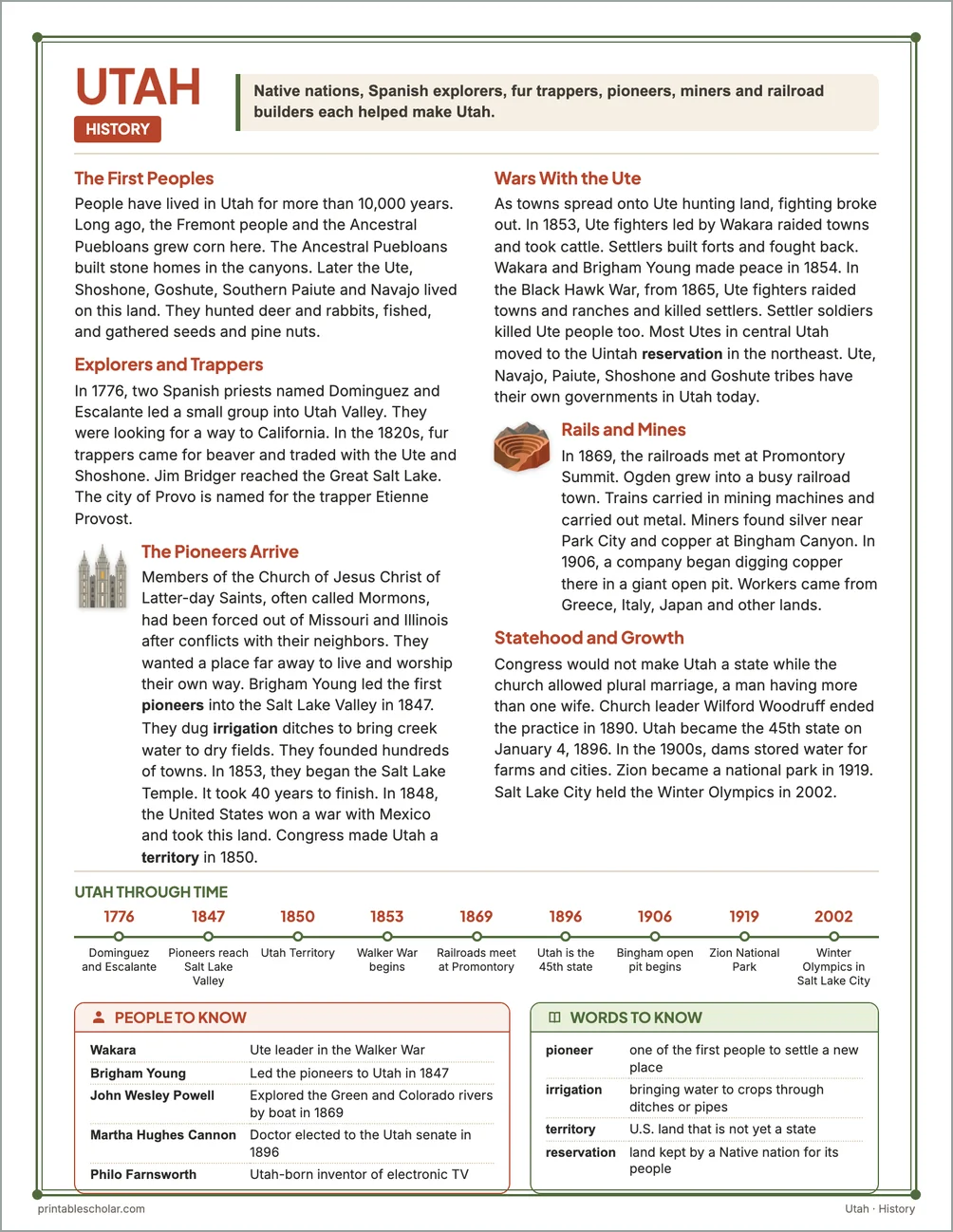
Free: the Utah History reading page
One page on the history of Utah for grades 3 to 5, free to print in color or black and white. It is the second reading page in the kit.
The First Peoples
People have lived in Utah for more than 10,000 years. Long ago, the Fremont people and the Ancestral Puebloans grew corn here. The Ancestral Puebloans built stone homes in the canyons. Later the Ute, Shoshone, Goshute, Southern Paiute and Navajo lived on this land. They hunted deer and rabbits, fished, and gathered seeds and pine nuts.
Explorers and Trappers
In 1776, two Spanish priests named Dominguez and Escalante led a small group into Utah Valley. They were looking for a way to California. In the 1820s, fur trappers came for beaver and traded with the Ute and Shoshone. Jim Bridger reached the Great Salt Lake. The city of Provo is named for the trapper Etienne Provost.
The Pioneers Arrive
Members of the Church of Jesus Christ of Latter-day Saints, often called Mormons, had been forced out of Missouri and Illinois after conflicts with their neighbors. They wanted a place far away to live and worship their own way. Brigham Young led the first pioneers into the Salt Lake Valley in 1847. They dug irrigation ditches to bring creek water to dry fields. They founded hundreds of towns. In 1853, they began the Salt Lake Temple. It took 40 years to finish. In 1848, the United States won a war with Mexico and took this land. Congress made Utah a territory in 1850.
Wars With the Ute
As towns spread onto Ute hunting land, fighting broke out. In 1853, Ute fighters led by Wakara raided towns and took cattle. Settlers built forts and fought back. Wakara and Brigham Young made peace in 1854. In the Black Hawk War, from 1865, Ute fighters raided towns and ranches and killed settlers. Settler soldiers killed Ute people too. Most Utes in central Utah moved to the Uintah reservation in the northeast. Ute, Navajo, Paiute, Shoshone and Goshute tribes have their own governments in Utah today.
Rails and Mines
In 1869, the railroads met at Promontory Summit. Ogden grew into a busy railroad town. Trains carried in mining machines and carried out metal. Miners found silver near Park City and copper at Bingham Canyon. In 1906, a company began digging copper there in a giant open pit. Workers came from Greece, Italy, Japan and other lands.
Statehood and Growth
Congress would not make Utah a state while the church allowed plural marriage, a man having more than one wife. Church leader Wilford Woodruff ended the practice in 1890. Utah became the 45th state on January 4, 1896. In the 1900s, dams stored water for farms and cities. Zion became a national park in 1919. Salt Lake City held the Winter Olympics in 2002.
Utah through time
- 1776 Dominguez and Escalante
- 1847 Pioneers reach Salt Lake Valley
- 1850 Utah Territory
- 1853 Walker War begins
- 1869 Railroads meet at Promontory
- 1896 Utah is the 45th state
- 1906 Bingham open pit begins
- 1919 Zion National Park
- 2002 Winter Olympics in Salt Lake City
People to know
- Wakara: Ute leader in the Walker War
- Brigham Young: Led the pioneers to Utah in 1847
- John Wesley Powell: Explored the Green and Colorado rivers by boat in 1869
- Martha Hughes Cannon: Doctor elected to the Utah senate in 1896
- Philo Farnsworth: Utah-born inventor of electronic TV
Free Utah maps
Each of these maps is free to print on its own page. The kit puts them in one file with the reading pages and the booklet.