Printable Scholar

Spain Country Report Kit
Everything a student needs to research and write a report on Spain: the reading, the maps and the pages to fill in. Nothing else to look up.
- 4 reading pages: Spain fun facts with the flag, History, Land and Work, and Culture and Daily Life
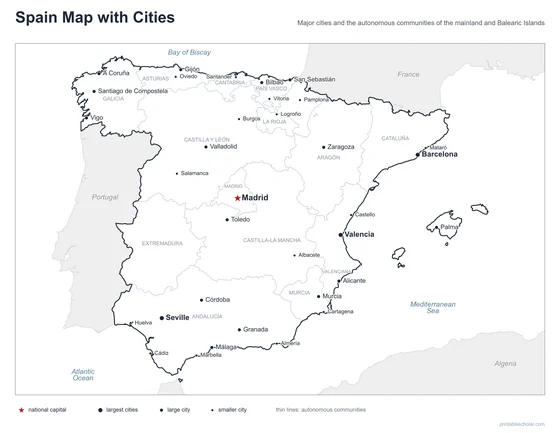
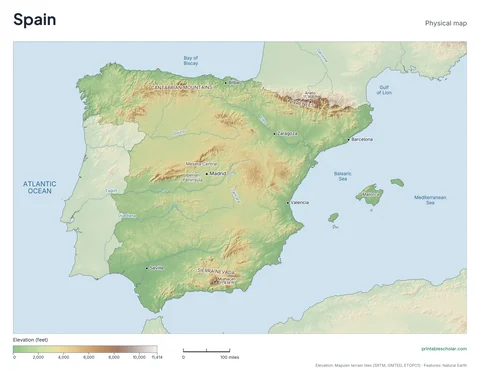
- 5 maps: landmarks, cities, Where in the World, outline, and rivers, lakes and neighbors
- A 9-page My Country Report booklet, from fast facts to a trip plan, a stamp to design and a written report
- A pennant to cut out and hang, two map skills sheets and a 10-question reading quiz
- Answer keys, a grading rubric and talking points for the teacher
- Two print-ready PDFs, 26 pages each, US Letter: color, and ink-saving black and white
Each student on a different country? Get every country kit for $24.
Look inside: all 26 pages
Read it, map it, write it.
The reading pages and maps hold every answer the booklet asks for. About one third of the booklet is looking things up. The rest asks students to choose, plan and explain.

What is in the Spain kit
To read and study
- Spain fun facts: six short true stories, the flag, By the Numbers and Did You Know
- History: the country’s story from its first peoples to today, with a timeline, people to know and words to know
- Land and Work: the land and climate, what people grow, make and mine, and how one leads to the other
- Culture and Daily Life: food, school, sports, holidays, music and crafts, with everyday words to say
- Five maps, including Where in the World with latitude and longitude, and a rivers, lakes and neighbors map with a letter key
To fill in and make
- My Country Report booklet: cover, Fast Facts, My Map, Culture and Daily Life, My Trip, Think Like a Geographer, Design a Stamp, Dig Deeper and My Report
- A pennant with the country’s name and outline, to color, cut out and hang
- Name the Cities and Name the Rivers and Lakes sheets, each with a word bank
- A 10-question reading quiz, answer keys, a rubric and talking points for the teacher
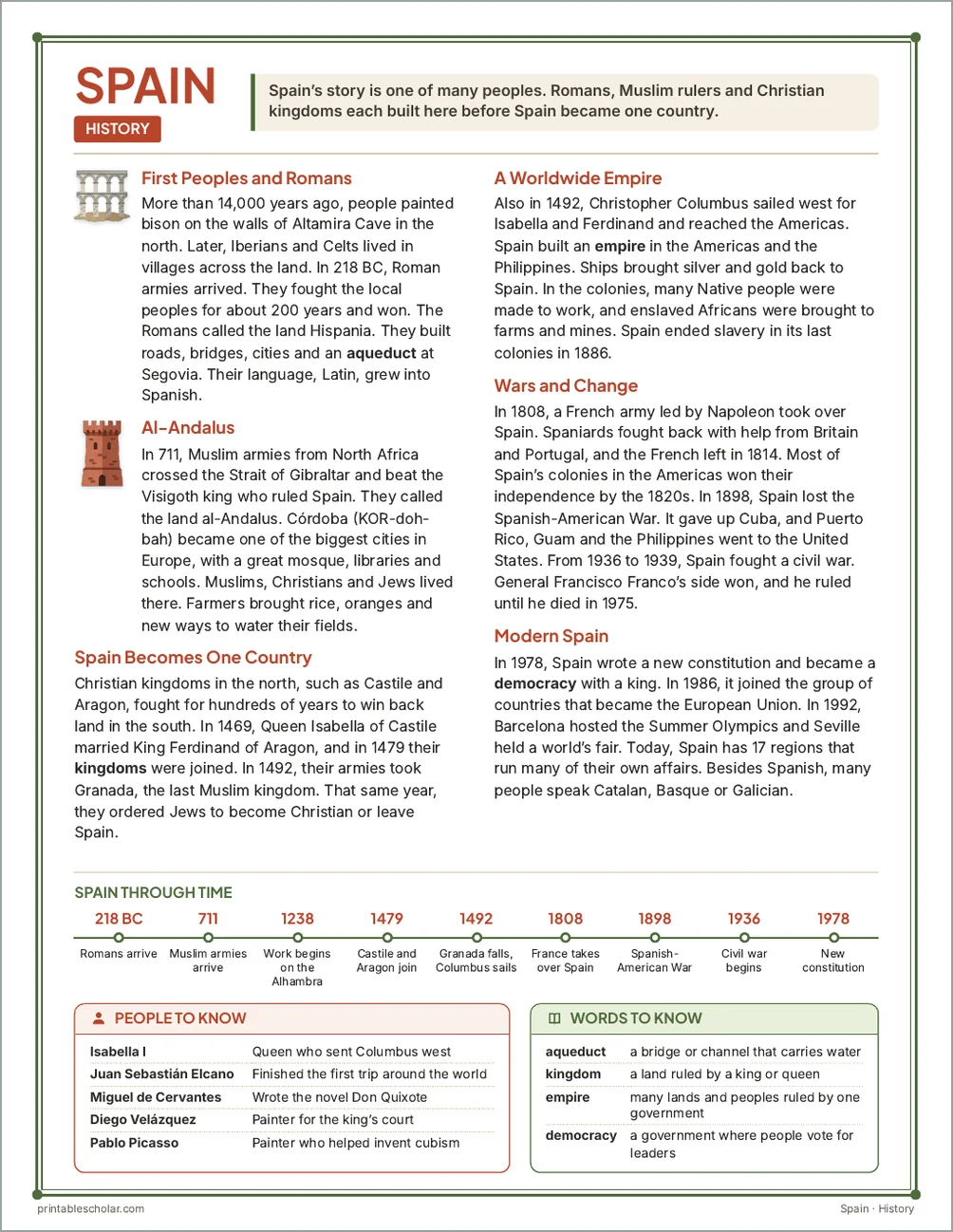
Free: the Spain History reading page
One page on the history of Spain for grades 3 to 5, free to print in color or black and white. It is the second reading page in the kit.
First Peoples and Romans
More than 14,000 years ago, people painted bison on the walls of Altamira Cave in the north. Later, Iberians and Celts lived in villages across the land. In 218 BC, Roman armies arrived. They fought the local peoples for about 200 years and won. The Romans called the land Hispania. They built roads, bridges, cities and an aqueduct at Segovia. Their language, Latin, grew into Spanish.
Al-Andalus
In 711, Muslim armies from North Africa crossed the Strait of Gibraltar and beat the Visigoth king who ruled Spain. They called the land al-Andalus. Córdoba (KOR-doh-bah) became one of the biggest cities in Europe, with a great mosque, libraries and schools. Muslims, Christians and Jews lived there. Farmers brought rice, oranges and new ways to water their fields.
Spain Becomes One Country
Christian kingdoms in the north, such as Castile and Aragon, fought for hundreds of years to win back land in the south. In 1469, Queen Isabella of Castile married King Ferdinand of Aragon, and in 1479 their kingdoms were joined. In 1492, their armies took Granada, the last Muslim kingdom. That same year, they ordered Jews to become Christian or leave Spain.
A Worldwide Empire
Also in 1492, Christopher Columbus sailed west for Isabella and Ferdinand and reached the Americas. Spain built an empire in the Americas and the Philippines. Ships brought silver and gold back to Spain. In the colonies, many Native people were made to work, and enslaved Africans were brought to farms and mines. Spain ended slavery in its last colonies in 1886.
Wars and Change
In 1808, a French army led by Napoleon took over Spain. Spaniards fought back with help from Britain and Portugal, and the French left in 1814. Most of Spain’s colonies in the Americas won their independence by the 1820s. In 1898, Spain lost the Spanish-American War. It gave up Cuba, and Puerto Rico, Guam and the Philippines went to the United States. From 1936 to 1939, Spain fought a civil war. General Francisco Franco’s side won, and he ruled until he died in 1975.
Modern Spain
In 1978, Spain wrote a new constitution and became a democracy with a king. In 1986, it joined the group of countries that became the European Union. In 1992, Barcelona hosted the Summer Olympics and Seville held a world’s fair. Today, Spain has 17 regions that run many of their own affairs. Besides Spanish, many people speak Catalan, Basque or Galician.
Spain through time
- 218 BC Romans arrive
- 711 Muslim armies arrive
- 1238 Work begins on the Alhambra
- 1479 Castile and Aragon join
- 1492 Granada falls, Columbus sails
- 1808 France takes over Spain
- 1898 Spanish-American War
- 1936 Civil war begins
- 1978 New constitution
People to know
- Isabella I: Queen who sent Columbus west
- Juan Sebastián Elcano: Finished the first trip around the world
- Miguel de Cervantes: Wrote the novel Don Quixote
- Diego Velázquez: Painter for the king’s court
- Pablo Picasso: Painter who helped invent cubism
Free Spain maps
Each of these maps is free to print on its own. The kit puts its maps in one file with the reading pages and the booklet.