
Nebraska State Report Kit
Everything a student needs to research and write a report on Nebraska: the reading, the maps and the pages to fill in. Nothing else to look up.
- 3 reading pages: Nebraska fun facts, History, and Land and Work
- 5 maps: landmarks, cities, county, outline, and rivers and lakes
- An 8-page My State Report booklet, from fast facts to a trip plan and a license plate to design
- A pennant to cut out and hang, two map skills sheets and a 10-question reading quiz
- Answer keys for the quiz, the fast facts and the map sheets
- One print-ready PDF, 23 pages, black and white, US Letter
Look inside
Read it, map it, write it.
The reading pages and maps hold every answer the booklet asks for. About one third of the booklet is looking things up. The rest asks students to choose, plan and explain.

What is in the Nebraska kit
To read and study
- Nebraska fun facts: six short true stories, By the Numbers and Did You Know
- History: the state’s story in order, with a timeline, people to know and words to know
- Land and Work: the land and climate, what the state grows, makes and mines, and how one leads to the other
- Five maps, including a rivers, lakes and neighbors map with a letter key
To fill in and make
- My State Report booklet: cover, Fast Facts, My Map, State Symbols, My Trip, Think Like a Geographer, Design a License Plate and Dig Deeper
- A pennant with the state’s name and outline, to color, cut out and hang
- Name the Cities and Name the Rivers and Lakes sheets, each with a word bank
- A 10-question reading quiz, with answer keys for everything that has one right answer
Free: the Nebraska History reading page
One page on the history of Nebraska for grades 3 to 5, free to print in color or black and white. It is the second reading page in the kit.
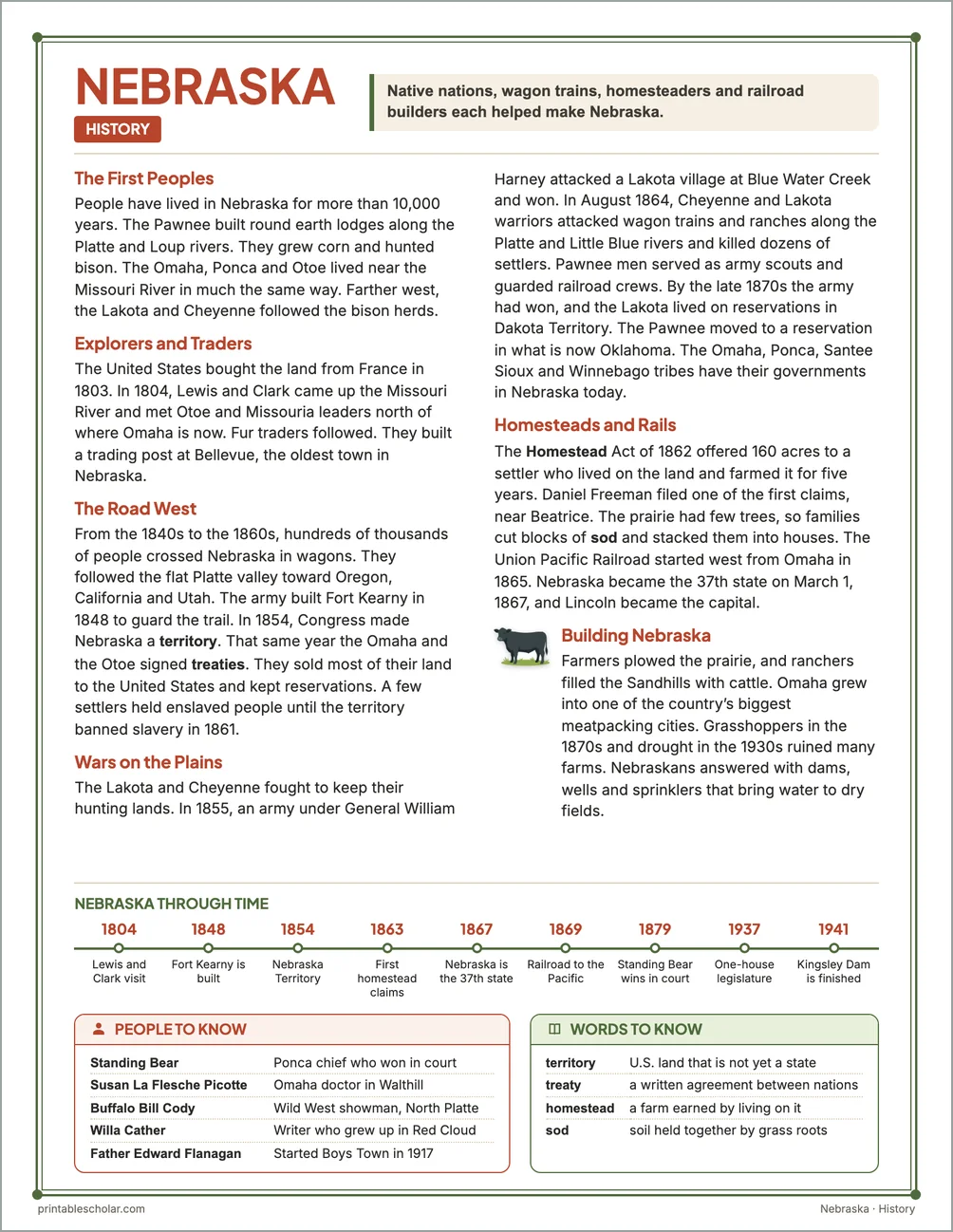
The First Peoples
People have lived in Nebraska for more than 10,000 years. The Pawnee built round earth lodges along the Platte and Loup rivers. They grew corn and hunted bison. The Omaha, Ponca and Otoe lived near the Missouri River in much the same way. Farther west, the Lakota and Cheyenne followed the bison herds.
Explorers and Traders
The United States bought the land from France in 1803. In 1804, Lewis and Clark came up the Missouri River and met Otoe and Missouria leaders north of where Omaha is now. Fur traders followed. They built a trading post at Bellevue, the oldest town in Nebraska.
The Road West
From the 1840s to the 1860s, hundreds of thousands of people crossed Nebraska in wagons. They followed the flat Platte valley toward Oregon, California and Utah. The army built Fort Kearny in 1848 to guard the trail. In 1854, Congress made Nebraska a territory. That same year the Omaha and the Otoe signed treaties. They sold most of their land to the United States and kept reservations. A few settlers held enslaved people until the territory banned slavery in 1861.
Wars on the Plains
The Lakota and Cheyenne fought to keep their hunting lands. In 1855, an army under General William Harney attacked a Lakota village at Blue Water Creek and won. In August 1864, Cheyenne and Lakota warriors attacked wagon trains and ranches along the Platte and Little Blue rivers and killed dozens of settlers. Pawnee men served as army scouts and guarded railroad crews. By the late 1870s the army had won, and the Lakota lived on reservations in Dakota Territory. The Pawnee moved to a reservation in what is now Oklahoma. The Omaha, Ponca, Santee Sioux and Winnebago tribes have their governments in Nebraska today.
Homesteads and Rails
The Homestead Act of 1862 offered 160 acres to a settler who lived on the land and farmed it for five years. Daniel Freeman filed one of the first claims, near Beatrice. The prairie had few trees, so families cut blocks of sod and stacked them into houses. The Union Pacific Railroad started west from Omaha in 1865. Nebraska became the 37th state on March 1, 1867, and Lincoln became the capital.
Building Nebraska
Farmers plowed the prairie, and ranchers filled the Sandhills with cattle. Omaha grew into one of the country’s biggest meatpacking cities. Grasshoppers in the 1870s and drought in the 1930s ruined many farms. Nebraskans answered with dams, wells and sprinklers that bring water to dry fields.
Nebraska through time
- 1804 Lewis and Clark visit
- 1848 Fort Kearny is built
- 1854 Nebraska Territory
- 1863 First homestead claims
- 1867 Nebraska is the 37th state
- 1869 Railroad to the Pacific
- 1879 Standing Bear wins in court
- 1937 One-house legislature
- 1941 Kingsley Dam is finished
People to know
- Standing Bear: Ponca chief who won in court
- Susan La Flesche Picotte: Omaha doctor in Walthill
- Buffalo Bill Cody: Wild West showman, North Platte
- Willa Cather: Writer who grew up in Red Cloud
- Father Edward Flanagan: Started Boys Town in 1917
Free Nebraska maps
Each of these maps is free to print on its own page. The kit puts them in one file with the reading pages and the booklet.