
Kansas State Report Kit
Everything a student needs to research and write a report on Kansas: the reading, the maps and the pages to fill in. Nothing else to look up.
- 3 reading pages: Kansas fun facts, History, and Land and Work
- 5 maps: landmarks, cities, county, outline, and rivers and lakes
- An 8-page My State Report booklet, from fast facts to a trip plan and a license plate to design
- A pennant to cut out and hang, two map skills sheets and a 10-question reading quiz
- Answer keys for the quiz, the fast facts and the map sheets
- One print-ready PDF, 23 pages, black and white, US Letter
Look inside
Read it, map it, write it.
The reading pages and maps hold every answer the booklet asks for. About one third of the booklet is looking things up. The rest asks students to choose, plan and explain.

What is in the Kansas kit
To read and study
- Kansas fun facts: six short true stories, By the Numbers and Did You Know
- History: the state’s story in order, with a timeline, people to know and words to know
- Land and Work: the land and climate, what the state grows, makes and mines, and how one leads to the other
- Five maps, including a rivers, lakes and neighbors map with a letter key
To fill in and make
- My State Report booklet: cover, Fast Facts, My Map, State Symbols, My Trip, Think Like a Geographer, Design a License Plate and Dig Deeper
- A pennant with the state’s name and outline, to color, cut out and hang
- Name the Cities and Name the Rivers and Lakes sheets, each with a word bank
- A 10-question reading quiz, with answer keys for everything that has one right answer
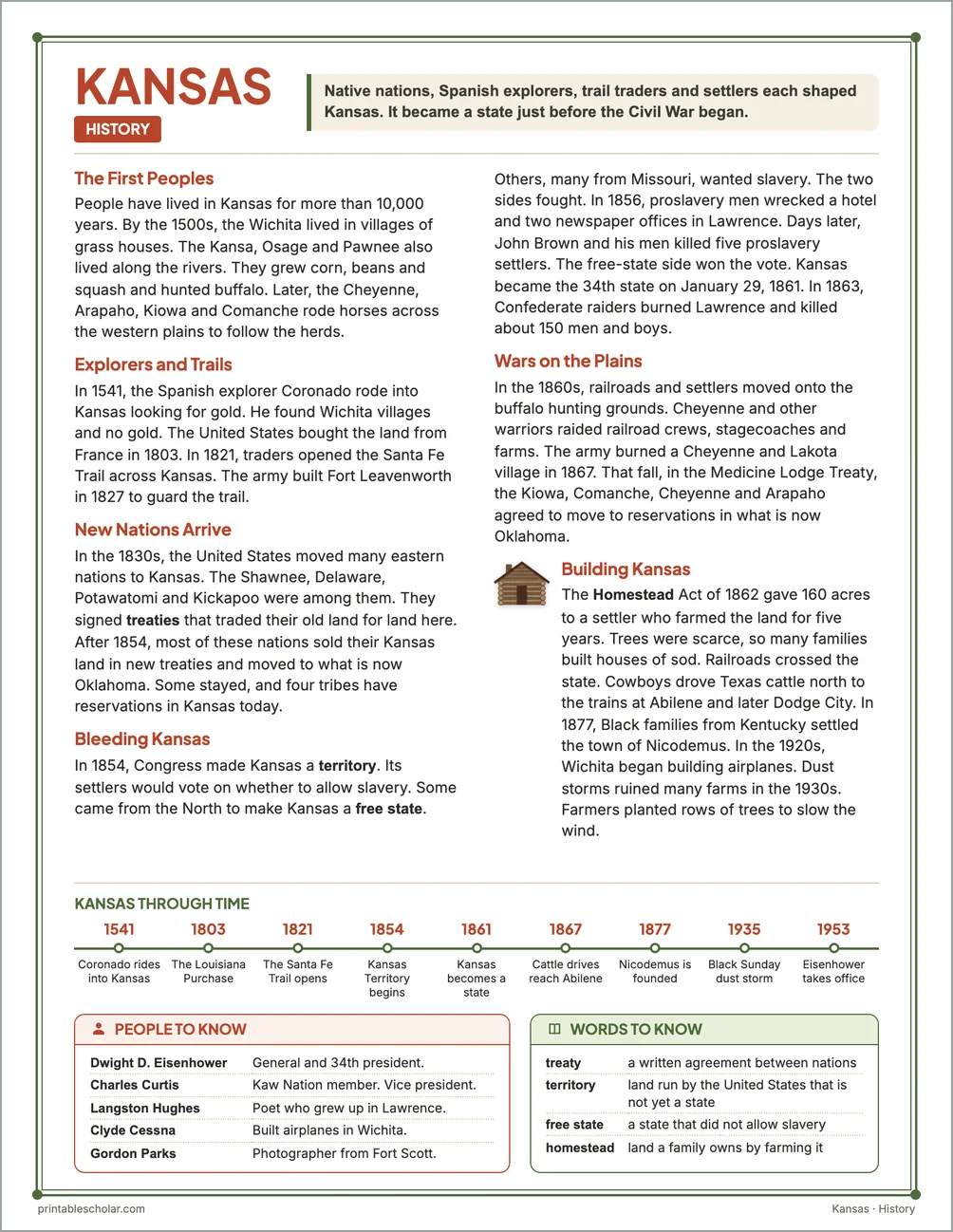
Free: the Kansas History reading page
One page on the history of Kansas for grades 3 to 5, free to print in color or black and white. It is the second reading page in the kit.
The First Peoples
People have lived in Kansas for more than 10,000 years. By the 1500s, the Wichita lived in villages of grass houses. The Kansa, Osage and Pawnee also lived along the rivers. They grew corn, beans and squash and hunted buffalo. Later, the Cheyenne, Arapaho, Kiowa and Comanche rode horses across the western plains to follow the herds.
Explorers and Trails
In 1541, the Spanish explorer Coronado rode into Kansas looking for gold. He found Wichita villages and no gold. The United States bought the land from France in 1803. In 1821, traders opened the Santa Fe Trail across Kansas. The army built Fort Leavenworth in 1827 to guard the trail.
New Nations Arrive
In the 1830s, the United States moved many eastern nations to Kansas. The Shawnee, Delaware, Potawatomi and Kickapoo were among them. They signed treaties that traded their old land for land here. After 1854, most of these nations sold their Kansas land in new treaties and moved to what is now Oklahoma. Some stayed, and four tribes have reservations in Kansas today.
Bleeding Kansas
In 1854, Congress made Kansas a territory. Its settlers would vote on whether to allow slavery. Some came from the North to make Kansas a free state. Others, many from Missouri, wanted slavery. The two sides fought. In 1856, proslavery men wrecked a hotel and two newspaper offices in Lawrence. Days later, John Brown and his men killed five proslavery settlers. The free-state side won the vote. Kansas became the 34th state on January 29, 1861. In 1863, Confederate raiders burned Lawrence and killed about 150 men and boys.
Wars on the Plains
In the 1860s, railroads and settlers moved onto the buffalo hunting grounds. Cheyenne and other warriors raided railroad crews, stagecoaches and farms. The army burned a Cheyenne and Lakota village in 1867. That fall, in the Medicine Lodge Treaty, the Kiowa, Comanche, Cheyenne and Arapaho agreed to move to reservations in what is now Oklahoma.
Building Kansas
The Homestead Act of 1862 gave 160 acres to a settler who farmed the land for five years. Trees were scarce, so many families built houses of sod. Railroads crossed the state. Cowboys drove Texas cattle north to the trains at Abilene and later Dodge City. In 1877, Black families from Kentucky settled the town of Nicodemus. In the 1920s, Wichita began building airplanes. Dust storms ruined many farms in the 1930s. Farmers planted rows of trees to slow the wind.
Kansas through time
- 1541 Coronado rides into Kansas
- 1803 The Louisiana Purchase
- 1821 The Santa Fe Trail opens
- 1854 Kansas Territory begins
- 1861 Kansas becomes a state
- 1867 Cattle drives reach Abilene
- 1877 Nicodemus is founded
- 1935 Black Sunday dust storm
- 1953 Eisenhower takes office
People to know
- Dwight D. Eisenhower: General and 34th president.
- Charles Curtis: Kaw Nation member. Vice president.
- Langston Hughes: Poet who grew up in Lawrence.
- Clyde Cessna: Built airplanes in Wichita.
- Gordon Parks: Photographer from Fort Scott.
Free Kansas maps
Each of these maps is free to print on its own page. The kit puts them in one file with the reading pages and the booklet.