Printable Scholar

Japan Country Report Kit
Everything a student needs to research and write a report on Japan: the reading, the maps and the pages to fill in. Nothing else to look up.
- 4 reading pages: Japan fun facts with the flag, History, Land and Work, and Culture and Daily Life
- 5 maps: landmarks, cities, Where in the World, outline, and rivers, lakes and neighbors
- A 9-page My Country Report booklet, from fast facts to a trip plan, a stamp to design and a written report
- A pennant to cut out and hang, two map skills sheets and a 10-question reading quiz
- Answer keys, a grading rubric and talking points for the teacher
- Two print-ready PDFs, 26 pages each, US Letter: color, and ink-saving black and white
Each student on a different country? Get every country kit for $24.
Look inside: all 26 pages
Read it, map it, write it.
The reading pages and maps hold every answer the booklet asks for. About one third of the booklet is looking things up. The rest asks students to choose, plan and explain.

What is in the Japan kit
To read and study
- Japan fun facts: six short true stories, the flag, By the Numbers and Did You Know
- History: the country’s story from its first peoples to today, with a timeline, people to know and words to know
- Land and Work: the land and climate, what people grow, make and mine, and how one leads to the other
- Culture and Daily Life: food, school, sports, holidays, music and crafts, with everyday words to say
- Five maps, including Where in the World with latitude and longitude, and a rivers, lakes and neighbors map with a letter key
To fill in and make
- My Country Report booklet: cover, Fast Facts, My Map, Culture and Daily Life, My Trip, Think Like a Geographer, Design a Stamp, Dig Deeper and My Report
- A pennant with the country’s name and outline, to color, cut out and hang
- Name the Cities and Name the Rivers and Lakes sheets, each with a word bank
- A 10-question reading quiz, answer keys, a rubric and talking points for the teacher
Free: the Japan History reading page
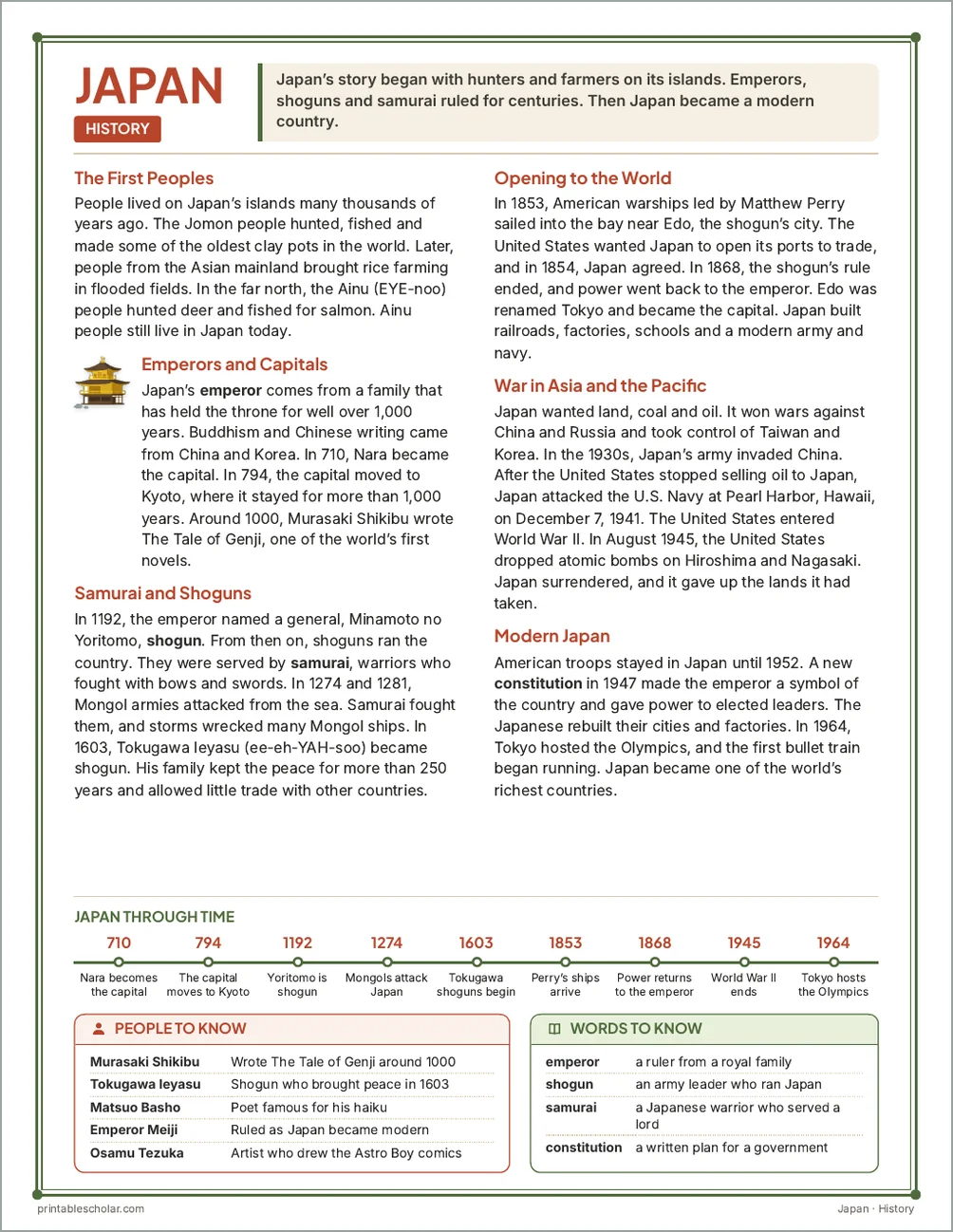
One page on the history of Japan for grades 3 to 5, free to print in color or black and white. It is the second reading page in the kit.
The First Peoples
People lived on Japan’s islands many thousands of years ago. The Jomon people hunted, fished and made some of the oldest clay pots in the world. Later, people from the Asian mainland brought rice farming in flooded fields. In the far north, the Ainu (EYE-noo) people hunted deer and fished for salmon. Ainu people still live in Japan today.
Emperors and Capitals
Japan’s emperor comes from a family that has held the throne for well over 1,000 years. Buddhism and Chinese writing came from China and Korea. In 710, Nara became the capital. In 794, the capital moved to Kyoto, where it stayed for more than 1,000 years. Around 1000, Murasaki Shikibu wrote The Tale of Genji, one of the world’s first novels.
Samurai and Shoguns
In 1192, the emperor named a general, Minamoto no Yoritomo, shogun. From then on, shoguns ran the country. They were served by samurai, warriors who fought with bows and swords. In 1274 and 1281, Mongol armies attacked from the sea. Samurai fought them, and storms wrecked many Mongol ships. In 1603, Tokugawa Ieyasu (ee-eh-YAH-soo) became shogun. His family kept the peace for more than 250 years and allowed little trade with other countries.
Opening to the World
In 1853, American warships led by Matthew Perry sailed into the bay near Edo, the shogun’s city. The United States wanted Japan to open its ports to trade, and in 1854, Japan agreed. In 1868, the shogun’s rule ended, and power went back to the emperor. Edo was renamed Tokyo and became the capital. Japan built railroads, factories, schools and a modern army and navy.
War in Asia and the Pacific
Japan wanted land, coal and oil. It won wars against China and Russia and took control of Taiwan and Korea. In the 1930s, Japan’s army invaded China. After the United States stopped selling oil to Japan, Japan attacked the U.S. Navy at Pearl Harbor, Hawaii, on December 7, 1941. The United States entered World War II. In August 1945, the United States dropped atomic bombs on Hiroshima and Nagasaki. Japan surrendered, and it gave up the lands it had taken.
Modern Japan
American troops stayed in Japan until 1952. A new constitution in 1947 made the emperor a symbol of the country and gave power to elected leaders. The Japanese rebuilt their cities and factories. In 1964, Tokyo hosted the Olympics, and the first bullet train began running. Japan became one of the world’s richest countries.
Japan through time
- 710 Nara becomes the capital
- 794 The capital moves to Kyoto
- 1192 Yoritomo is shogun
- 1274 Mongols attack Japan
- 1603 Tokugawa shoguns begin
- 1853 Perry’s ships arrive
- 1868 Power returns to the emperor
- 1945 World War II ends
- 1964 Tokyo hosts the Olympics
People to know
- Murasaki Shikibu: Wrote The Tale of Genji around 1000
- Tokugawa Ieyasu: Shogun who brought peace in 1603
- Matsuo Basho: Poet famous for his haiku
- Emperor Meiji: Ruled as Japan became modern
- Osamu Tezuka: Artist who drew the Astro Boy comics
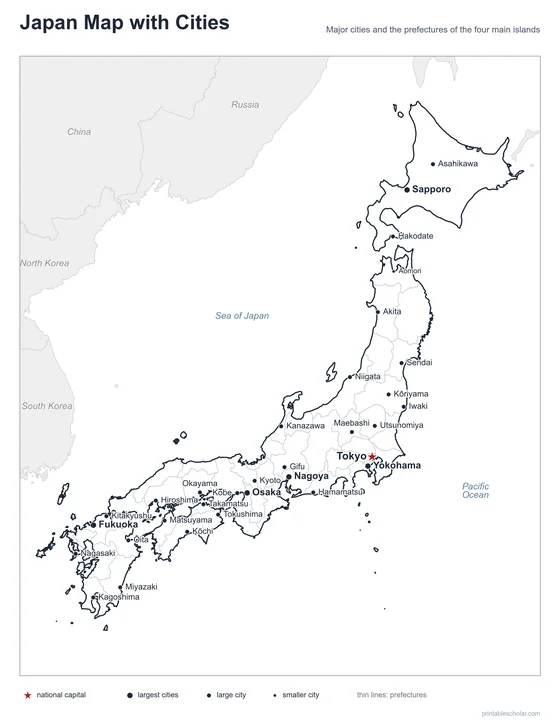
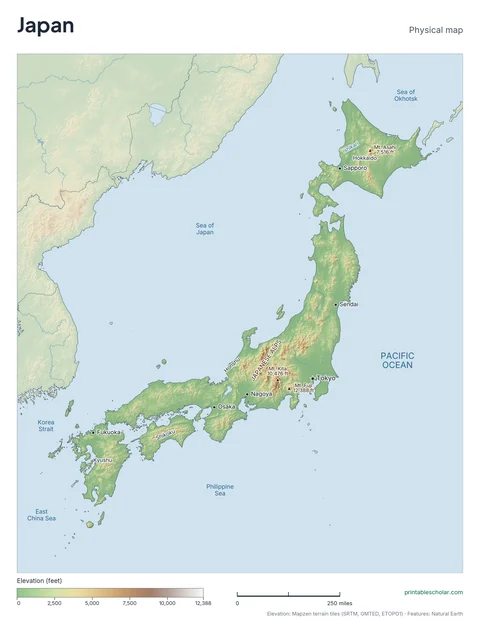
Free Japan maps
Each of these maps is free to print on its own. The kit puts its maps in one file with the reading pages and the booklet.