Printable Scholar

Italy Country Report Kit
Everything a student needs to research and write a report on Italy: the reading, the maps and the pages to fill in. Nothing else to look up.
- 4 reading pages: Italy fun facts with the flag, History, Land and Work, and Culture and Daily Life
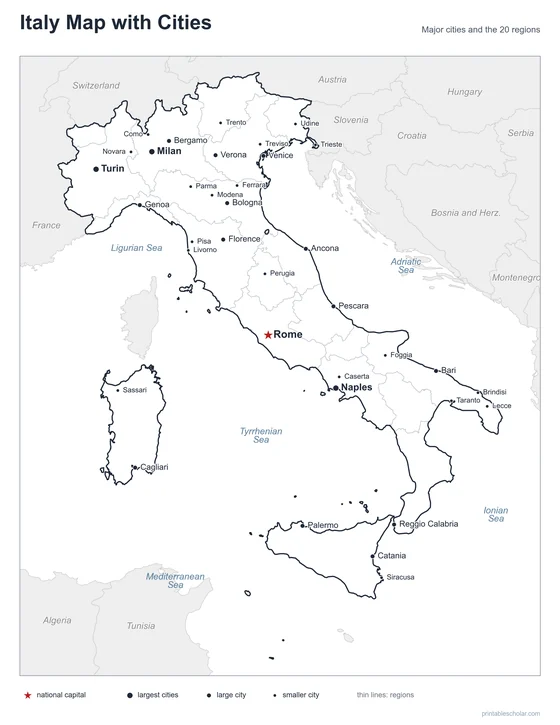
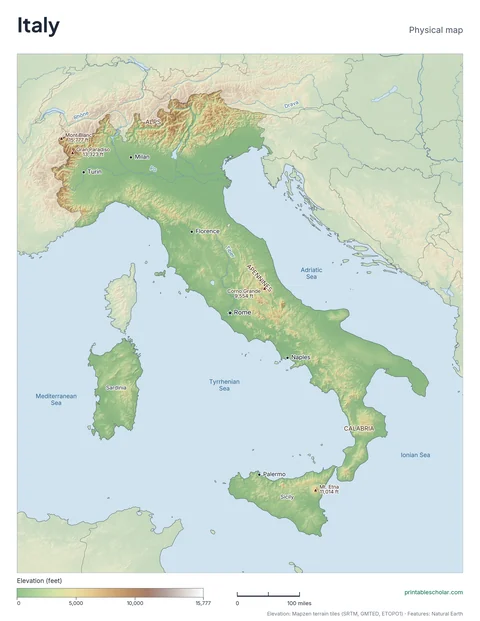
- 5 maps: landmarks, cities, Where in the World, outline, and rivers, lakes and neighbors
- A 9-page My Country Report booklet, from fast facts to a trip plan, a stamp to design and a written report
- A pennant to cut out and hang, two map skills sheets and a 10-question reading quiz
- Answer keys, a grading rubric and talking points for the teacher
- Two print-ready PDFs, 26 pages each, US Letter: color, and ink-saving black and white
Each student on a different country? Get every country kit for $24.
Look inside: all 26 pages
Read it, map it, write it.
The reading pages and maps hold every answer the booklet asks for. About one third of the booklet is looking things up. The rest asks students to choose, plan and explain.

What is in the Italy kit
To read and study
- Italy fun facts: six short true stories, the flag, By the Numbers and Did You Know
- History: the country’s story from its first peoples to today, with a timeline, people to know and words to know
- Land and Work: the land and climate, what people grow, make and mine, and how one leads to the other
- Culture and Daily Life: food, school, sports, holidays, music and crafts, with everyday words to say
- Five maps, including Where in the World with latitude and longitude, and a rivers, lakes and neighbors map with a letter key
To fill in and make
- My Country Report booklet: cover, Fast Facts, My Map, Culture and Daily Life, My Trip, Think Like a Geographer, Design a Stamp, Dig Deeper and My Report
- A pennant with the country’s name and outline, to color, cut out and hang
- Name the Cities and Name the Rivers and Lakes sheets, each with a word bank
- A 10-question reading quiz, answer keys, a rubric and talking points for the teacher
Free: the Italy History reading page
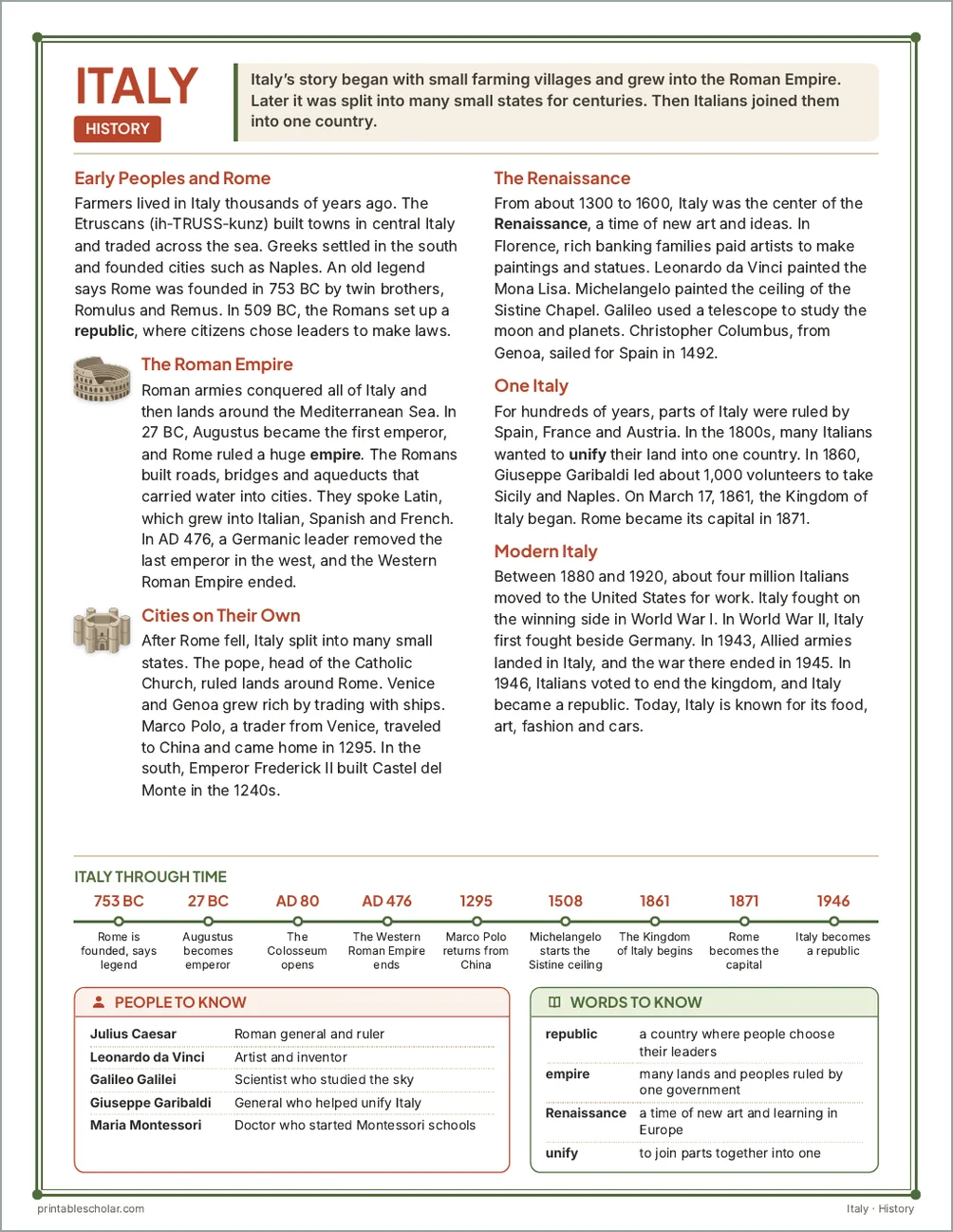
One page on the history of Italy for grades 3 to 5, free to print in color or black and white. It is the second reading page in the kit.
Early Peoples and Rome
Farmers lived in Italy thousands of years ago. The Etruscans (ih-TRUSS-kunz) built towns in central Italy and traded across the sea. Greeks settled in the south and founded cities such as Naples. An old legend says Rome was founded in 753 BC by twin brothers, Romulus and Remus. In 509 BC, the Romans set up a republic, where citizens chose leaders to make laws.
The Roman Empire
Roman armies conquered all of Italy and then lands around the Mediterranean Sea. In 27 BC, Augustus became the first emperor, and Rome ruled a huge empire. The Romans built roads, bridges and aqueducts that carried water into cities. They spoke Latin, which grew into Italian, Spanish and French. In AD 476, a Germanic leader removed the last emperor in the west, and the Western Roman Empire ended.
Cities on Their Own
After Rome fell, Italy split into many small states. The pope, head of the Catholic Church, ruled lands around Rome. Venice and Genoa grew rich by trading with ships. Marco Polo, a trader from Venice, traveled to China and came home in 1295. In the south, Emperor Frederick II built Castel del Monte in the 1240s.
The Renaissance
From about 1300 to 1600, Italy was the center of the Renaissance, a time of new art and ideas. In Florence, rich banking families paid artists to make paintings and statues. Leonardo da Vinci painted the Mona Lisa. Michelangelo painted the ceiling of the Sistine Chapel. Galileo used a telescope to study the moon and planets. Christopher Columbus, from Genoa, sailed for Spain in 1492.
One Italy
For hundreds of years, parts of Italy were ruled by Spain, France and Austria. In the 1800s, many Italians wanted to unify their land into one country. In 1860, Giuseppe Garibaldi led about 1,000 volunteers to take Sicily and Naples. On March 17, 1861, the Kingdom of Italy began. Rome became its capital in 1871.
Modern Italy
Between 1880 and 1920, about four million Italians moved to the United States for work. Italy fought on the winning side in World War I. In World War II, Italy first fought beside Germany. In 1943, Allied armies landed in Italy, and the war there ended in 1945. In 1946, Italians voted to end the kingdom, and Italy became a republic. Today, Italy is known for its food, art, fashion and cars.
Italy through time
- 753 BC Rome is founded, says legend
- 27 BC Augustus becomes emperor
- AD 80 The Colosseum opens
- AD 476 The Western Roman Empire ends
- 1295 Marco Polo returns from China
- 1508 Michelangelo starts the Sistine ceiling
- 1861 The Kingdom of Italy begins
- 1871 Rome becomes the capital
- 1946 Italy becomes a republic
People to know
- Julius Caesar: Roman general and ruler
- Leonardo da Vinci: Artist and inventor
- Galileo Galilei: Scientist who studied the sky
- Giuseppe Garibaldi: General who helped unify Italy
- Maria Montessori: Doctor who started Montessori schools
Free Italy maps
Each of these maps is free to print on its own. The kit puts its maps in one file with the reading pages and the booklet.