
Iowa State Report Kit
Everything a student needs to research and write a report on Iowa: the reading, the maps and the pages to fill in. Nothing else to look up.
- 3 reading pages: Iowa fun facts, History, and Land and Work
- 5 maps: landmarks, cities, county, outline, and rivers and lakes
- An 8-page My State Report booklet, from fast facts to a trip plan and a license plate to design
- A pennant to cut out and hang, two map skills sheets and a 10-question reading quiz
- Answer keys for the quiz, the fast facts and the map sheets
- One print-ready PDF, 23 pages, black and white, US Letter
Look inside
Read it, map it, write it.
The reading pages and maps hold every answer the booklet asks for. About one third of the booklet is looking things up. The rest asks students to choose, plan and explain.

What is in the Iowa kit
To read and study
- Iowa fun facts: six short true stories, By the Numbers and Did You Know
- History: the state’s story in order, with a timeline, people to know and words to know
- Land and Work: the land and climate, what the state grows, makes and mines, and how one leads to the other
- Five maps, including a rivers, lakes and neighbors map with a letter key
To fill in and make
- My State Report booklet: cover, Fast Facts, My Map, State Symbols, My Trip, Think Like a Geographer, Design a License Plate and Dig Deeper
- A pennant with the state’s name and outline, to color, cut out and hang
- Name the Cities and Name the Rivers and Lakes sheets, each with a word bank
- A 10-question reading quiz, with answer keys for everything that has one right answer
Free: the Iowa History reading page
One page on the history of Iowa for grades 3 to 5, free to print in color or black and white. It is the second reading page in the kit.
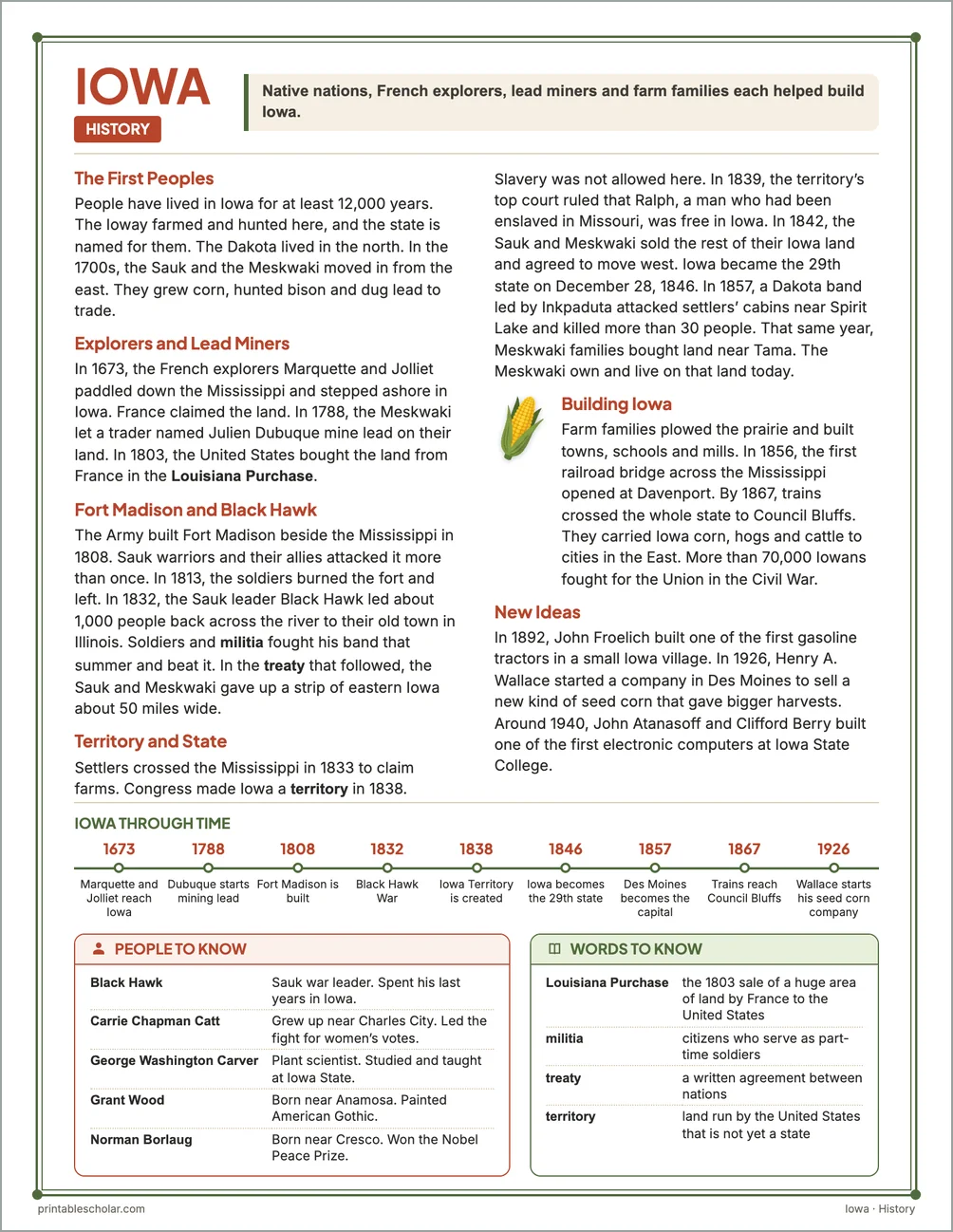
The First Peoples
People have lived in Iowa for at least 12,000 years. The Ioway farmed and hunted here, and the state is named for them. The Dakota lived in the north. In the 1700s, the Sauk and the Meskwaki moved in from the east. They grew corn, hunted bison and dug lead to trade.
Explorers and Lead Miners
In 1673, the French explorers Marquette and Jolliet paddled down the Mississippi and stepped ashore in Iowa. France claimed the land. In 1788, the Meskwaki let a trader named Julien Dubuque mine lead on their land. In 1803, the United States bought the land from France in the Louisiana Purchase.
Fort Madison and Black Hawk
The Army built Fort Madison beside the Mississippi in 1808. Sauk warriors and their allies attacked it more than once. In 1813, the soldiers burned the fort and left. In 1832, the Sauk leader Black Hawk led about 1,000 people back across the river to their old town in Illinois. Soldiers and militia fought his band that summer and beat it. In the treaty that followed, the Sauk and Meskwaki gave up a strip of eastern Iowa about 50 miles wide.
Territory and State
Settlers crossed the Mississippi in 1833 to claim farms. Congress made Iowa a territory in 1838. Slavery was not allowed here. In 1839, the territory’s top court ruled that Ralph, a man who had been enslaved in Missouri, was free in Iowa. In 1842, the Sauk and Meskwaki sold the rest of their Iowa land and agreed to move west. Iowa became the 29th state on December 28, 1846. In 1857, a Dakota band led by Inkpaduta attacked settlers’ cabins near Spirit Lake and killed more than 30 people. That same year, Meskwaki families bought land near Tama. The Meskwaki own and live on that land today.
Building Iowa
Farm families plowed the prairie and built towns, schools and mills. In 1856, the first railroad bridge across the Mississippi opened at Davenport. By 1867, trains crossed the whole state to Council Bluffs. They carried Iowa corn, hogs and cattle to cities in the East. More than 70,000 Iowans fought for the Union in the Civil War.
New Ideas
In 1892, John Froelich built one of the first gasoline tractors in a small Iowa village. In 1926, Henry A. Wallace started a company in Des Moines to sell a new kind of seed corn that gave bigger harvests. Around 1940, John Atanasoff and Clifford Berry built one of the first electronic computers at Iowa State College.
Iowa through time
- 1673 Marquette and Jolliet reach Iowa
- 1788 Dubuque starts mining lead
- 1808 Fort Madison is built
- 1832 Black Hawk War
- 1838 Iowa Territory is created
- 1846 Iowa becomes the 29th state
- 1857 Des Moines becomes the capital
- 1867 Trains reach Council Bluffs
- 1926 Wallace starts his seed corn company
People to know
- Black Hawk: Sauk war leader. Spent his last years in Iowa.
- Carrie Chapman Catt: Grew up near Charles City. Led the fight for women’s votes.
- George Washington Carver: Plant scientist. Studied and taught at Iowa State.
- Grant Wood: Born near Anamosa. Painted American Gothic.
- Norman Borlaug: Born near Cresco. Won the Nobel Peace Prize.
Free Iowa maps
Each of these maps is free to print on its own page. The kit puts them in one file with the reading pages and the booklet.