Printable Scholar

India Country Report Kit
Everything a student needs to research and write a report on India: the reading, the maps and the pages to fill in. Nothing else to look up.
- 4 reading pages: India fun facts with the flag, History, Land and Work, and Culture and Daily Life
- 5 maps: landmarks, cities, Where in the World, outline, and rivers, lakes and neighbors
- A 9-page My Country Report booklet, from fast facts to a trip plan, a stamp to design and a written report
- A pennant to cut out and hang, two map skills sheets and a 10-question reading quiz
- Answer keys, a grading rubric and talking points for the teacher
- Two print-ready PDFs, 26 pages each, US Letter: color, and ink-saving black and white
Each student on a different country? Get every country kit for $24.
Look inside: all 26 pages
Read it, map it, write it.
The reading pages and maps hold every answer the booklet asks for. About one third of the booklet is looking things up. The rest asks students to choose, plan and explain.

What is in the India kit
To read and study
- India fun facts: six short true stories, the flag, By the Numbers and Did You Know
- History: the country’s story from its first peoples to today, with a timeline, people to know and words to know
- Land and Work: the land and climate, what people grow, make and mine, and how one leads to the other
- Culture and Daily Life: food, school, sports, holidays, music and crafts, with everyday words to say
- Five maps, including Where in the World with latitude and longitude, and a rivers, lakes and neighbors map with a letter key
To fill in and make
- My Country Report booklet: cover, Fast Facts, My Map, Culture and Daily Life, My Trip, Think Like a Geographer, Design a Stamp, Dig Deeper and My Report
- A pennant with the country’s name and outline, to color, cut out and hang
- Name the Cities and Name the Rivers and Lakes sheets, each with a word bank
- A 10-question reading quiz, answer keys, a rubric and talking points for the teacher
Free: the India History reading page
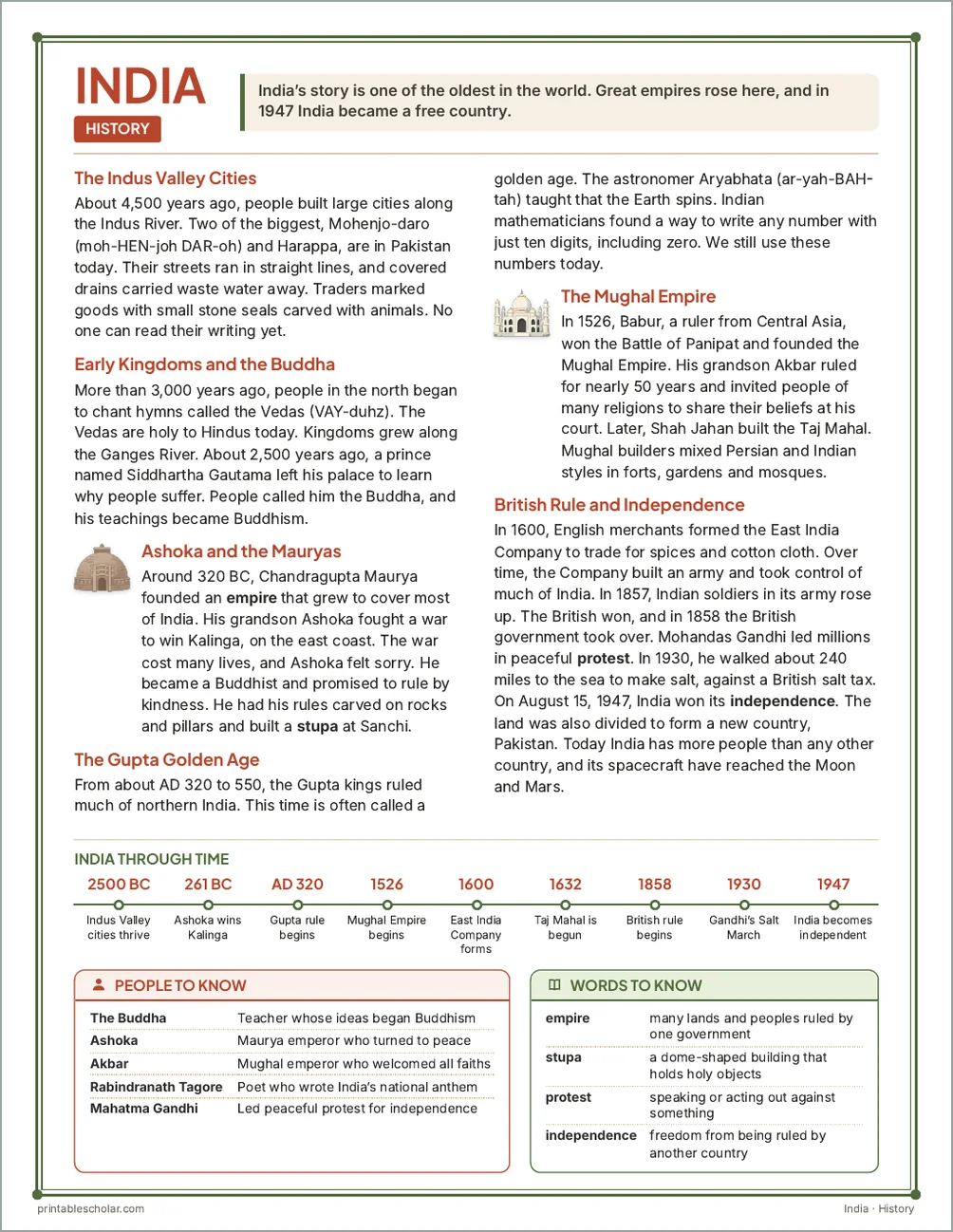
One page on the history of India for grades 3 to 5, free to print in color or black and white. It is the second reading page in the kit.
The Indus Valley Cities
About 4,500 years ago, people built large cities along the Indus River. Two of the biggest, Mohenjo-daro (moh-HEN-joh DAR-oh) and Harappa, are in Pakistan today. Their streets ran in straight lines, and covered drains carried waste water away. Traders marked goods with small stone seals carved with animals. No one can read their writing yet.
Early Kingdoms and the Buddha
More than 3,000 years ago, people in the north began to chant hymns called the Vedas (VAY-duhz). The Vedas are holy to Hindus today. Kingdoms grew along the Ganges River. About 2,500 years ago, a prince named Siddhartha Gautama left his palace to learn why people suffer. People called him the Buddha, and his teachings became Buddhism.
Ashoka and the Mauryas
Around 320 BC, Chandragupta Maurya founded an empire that grew to cover most of India. His grandson Ashoka fought a war to win Kalinga, on the east coast. The war cost many lives, and Ashoka felt sorry. He became a Buddhist and promised to rule by kindness. He had his rules carved on rocks and pillars and built a stupa at Sanchi.
The Gupta Golden Age
From about AD 320 to 550, the Gupta kings ruled much of northern India. This time is often called a golden age. The astronomer Aryabhata (ar-yah-BAH-tah) taught that the Earth spins. Indian mathematicians found a way to write any number with just ten digits, including zero. We still use these numbers today.
The Mughal Empire
In 1526, Babur, a ruler from Central Asia, won the Battle of Panipat and founded the Mughal Empire. His grandson Akbar ruled for nearly 50 years and invited people of many religions to share their beliefs at his court. Later, Shah Jahan built the Taj Mahal. Mughal builders mixed Persian and Indian styles in forts, gardens and mosques.
British Rule and Independence
In 1600, English merchants formed the East India Company to trade for spices and cotton cloth. Over time, the Company built an army and took control of much of India. In 1857, Indian soldiers in its army rose up. The British won, and in 1858 the British government took over. Mohandas Gandhi led millions in peaceful protest. In 1930, he walked about 240 miles to the sea to make salt, against a British salt tax. On August 15, 1947, India won its independence. The land was also divided to form a new country, Pakistan. Today India has more people than any other country, and its spacecraft have reached the Moon and Mars.
India through time
- 2500 BC Indus Valley cities thrive
- 261 BC Ashoka wins Kalinga
- AD 320 Gupta rule begins
- 1526 Mughal Empire begins
- 1600 East India Company forms
- 1632 Taj Mahal is begun
- 1858 British rule begins
- 1930 Gandhi’s Salt March
- 1947 India becomes independent
People to know
- The Buddha: Teacher whose ideas began Buddhism
- Ashoka: Maurya emperor who turned to peace
- Akbar: Mughal emperor who welcomed all faiths
- Rabindranath Tagore: Poet who wrote India’s national anthem
- Mahatma Gandhi: Led peaceful protest for independence
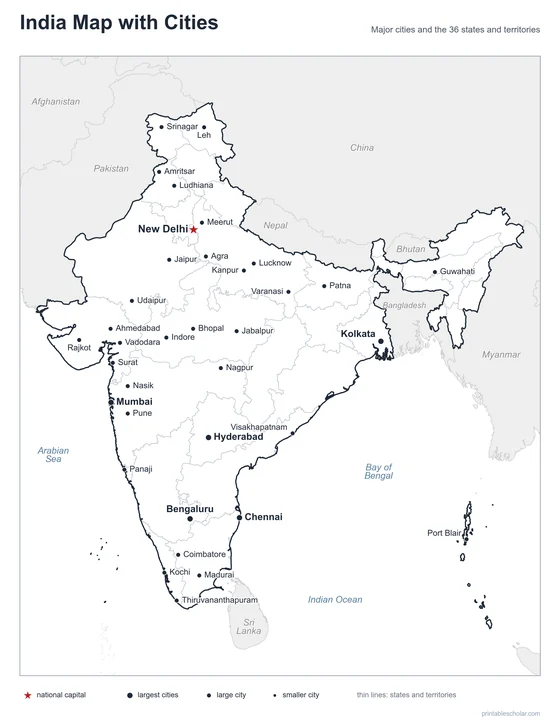
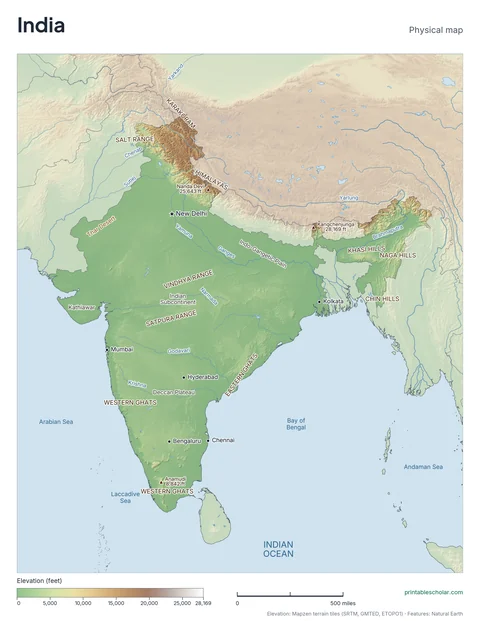
Free India maps
Each of these maps is free to print on its own. The kit puts its maps in one file with the reading pages and the booklet.