Printable Scholar

Germany Country Report Kit
Everything a student needs to research and write a report on Germany: the reading, the maps and the pages to fill in. Nothing else to look up.
- 4 reading pages: Germany fun facts with the flag, History, Land and Work, and Culture and Daily Life
- 5 maps: landmarks, cities, Where in the World, outline, and rivers, lakes and neighbors
- A 9-page My Country Report booklet, from fast facts to a trip plan, a stamp to design and a written report
- A pennant to cut out and hang, two map skills sheets and a 10-question reading quiz
- Answer keys, a grading rubric and talking points for the teacher
- Two print-ready PDFs, 26 pages each, US Letter: color, and ink-saving black and white
Each student on a different country? Get every country kit for $24.
Look inside: all 26 pages
Read it, map it, write it.
The reading pages and maps hold every answer the booklet asks for. About one third of the booklet is looking things up. The rest asks students to choose, plan and explain.

What is in the Germany kit
To read and study
- Germany fun facts: six short true stories, the flag, By the Numbers and Did You Know
- History: the country’s story from its first peoples to today, with a timeline, people to know and words to know
- Land and Work: the land and climate, what people grow, make and mine, and how one leads to the other
- Culture and Daily Life: food, school, sports, holidays, music and crafts, with everyday words to say
- Five maps, including Where in the World with latitude and longitude, and a rivers, lakes and neighbors map with a letter key
To fill in and make
- My Country Report booklet: cover, Fast Facts, My Map, Culture and Daily Life, My Trip, Think Like a Geographer, Design a Stamp, Dig Deeper and My Report
- A pennant with the country’s name and outline, to color, cut out and hang
- Name the Cities and Name the Rivers and Lakes sheets, each with a word bank
- A 10-question reading quiz, answer keys, a rubric and talking points for the teacher
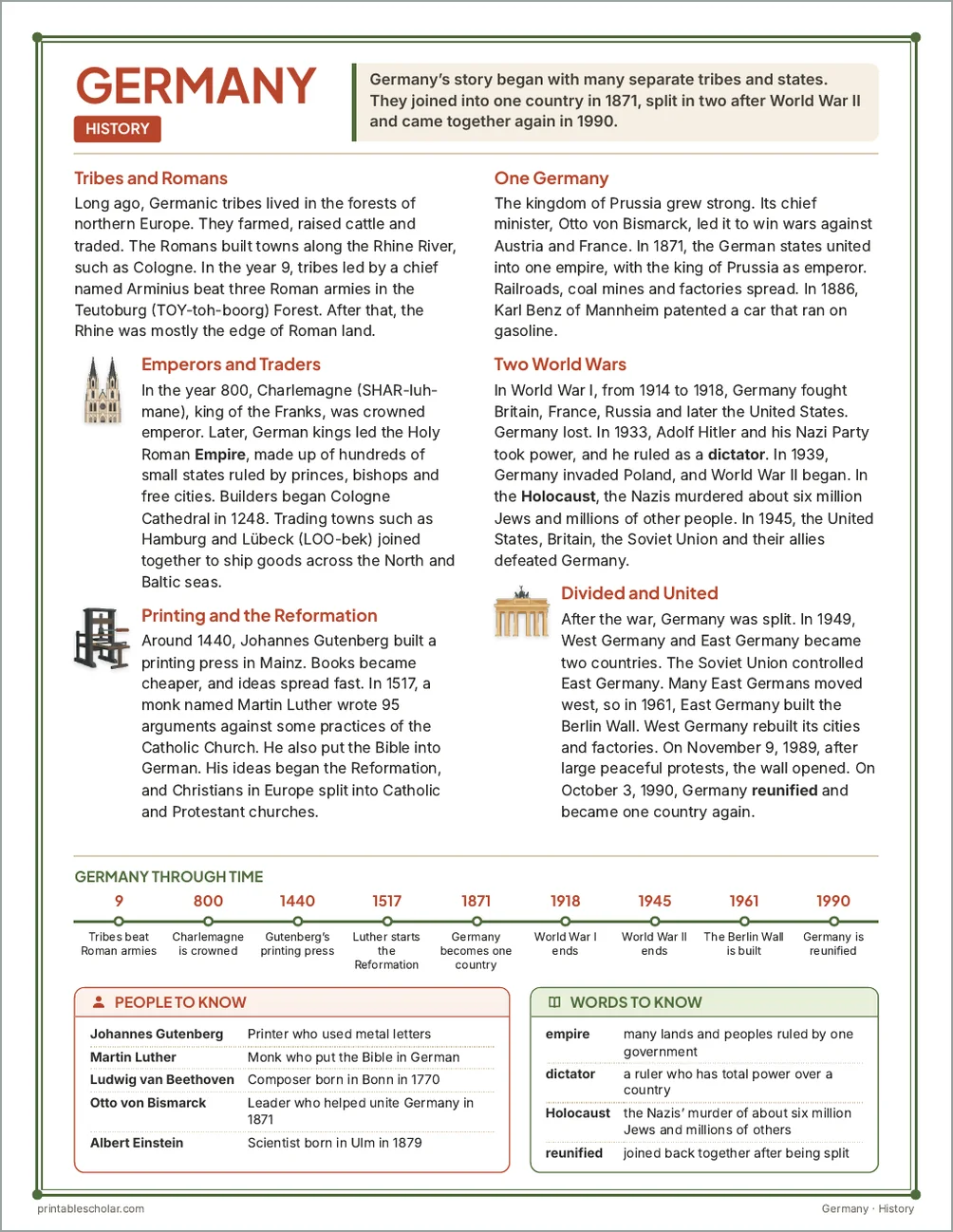
Free: the Germany History reading page
One page on the history of Germany for grades 3 to 5, free to print in color or black and white. It is the second reading page in the kit.
Tribes and Romans
Long ago, Germanic tribes lived in the forests of northern Europe. They farmed, raised cattle and traded. The Romans built towns along the Rhine River, such as Cologne. In the year 9, tribes led by a chief named Arminius beat three Roman armies in the Teutoburg (TOY-toh-boorg) Forest. After that, the Rhine was mostly the edge of Roman land.
Emperors and Traders
In the year 800, Charlemagne (SHAR-luh-mane), king of the Franks, was crowned emperor. Later, German kings led the Holy Roman Empire, made up of hundreds of small states ruled by princes, bishops and free cities. Builders began Cologne Cathedral in 1248. Trading towns such as Hamburg and Lübeck (LOO-bek) joined together to ship goods across the North and Baltic seas.
Printing and the Reformation
Around 1440, Johannes Gutenberg built a printing press in Mainz. Books became cheaper, and ideas spread fast. In 1517, a monk named Martin Luther wrote 95 arguments against some practices of the Catholic Church. He also put the Bible into German. His ideas began the Reformation, and Christians in Europe split into Catholic and Protestant churches.
One Germany
The kingdom of Prussia grew strong. Its chief minister, Otto von Bismarck, led it to win wars against Austria and France. In 1871, the German states united into one empire, with the king of Prussia as emperor. Railroads, coal mines and factories spread. In 1886, Karl Benz of Mannheim patented a car that ran on gasoline.
Two World Wars
In World War I, from 1914 to 1918, Germany fought Britain, France, Russia and later the United States. Germany lost. In 1933, Adolf Hitler and his Nazi Party took power, and he ruled as a dictator. In 1939, Germany invaded Poland, and World War II began. In the Holocaust, the Nazis murdered about six million Jews and millions of other people. In 1945, the United States, Britain, the Soviet Union and their allies defeated Germany.
Divided and United
After the war, Germany was split. In 1949, West Germany and East Germany became two countries. The Soviet Union controlled East Germany. Many East Germans moved west, so in 1961, East Germany built the Berlin Wall. West Germany rebuilt its cities and factories. On November 9, 1989, after large peaceful protests, the wall opened. On October 3, 1990, Germany reunified and became one country again.
Germany through time
- 9 Tribes beat Roman armies
- 800 Charlemagne is crowned
- 1440 Gutenberg’s printing press
- 1517 Luther starts the Reformation
- 1871 Germany becomes one country
- 1918 World War I ends
- 1945 World War II ends
- 1961 The Berlin Wall is built
- 1990 Germany is reunified
People to know
- Johannes Gutenberg: Printer who used metal letters
- Martin Luther: Monk who put the Bible in German
- Ludwig van Beethoven: Composer born in Bonn in 1770
- Otto von Bismarck: Leader who helped unite Germany in 1871
- Albert Einstein: Scientist born in Ulm in 1879
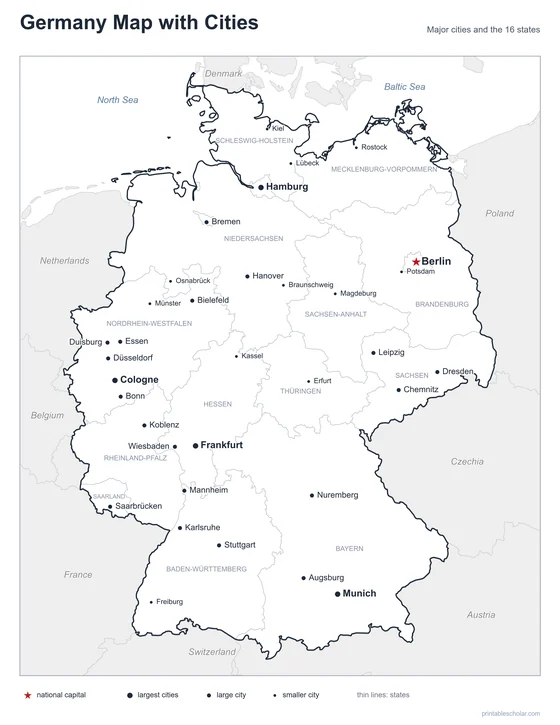
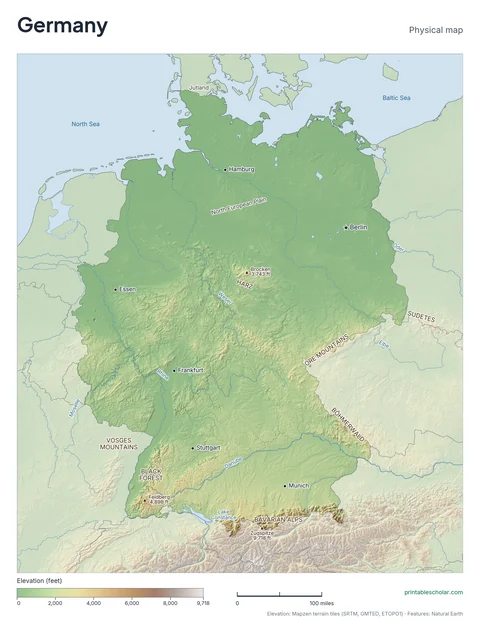
Free Germany maps
Each of these maps is free to print on its own. The kit puts its maps in one file with the reading pages and the booklet.