Printable Scholar

France Country Report Kit
Everything a student needs to research and write a report on France: the reading, the maps and the pages to fill in. Nothing else to look up.
- 4 reading pages: France fun facts with the flag, History, Land and Work, and Culture and Daily Life
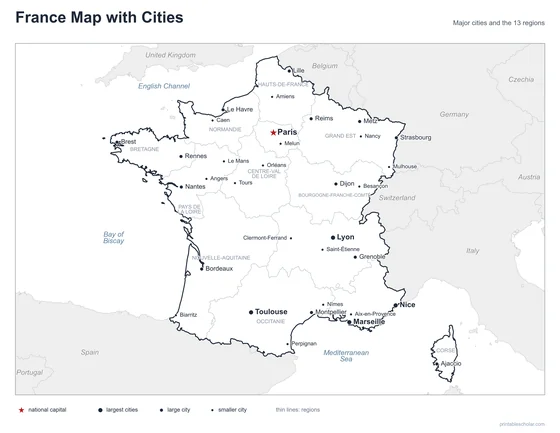
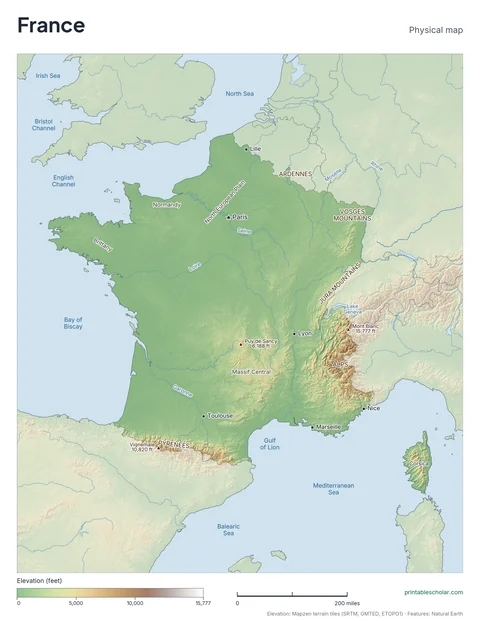
- 5 maps: landmarks, cities, Where in the World, outline, and rivers, lakes and neighbors
- A 9-page My Country Report booklet, from fast facts to a trip plan, a stamp to design and a written report
- A pennant to cut out and hang, two map skills sheets and a 10-question reading quiz
- Answer keys, a grading rubric and talking points for the teacher
- Two print-ready PDFs, 26 pages each, US Letter: color, and ink-saving black and white
Each student on a different country? Get every country kit for $24.
Look inside: all 26 pages
Read it, map it, write it.
The reading pages and maps hold every answer the booklet asks for. About one third of the booklet is looking things up. The rest asks students to choose, plan and explain.

What is in the France kit
To read and study
- France fun facts: six short true stories, the flag, By the Numbers and Did You Know
- History: the country’s story from its first peoples to today, with a timeline, people to know and words to know
- Land and Work: the land and climate, what people grow, make and mine, and how one leads to the other
- Culture and Daily Life: food, school, sports, holidays, music and crafts, with everyday words to say
- Five maps, including Where in the World with latitude and longitude, and a rivers, lakes and neighbors map with a letter key
To fill in and make
- My Country Report booklet: cover, Fast Facts, My Map, Culture and Daily Life, My Trip, Think Like a Geographer, Design a Stamp, Dig Deeper and My Report
- A pennant with the country’s name and outline, to color, cut out and hang
- Name the Cities and Name the Rivers and Lakes sheets, each with a word bank
- A 10-question reading quiz, answer keys, a rubric and talking points for the teacher
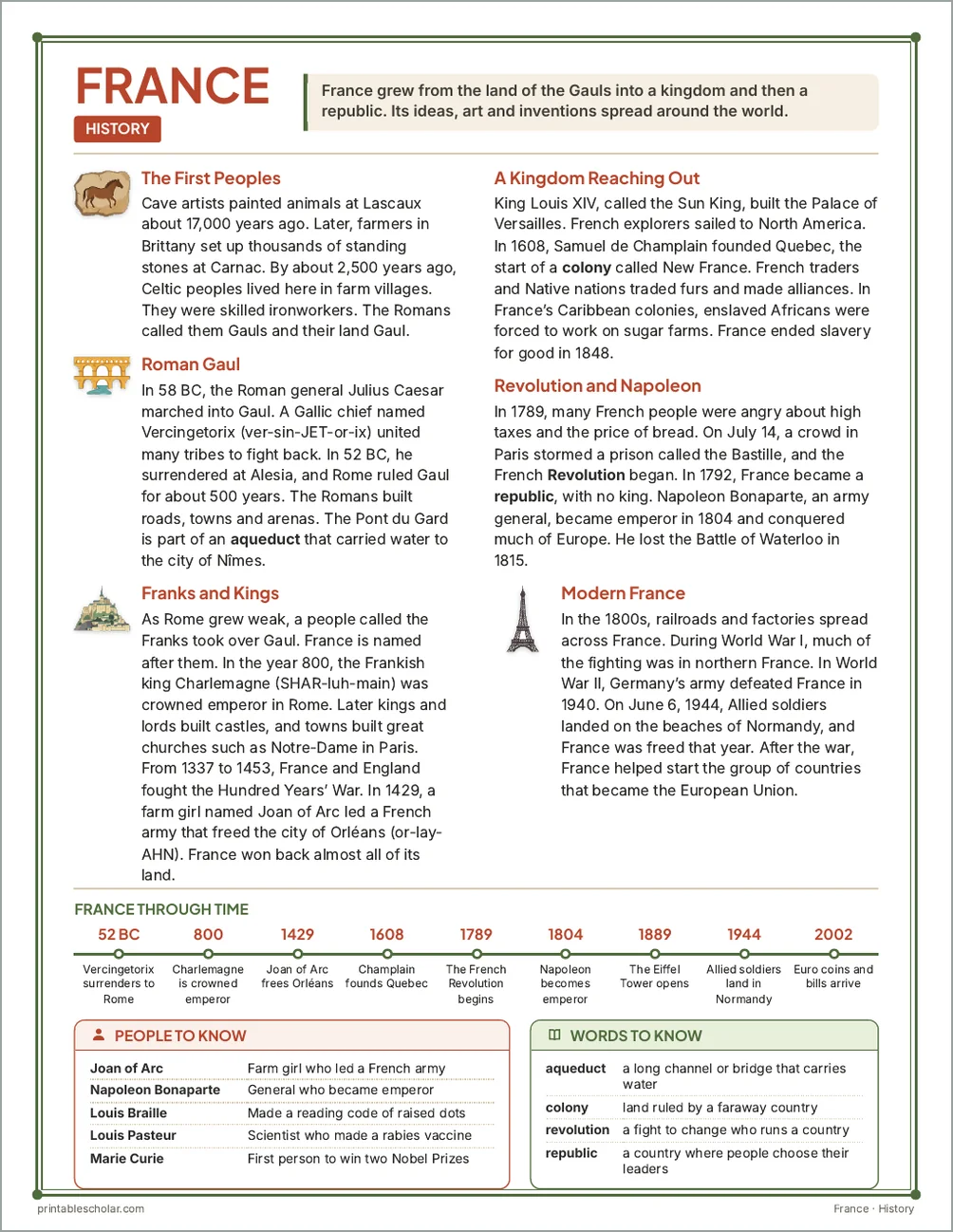
Free: the France History reading page
One page on the history of France for grades 3 to 5, free to print in color or black and white. It is the second reading page in the kit.
The First Peoples
Cave artists painted animals at Lascaux about 17,000 years ago. Later, farmers in Brittany set up thousands of standing stones at Carnac. By about 2,500 years ago, Celtic peoples lived here in farm villages. They were skilled ironworkers. The Romans called them Gauls and their land Gaul.
Roman Gaul
In 58 BC, the Roman general Julius Caesar marched into Gaul. A Gallic chief named Vercingetorix (ver-sin-JET-or-ix) united many tribes to fight back. In 52 BC, he surrendered at Alesia, and Rome ruled Gaul for about 500 years. The Romans built roads, towns and arenas. The Pont du Gard is part of an aqueduct that carried water to the city of Nîmes.
Franks and Kings
As Rome grew weak, a people called the Franks took over Gaul. France is named after them. In the year 800, the Frankish king Charlemagne (SHAR-luh-main) was crowned emperor in Rome. Later kings and lords built castles, and towns built great churches such as Notre-Dame in Paris. From 1337 to 1453, France and England fought the Hundred Years’ War. In 1429, a farm girl named Joan of Arc led a French army that freed the city of Orléans (or-lay-AHN). France won back almost all of its land.
A Kingdom Reaching Out
King Louis XIV, called the Sun King, built the Palace of Versailles. French explorers sailed to North America. In 1608, Samuel de Champlain founded Quebec, the start of a colony called New France. French traders and Native nations traded furs and made alliances. In France’s Caribbean colonies, enslaved Africans were forced to work on sugar farms. France ended slavery for good in 1848.
Revolution and Napoleon
In 1789, many French people were angry about high taxes and the price of bread. On July 14, a crowd in Paris stormed a prison called the Bastille, and the French Revolution began. In 1792, France became a republic, with no king. Napoleon Bonaparte, an army general, became emperor in 1804 and conquered much of Europe. He lost the Battle of Waterloo in 1815.
Modern France
In the 1800s, railroads and factories spread across France. During World War I, much of the fighting was in northern France. In World War II, Germany’s army defeated France in 1940. On June 6, 1944, Allied soldiers landed on the beaches of Normandy, and France was freed that year. After the war, France helped start the group of countries that became the European Union.
France through time
- 52 BC Vercingetorix surrenders to Rome
- 800 Charlemagne is crowned emperor
- 1429 Joan of Arc frees Orléans
- 1608 Champlain founds Quebec
- 1789 The French Revolution begins
- 1804 Napoleon becomes emperor
- 1889 The Eiffel Tower opens
- 1944 Allied soldiers land in Normandy
- 2002 Euro coins and bills arrive
People to know
- Joan of Arc: Farm girl who led a French army
- Napoleon Bonaparte: General who became emperor
- Louis Braille: Made a reading code of raised dots
- Louis Pasteur: Scientist who made a rabies vaccine
- Marie Curie: First person to win two Nobel Prizes
Free France maps
Each of these maps is free to print on its own. The kit puts its maps in one file with the reading pages and the booklet.