Printable Scholar

Egypt Country Report Kit
Everything a student needs to research and write a report on Egypt: the reading, the maps and the pages to fill in. Nothing else to look up.
- 4 reading pages: Egypt fun facts with the flag, History, Land and Work, and Culture and Daily Life
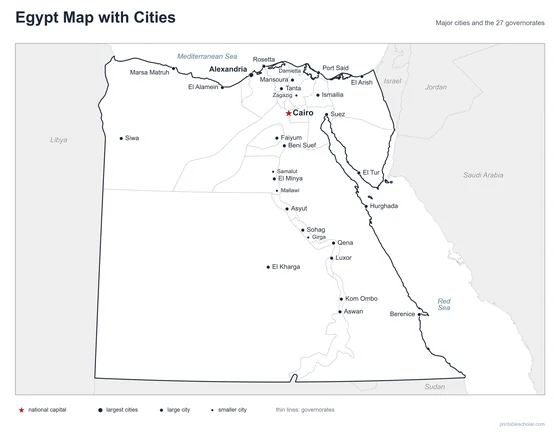
- 5 maps: landmarks, cities, Where in the World, outline, and rivers, lakes and neighbors
- A 9-page My Country Report booklet, from fast facts to a trip plan, a stamp to design and a written report
- A pennant to cut out and hang, two map skills sheets and a 10-question reading quiz
- Answer keys, a grading rubric and talking points for the teacher
- Two print-ready PDFs, 26 pages each, US Letter: color, and ink-saving black and white
Each student on a different country? Get every country kit for $24.
Look inside: all 26 pages
Read it, map it, write it.
The reading pages and maps hold every answer the booklet asks for. About one third of the booklet is looking things up. The rest asks students to choose, plan and explain.

What is in the Egypt kit
To read and study
- Egypt fun facts: six short true stories, the flag, By the Numbers and Did You Know
- History: the country’s story from its first peoples to today, with a timeline, people to know and words to know
- Land and Work: the land and climate, what people grow, make and mine, and how one leads to the other
- Culture and Daily Life: food, school, sports, holidays, music and crafts, with everyday words to say
- Five maps, including Where in the World with latitude and longitude, and a rivers, lakes and neighbors map with a letter key
To fill in and make
- My Country Report booklet: cover, Fast Facts, My Map, Culture and Daily Life, My Trip, Think Like a Geographer, Design a Stamp, Dig Deeper and My Report
- A pennant with the country’s name and outline, to color, cut out and hang
- Name the Cities and Name the Rivers and Lakes sheets, each with a word bank
- A 10-question reading quiz, answer keys, a rubric and talking points for the teacher
Free: the Egypt History reading page
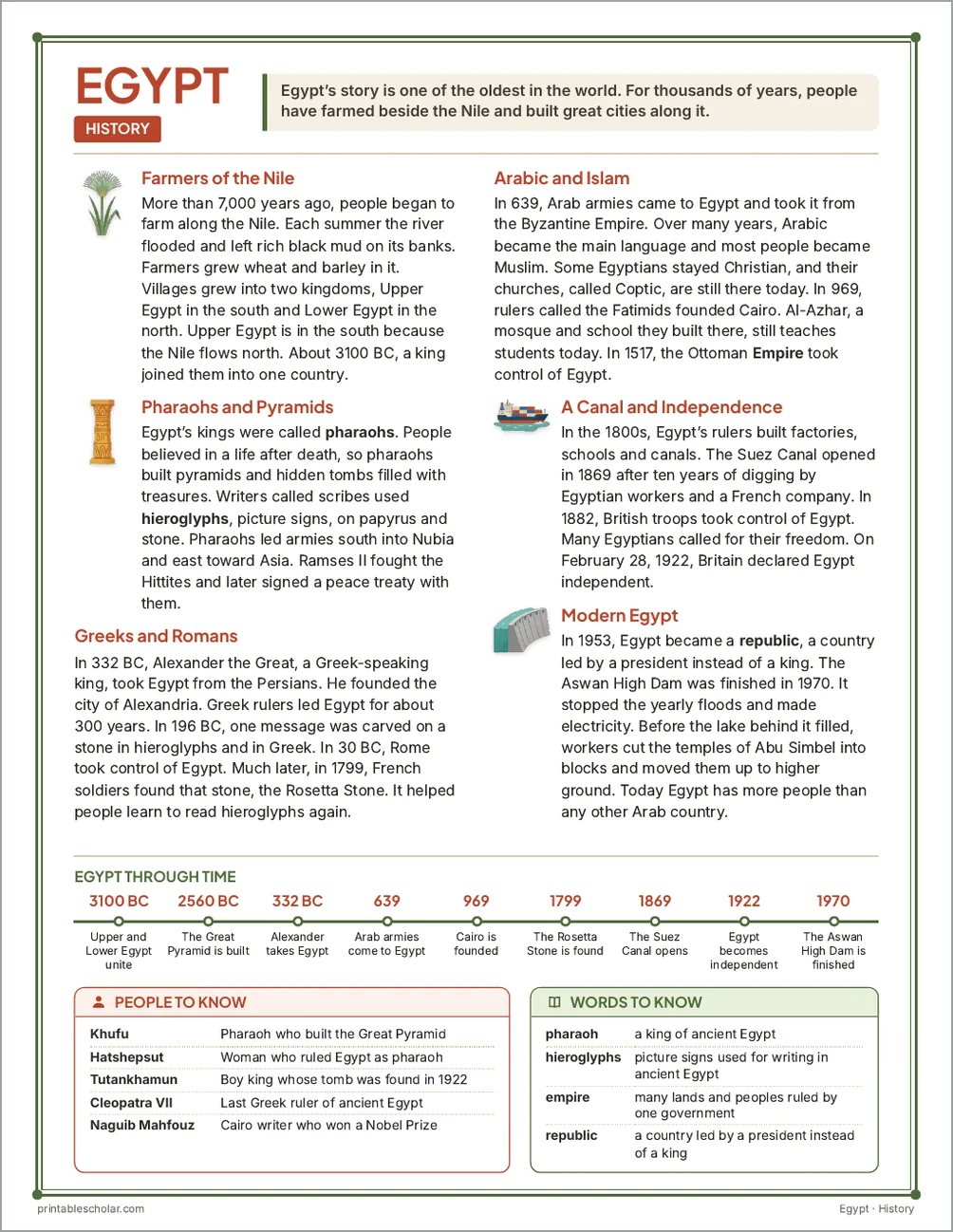
One page on the history of Egypt for grades 3 to 5, free to print in color or black and white. It is the second reading page in the kit.
Farmers of the Nile
More than 7,000 years ago, people began to farm along the Nile. Each summer the river flooded and left rich black mud on its banks. Farmers grew wheat and barley in it. Villages grew into two kingdoms, Upper Egypt in the south and Lower Egypt in the north. Upper Egypt is in the south because the Nile flows north. About 3100 BC, a king joined them into one country.
Pharaohs and Pyramids
Egypt’s kings were called pharaohs. People believed in a life after death, so pharaohs built pyramids and hidden tombs filled with treasures. Writers called scribes used hieroglyphs, picture signs, on papyrus and stone. Pharaohs led armies south into Nubia and east toward Asia. Ramses II fought the Hittites and later signed a peace treaty with them.
Greeks and Romans
In 332 BC, Alexander the Great, a Greek-speaking king, took Egypt from the Persians. He founded the city of Alexandria. Greek rulers led Egypt for about 300 years. In 196 BC, one message was carved on a stone in hieroglyphs and in Greek. In 30 BC, Rome took control of Egypt. Much later, in 1799, French soldiers found that stone, the Rosetta Stone. It helped people learn to read hieroglyphs again.
Arabic and Islam
In 639, Arab armies came to Egypt and took it from the Byzantine Empire. Over many years, Arabic became the main language and most people became Muslim. Some Egyptians stayed Christian, and their churches, called Coptic, are still there today. In 969, rulers called the Fatimids founded Cairo. Al-Azhar, a mosque and school they built there, still teaches students today. In 1517, the Ottoman Empire took control of Egypt.
A Canal and Independence
In the 1800s, Egypt’s rulers built factories, schools and canals. The Suez Canal opened in 1869 after ten years of digging by Egyptian workers and a French company. In 1882, British troops took control of Egypt. Many Egyptians called for their freedom. On February 28, 1922, Britain declared Egypt independent.
Modern Egypt
In 1953, Egypt became a republic, a country led by a president instead of a king. The Aswan High Dam was finished in 1970. It stopped the yearly floods and made electricity. Before the lake behind it filled, workers cut the temples of Abu Simbel into blocks and moved them up to higher ground. Today Egypt has more people than any other Arab country.
Egypt through time
- 3100 BC Upper and Lower Egypt unite
- 2560 BC The Great Pyramid is built
- 332 BC Alexander takes Egypt
- 639 Arab armies come to Egypt
- 969 Cairo is founded
- 1799 The Rosetta Stone is found
- 1869 The Suez Canal opens
- 1922 Egypt becomes independent
- 1970 The Aswan High Dam is finished
People to know
- Khufu: Pharaoh who built the Great Pyramid
- Hatshepsut: Woman who ruled Egypt as pharaoh
- Tutankhamun: Boy king whose tomb was found in 1922
- Cleopatra VII: Last Greek ruler of ancient Egypt
- Naguib Mahfouz: Cairo writer who won a Nobel Prize
Free Egypt maps
Each of these maps is free to print on its own. The kit puts its maps in one file with the reading pages and the booklet.