Printable Scholar

Canada Country Report Kit
Everything a student needs to research and write a report on Canada: the reading, the maps and the pages to fill in. Nothing else to look up.
- 4 reading pages: Canada fun facts with the flag, History, Land and Work, and Culture and Daily Life
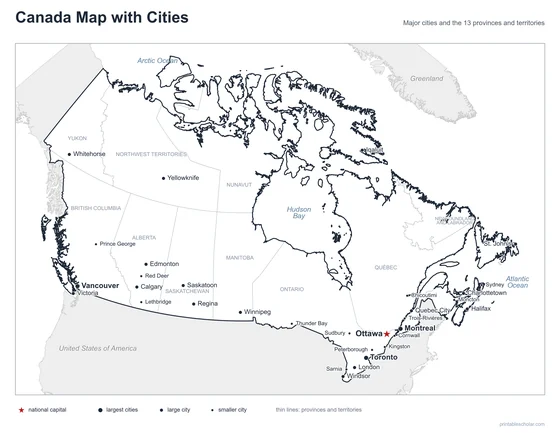
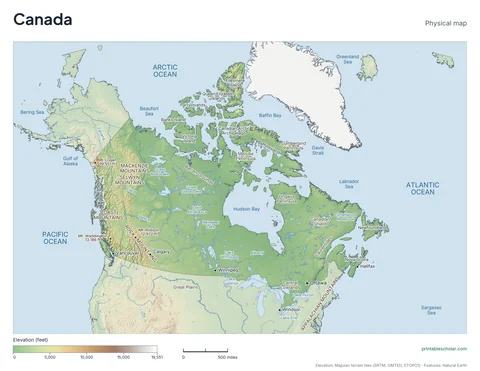
- 5 maps: landmarks, cities, Where in the World, outline, and rivers, lakes and neighbors
- A 9-page My Country Report booklet, from fast facts to a trip plan, a stamp to design and a written report
- A pennant to cut out and hang, two map skills sheets and a 10-question reading quiz
- Answer keys, a grading rubric and talking points for the teacher
- Two print-ready PDFs, 26 pages each, US Letter: color, and ink-saving black and white
Each student on a different country? Get every country kit for $24.
Look inside: all 26 pages
Read it, map it, write it.
The reading pages and maps hold every answer the booklet asks for. About one third of the booklet is looking things up. The rest asks students to choose, plan and explain.

What is in the Canada kit
To read and study
- Canada fun facts: six short true stories, the flag, By the Numbers and Did You Know
- History: the country’s story from its first peoples to today, with a timeline, people to know and words to know
- Land and Work: the land and climate, what people grow, make and mine, and how one leads to the other
- Culture and Daily Life: food, school, sports, holidays, music and crafts, with everyday words to say
- Five maps, including Where in the World with latitude and longitude, and a rivers, lakes and neighbors map with a letter key
To fill in and make
- My Country Report booklet: cover, Fast Facts, My Map, Culture and Daily Life, My Trip, Think Like a Geographer, Design a Stamp, Dig Deeper and My Report
- A pennant with the country’s name and outline, to color, cut out and hang
- Name the Cities and Name the Rivers and Lakes sheets, each with a word bank
- A 10-question reading quiz, answer keys, a rubric and talking points for the teacher
Free: the Canada History reading page
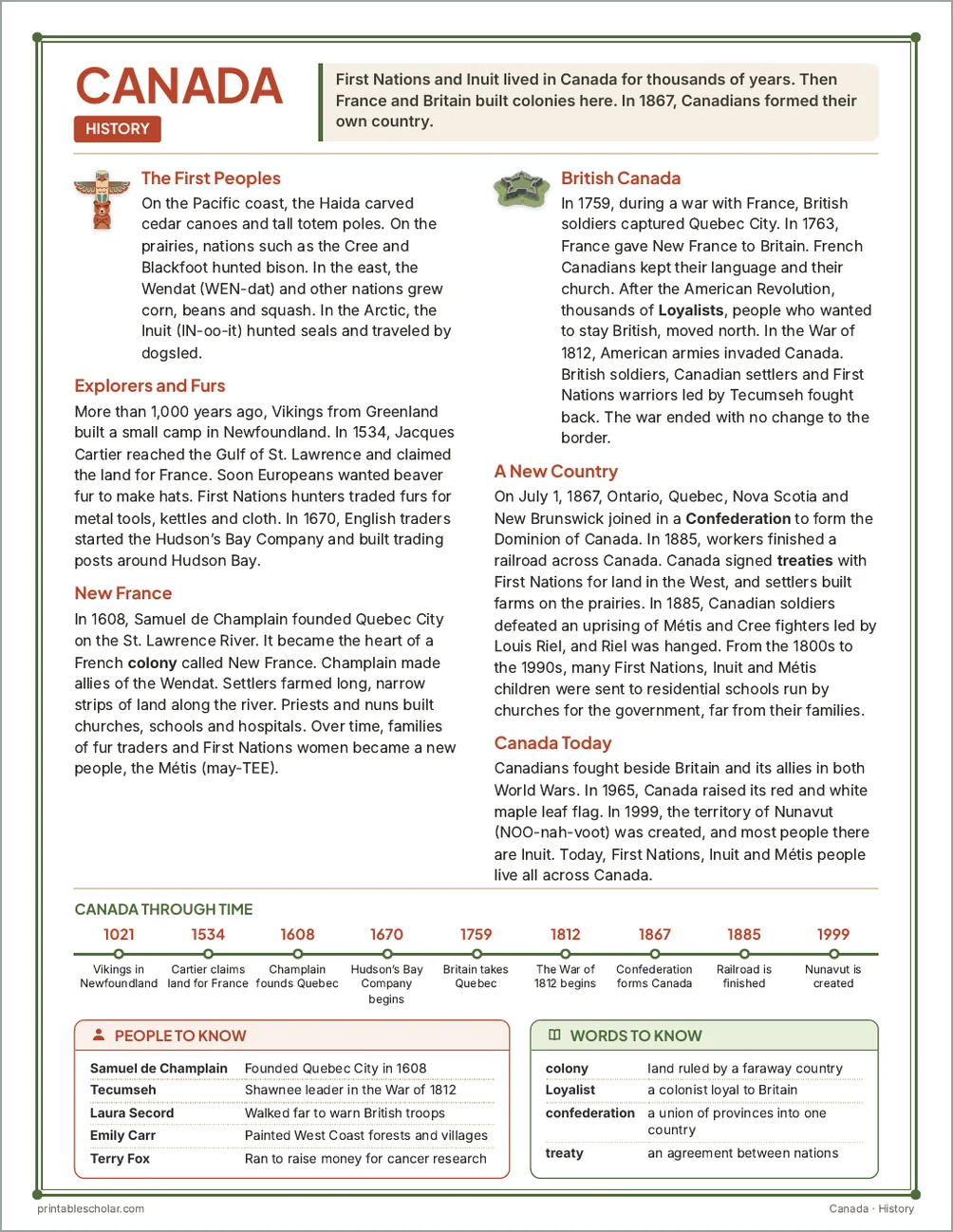
One page on the history of Canada for grades 3 to 5, free to print in color or black and white. It is the second reading page in the kit.
The First Peoples
On the Pacific coast, the Haida carved cedar canoes and tall totem poles. On the prairies, nations such as the Cree and Blackfoot hunted bison. In the east, the Wendat (WEN-dat) and other nations grew corn, beans and squash. In the Arctic, the Inuit (IN-oo-it) hunted seals and traveled by dogsled.
Explorers and Furs
More than 1,000 years ago, Vikings from Greenland built a small camp in Newfoundland. In 1534, Jacques Cartier reached the Gulf of St. Lawrence and claimed the land for France. Soon Europeans wanted beaver fur to make hats. First Nations hunters traded furs for metal tools, kettles and cloth. In 1670, English traders started the Hudson’s Bay Company and built trading posts around Hudson Bay.
New France
In 1608, Samuel de Champlain founded Quebec City on the St. Lawrence River. It became the heart of a French colony called New France. Champlain made allies of the Wendat. Settlers farmed long, narrow strips of land along the river. Priests and nuns built churches, schools and hospitals. Over time, families of fur traders and First Nations women became a new people, the Métis (may-TEE).
British Canada
In 1759, during a war with France, British soldiers captured Quebec City. In 1763, France gave New France to Britain. French Canadians kept their language and their church. After the American Revolution, thousands of Loyalists, people who wanted to stay British, moved north. In the War of 1812, American armies invaded Canada. British soldiers, Canadian settlers and First Nations warriors led by Tecumseh fought back. The war ended with no change to the border.
A New Country
On July 1, 1867, Ontario, Quebec, Nova Scotia and New Brunswick joined in a Confederation to form the Dominion of Canada. In 1885, workers finished a railroad across Canada. Canada signed treaties with First Nations for land in the West, and settlers built farms on the prairies. In 1885, Canadian soldiers defeated an uprising of Métis and Cree fighters led by Louis Riel, and Riel was hanged. From the 1800s to the 1990s, many First Nations, Inuit and Métis children were sent to residential schools run by churches for the government, far from their families.
Canada Today
Canadians fought beside Britain and its allies in both World Wars. In 1965, Canada raised its red and white maple leaf flag. In 1999, the territory of Nunavut (NOO-nah-voot) was created, and most people there are Inuit. Today, First Nations, Inuit and Métis people live all across Canada.
Canada through time
- 1021 Vikings in Newfoundland
- 1534 Cartier claims land for France
- 1608 Champlain founds Quebec
- 1670 Hudson’s Bay Company begins
- 1759 Britain takes Quebec
- 1812 The War of 1812 begins
- 1867 Confederation forms Canada
- 1885 Railroad is finished
- 1999 Nunavut is created
People to know
- Samuel de Champlain: Founded Quebec City in 1608
- Tecumseh: Shawnee leader in the War of 1812
- Laura Secord: Walked far to warn British troops
- Emily Carr: Painted West Coast forests and villages
- Terry Fox: Ran to raise money for cancer research
Free Canada maps
Each of these maps is free to print on its own. The kit puts its maps in one file with the reading pages and the booklet.