Printable Scholar

Australia Country Report Kit
Everything a student needs to research and write a report on Australia: the reading, the maps and the pages to fill in. Nothing else to look up.
- 4 reading pages: Australia fun facts with the flag, History, Land and Work, and Culture and Daily Life
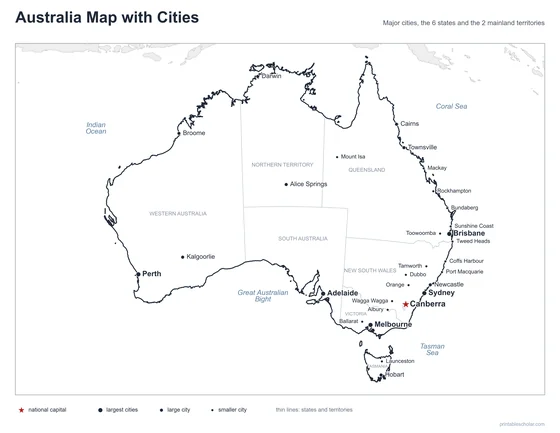
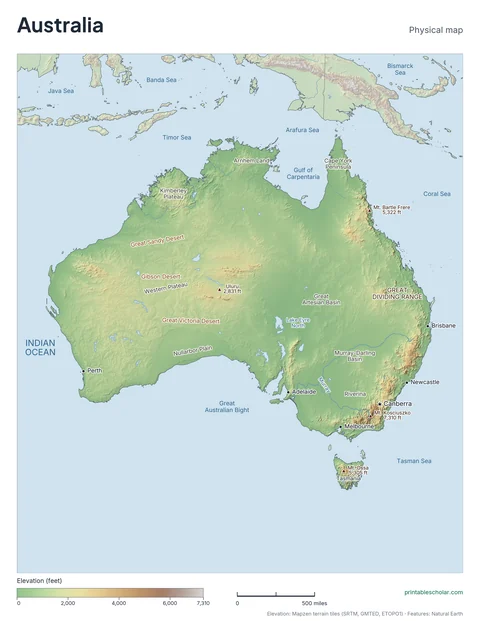
- 5 maps: landmarks, cities, Where in the World, outline, and rivers, lakes and neighbors
- A 9-page My Country Report booklet, from fast facts to a trip plan, a stamp to design and a written report
- A pennant to cut out and hang, two map skills sheets and a 10-question reading quiz
- Answer keys, a grading rubric and talking points for the teacher
- Two print-ready PDFs, 26 pages each, US Letter: color, and ink-saving black and white
Each student on a different country? Get every country kit for $24.
Look inside: all 26 pages
Read it, map it, write it.
The reading pages and maps hold every answer the booklet asks for. About one third of the booklet is looking things up. The rest asks students to choose, plan and explain.

What is in the Australia kit
To read and study
- Australia fun facts: six short true stories, the flag, By the Numbers and Did You Know
- History: the country’s story from its first peoples to today, with a timeline, people to know and words to know
- Land and Work: the land and climate, what people grow, make and mine, and how one leads to the other
- Culture and Daily Life: food, school, sports, holidays, music and crafts, with everyday words to say
- Five maps, including Where in the World with latitude and longitude, and a rivers, lakes and neighbors map with a letter key
To fill in and make
- My Country Report booklet: cover, Fast Facts, My Map, Culture and Daily Life, My Trip, Think Like a Geographer, Design a Stamp, Dig Deeper and My Report
- A pennant with the country’s name and outline, to color, cut out and hang
- Name the Cities and Name the Rivers and Lakes sheets, each with a word bank
- A 10-question reading quiz, answer keys, a rubric and talking points for the teacher
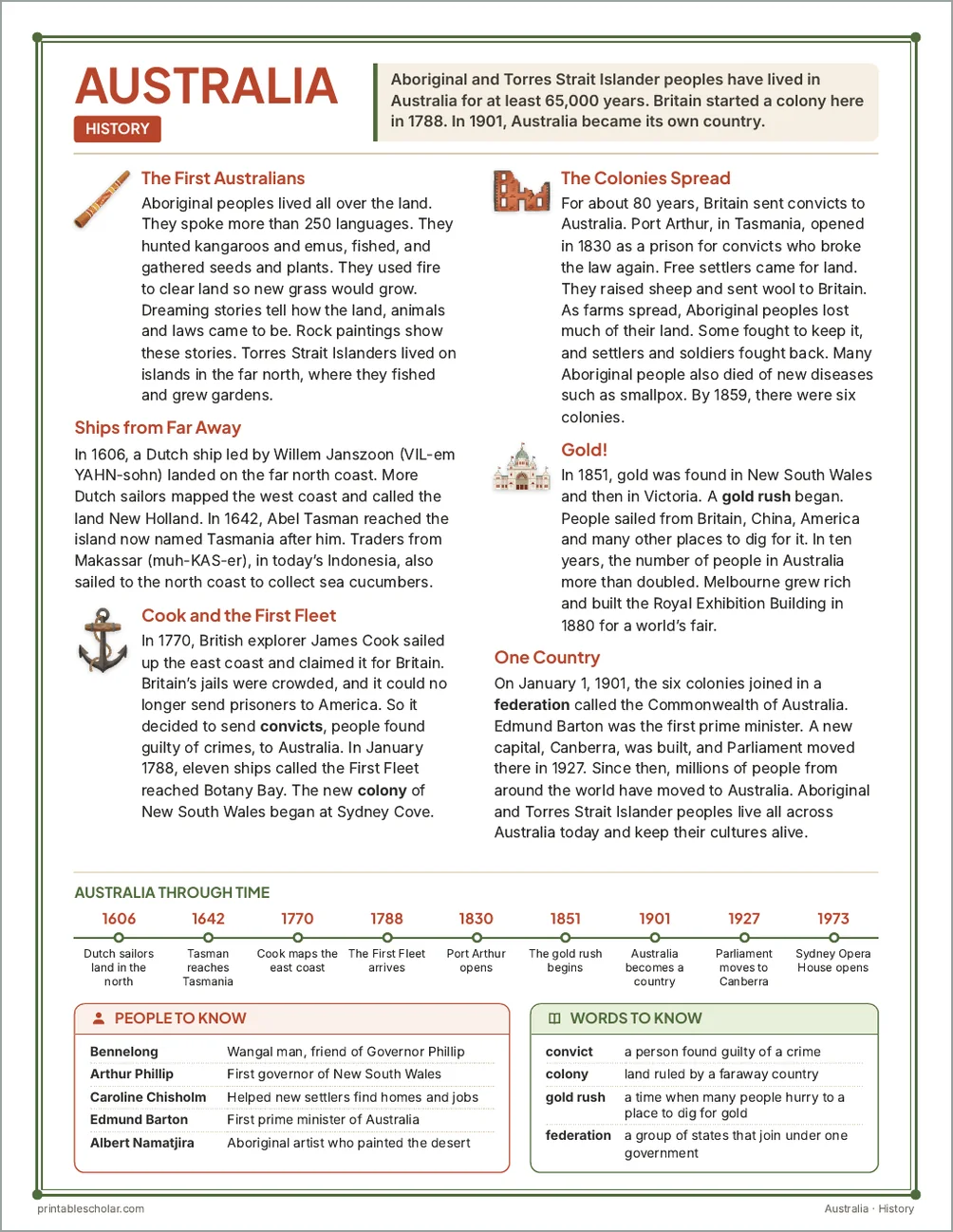
Free: the Australia History reading page
One page on the history of Australia for grades 3 to 5, free to print in color or black and white. It is the second reading page in the kit.
The First Australians
Aboriginal peoples lived all over the land. They spoke more than 250 languages. They hunted kangaroos and emus, fished, and gathered seeds and plants. They used fire to clear land so new grass would grow. Dreaming stories tell how the land, animals and laws came to be. Rock paintings show these stories. Torres Strait Islanders lived on islands in the far north, where they fished and grew gardens.
Ships from Far Away
In 1606, a Dutch ship led by Willem Janszoon (VIL-em YAHN-sohn) landed on the far north coast. More Dutch sailors mapped the west coast and called the land New Holland. In 1642, Abel Tasman reached the island now named Tasmania after him. Traders from Makassar (muh-KAS-er), in today’s Indonesia, also sailed to the north coast to collect sea cucumbers.
Cook and the First Fleet
In 1770, British explorer James Cook sailed up the east coast and claimed it for Britain. Britain’s jails were crowded, and it could no longer send prisoners to America. So it decided to send convicts, people found guilty of crimes, to Australia. In January 1788, eleven ships called the First Fleet reached Botany Bay. The new colony of New South Wales began at Sydney Cove.
The Colonies Spread
For about 80 years, Britain sent convicts to Australia. Port Arthur, in Tasmania, opened in 1830 as a prison for convicts who broke the law again. Free settlers came for land. They raised sheep and sent wool to Britain. As farms spread, Aboriginal peoples lost much of their land. Some fought to keep it, and settlers and soldiers fought back. Many Aboriginal people also died of new diseases such as smallpox. By 1859, there were six colonies.
Gold!
In 1851, gold was found in New South Wales and then in Victoria. A gold rush began. People sailed from Britain, China, America and many other places to dig for it. In ten years, the number of people in Australia more than doubled. Melbourne grew rich and built the Royal Exhibition Building in 1880 for a world’s fair.
One Country
On January 1, 1901, the six colonies joined in a federation called the Commonwealth of Australia. Edmund Barton was the first prime minister. A new capital, Canberra, was built, and Parliament moved there in 1927. Since then, millions of people from around the world have moved to Australia. Aboriginal and Torres Strait Islander peoples live all across Australia today and keep their cultures alive.
Australia through time
- 1606 Dutch sailors land in the north
- 1642 Tasman reaches Tasmania
- 1770 Cook maps the east coast
- 1788 The First Fleet arrives
- 1830 Port Arthur opens
- 1851 The gold rush begins
- 1901 Australia becomes a country
- 1927 Parliament moves to Canberra
- 1973 Sydney Opera House opens
People to know
- Bennelong: Wangal man, friend of Governor Phillip
- Arthur Phillip: First governor of New South Wales
- Caroline Chisholm: Helped new settlers find homes and jobs
- Edmund Barton: First prime minister of Australia
- Albert Namatjira: Aboriginal artist who painted the desert
Free Australia maps
Each of these maps is free to print on its own. The kit puts its maps in one file with the reading pages and the booklet.