 Printable Scholar
Elkonin Boxes
Elkonin boxes are a row of boxes, one for each sound in a word. A child says the word slowly and pushes a counter into a box for every sound: cat fills three boxes, /k/ /a/ /t/. They are also called sound boxes, and they are named after D. B. Elkonin, the psychologist who used them to teach children to hear the separate sounds in words.
- Blank mats with 2, 3, 4 and 5 boxes, big enough for counters
- Picture sheets from 2-sound words up to blends and digraphs
- An answer key with every picture sheet
- Black and white, US Letter, free
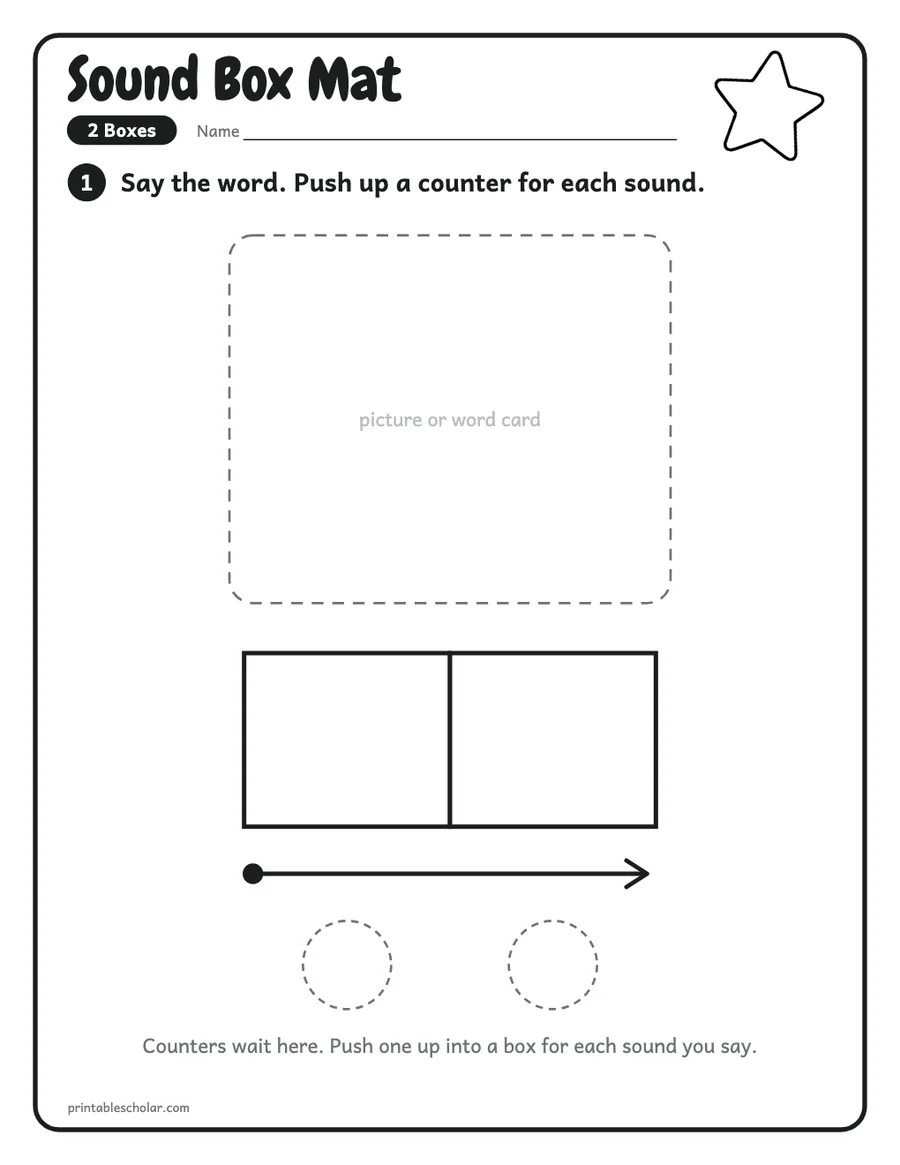
How to use Elkonin boxes
- Pick a word and a mat. Count the sounds yourself first and use the mat with that many boxes. Put a picture or the word card in the top space, or just say the word.
- Say the word together, slowly. Stretch it out so each sound can be heard: sssuuunnn.
- Push a counter for each sound. The child says the word again and pushes one counter up into a box for each sound, left to right along the arrow. Pennies, buttons, cubes or small blocks all work.
- Point and blend. The child touches each counter and says its sound, then runs a finger under all the boxes and says the whole word.
- Swap counters for letters. When hearing the sounds is easy, write a letter (or letter tiles) in each box instead. The picture sheets below are this step.
Two sounds, then three, then four
Start with words of two sounds (bee, pie, cow), then three-sound CVC words (cat, pig, sun), then four sounds with a blend (frog, nest). Hearing the middle sound in a CVC word and the second sound in a blend are the two places children most often get stuck, so stay on a level until it is easy.
A box holds a sound, not a letter. Fish has four letters but three sounds, /f/ /i/ /sh/, so it gets three boxes and the sh shares one. The digraph sheet shows this with a box split by a dotted line. Fox has three letters but four sounds, /f/ /o/ /k/ /s/, which is why the sheets here leave out words with x.
Free Elkonin box worksheets
Each picture sheet has eight pictures and a worked example at the top. The child says the picture, taps a dot for each sound, writes one sound in each box, then writes the word. Page 2 is the answer key. A grown-up can also read the words off the key aloud for a spelling-style lesson.
 Blank Box Mats
Four mats: 2, 3, 4 and 5 boxes, with spots for counters and a left-to-right arrow.
Download PDF
 2-Sound Words
bee, key, pie, boy, cow: every picture has two sounds to tap and write.
Download PDF
 3-Sound CVC Words
cat, bed, pig, dog, sun: short vowel words, three boxes each.
Download PDF
 4-Sound Words with Blends
frog, drum, nest, lamp: a blend at the start or the end, four boxes.
Download PDF
 Digraph Words
fish, duck, bath, ring: two letters share one box because they make one sound.
Download PDF
Onset and rime with two boxes
Before children split a word into every sound, many can split it into two parts: the onset (the sounds before the vowel) and the rime (the vowel and everything after it). On the 2-box mat, the onset goes in the first box and the rime in the second: c | at, sh | ip, fl | ag. Word families work the same way: keep -at in the second box and change the first (c, h, m, s). When that is easy, move the same word to the 3-box mat and split the rime too: c | a | t.
More phonemic awareness activities with the boxes
- Count the sounds
- Say a word and ask which mat it needs. Ship? Three boxes. Stop? Four.
- Blend from the boxes
- You push the counters and say each sound; the child says the word you built.
- Find a sound
- After filling the boxes, ask where a sound is: "Where is the /m/ in jam?" The child touches the first, middle or last box.
- Change a sound
- Fill the boxes for cat, then swap one counter for a new colour and ask for the new word: change /k/ to /h/ and it is hat; change /a/ to /u/ and it is cut.
- Take a sound away
- Fill the boxes for snap, pull the first counter back down and say what is left: nap.
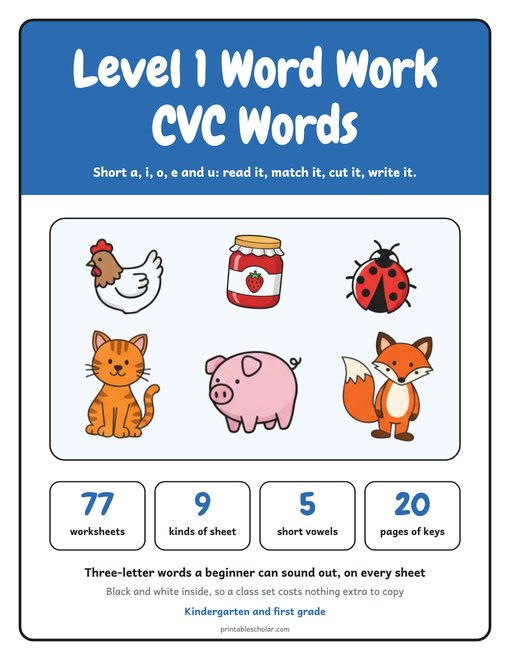
Sound boxes for every short vowel, and the next step after them
Once a child can tap out the sounds in cat, the next job is reading and spelling lots of words like it. Level 1 Word Work: CVC Words has 77 worksheets in the same look as these: sound boxes for short a, e, i, o and u and a mixed review, plus find the word, circle the picture, cut and glue, rhyming jars, picture sentences, tiny stories and change the vowel. Every sheet has an answer key.
More free sound practice: Daily Sound Games, five-minute rhyming, blending and segmenting games to read aloud, and CVC word work with a free sound box sheet for each short vowel.