 Printable Scholar
The Navajo Code Talkers: Crack the Code
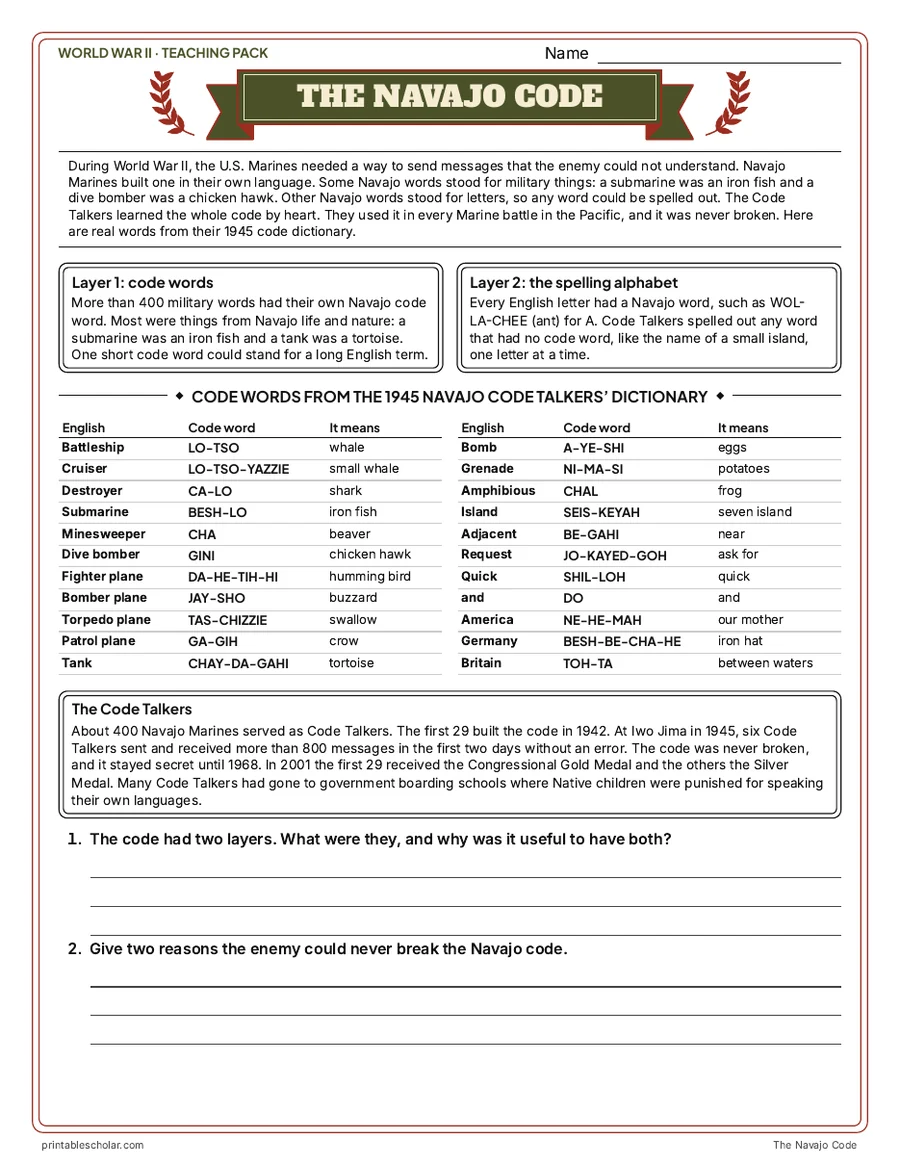
During World War II, Navajo Marines built a secret code in their own language and used it in every Marine battle in the Pacific. It was never broken. The code had two layers: Navajo code words for more than 400 military terms (a submarine was an iron fish, a dive bomber a chicken hawk) and a spelling alphabet with a Navajo word for every English letter. These two pages use real words copied from the declassified Navajo Code Talkers’ Dictionary of June 1945.
Free to print
The Navajo Code and Crack the Code, two pages
PDFs sized for US Letter paper, in color and black and white.
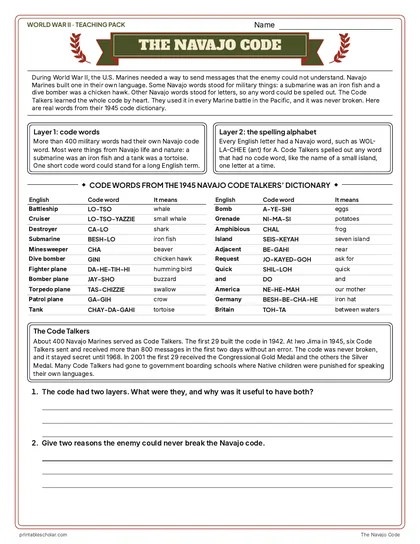
The Navajo Code
How the two layers of the code worked, 22 real code words with their literal meanings, and facts about the Code Talkers.
Download PDF Black and white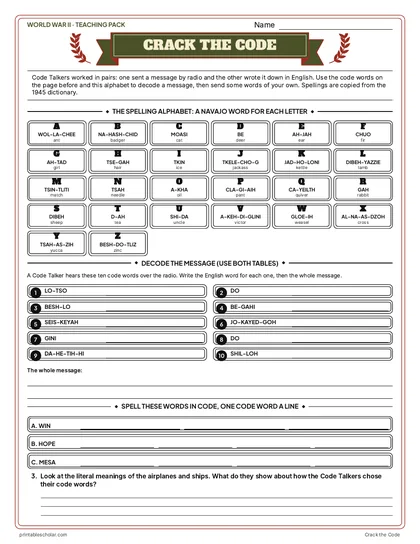
Crack the Code
The full spelling alphabet, a ten-word radio message to decode, three words to spell in code, and a question.
Download PDF Black and white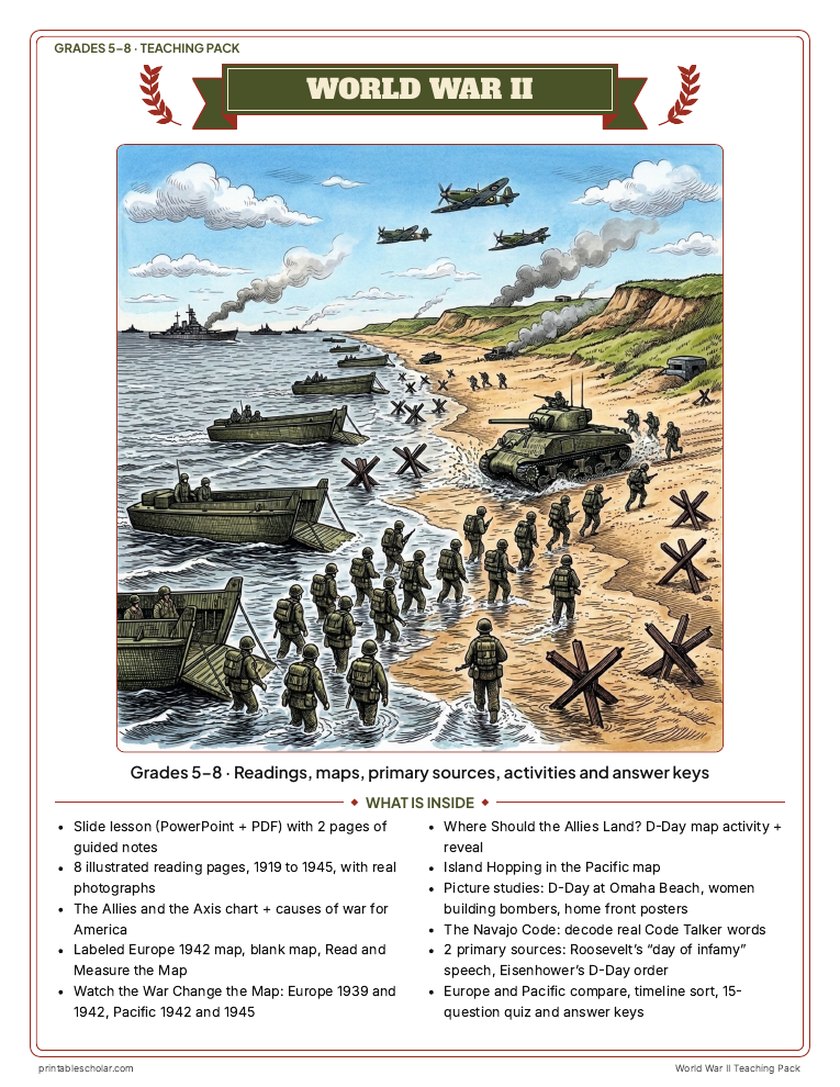
Teaching pack · Grades 5–8
Teaching World War II? The whole unit, ready to teach.
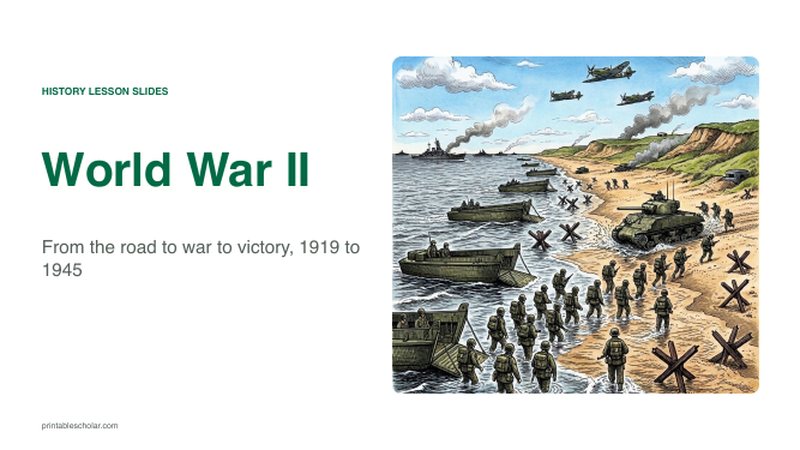
Two weeks of lessons in one download: slides to present, notes for students to fill in, and printable pages that use these maps and pictures.
Every slide comes with teacher notes: what to say, what to ask, and sample answers.
- 56 lesson slides (PowerPoint you can edit) and 2 pages of guided notes
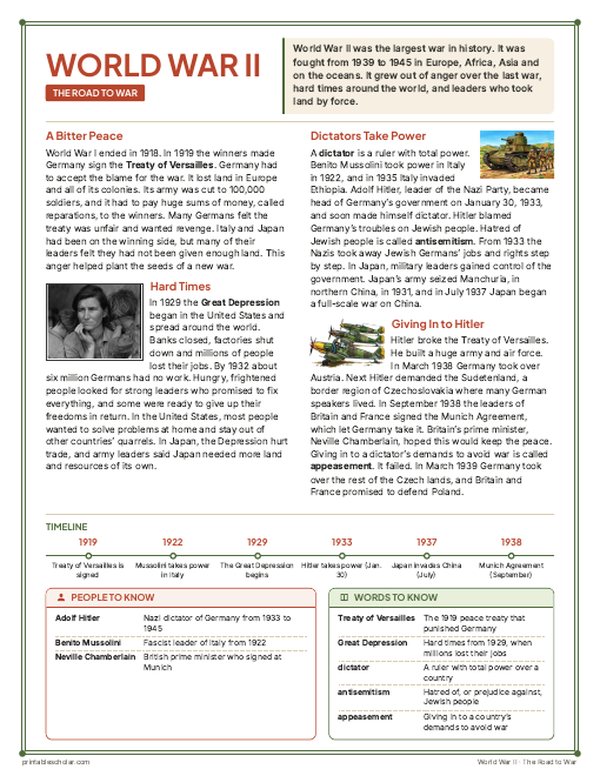
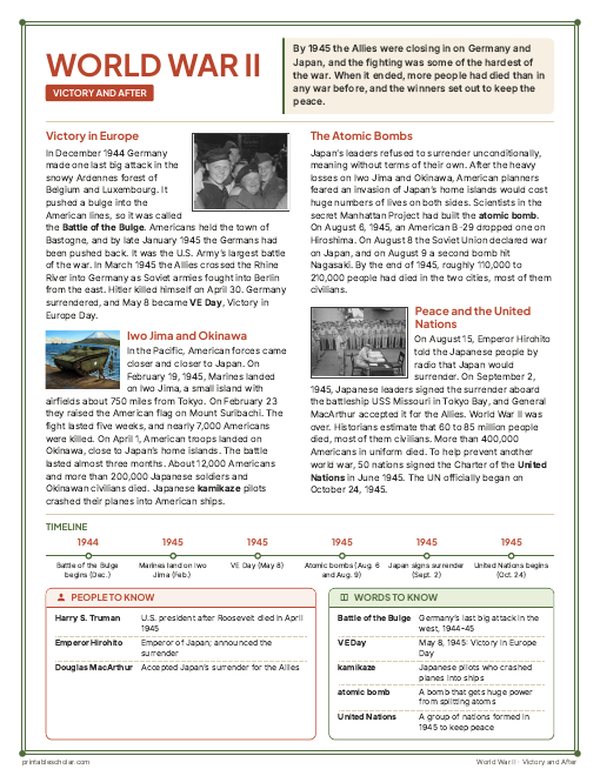
- 8 illustrated reading pages with real photographs, from the Treaty of Versailles to the United Nations, including a plain, respectful page on the Holocaust
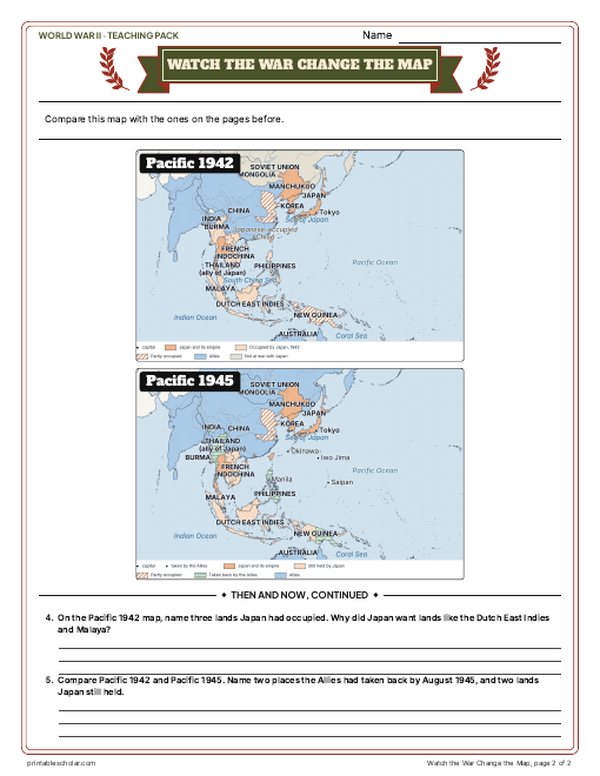
- Maps: labeled and blank Europe 1942, Read and Measure the Map, Watch the War Change the Map (Europe 1939 and 1942, the Pacific 1942 and 1945), Island Hopping in the Pacific, and a "Where should the Allies land?" D-Day decision with the reveal
- Primary sources and picture studies: Roosevelt's "day of infamy" speech and Eisenhower's D-Day order with plain English beside them, the "Into the Jaws of Death" photo, women building bombers, four home front posters, and the Navajo code to decode
- The Allies and the Axis chart, causes of war for America, Europe vs. the Pacific, a timeline sort, a 15-question quiz, a teacher guide with a two-week plan, and answer keys for everything
Every answer is in the pack. The readings, slides, maps and pictures teach everything the sheets and quiz ask, so no textbook is needed.
Get the World War II pack for $7Teaching more than one? Get both world war packs (World War I and World War II) for $12, with a bonus chart comparing the two wars: about four weeks of lessons.
Get both packs for $12See both packsOr get every history pack (26) in one download:Get all 26 for $49
One-time purchase. Instant download. Color and ink-saving black-and-white editions. Secure checkout by Stripe.
The 10-day plan
10 lessons, each planned for one class period of about 45 to 50 minutes, straight from the teacher guide. Some days are fuller than others; the note below shows how to even them out.
- Day 1The road to war and Europe in 1939
- Day 2The Axis advances and the maps of Europe
- Day 3America enters the war and "a date which will live in infamy"
- Day 4The home front, women building bombers and the posters
- Day 5Americans who served and the Navajo code
- Day 6Turning points of 1942 and 1943, then Where should the Allies land?
- Day 7D-Day, Into the Jaws of Death and the reveal
- Day 8The Holocaust, 1933 to 1945
- Day 9Victory and after, and island hopping
- Day 10Europe vs. the Pacific, the timeline sort and the quiz
Fitting it to your schedule: Days 4 and 7 are the fullest and Day 8 the lightest on purpose: the Holocaust reading gets a day of its own with time for questions. With 10 periods, move Posters on the Home Front from Day 4 to Day 5. With 8 periods, give Read and Measure the Map and the causes sheet as homework, fold the Day 2 map sheets into Days 1 and 3, and open the Day 10 review with the timeline sort; keep Day 8 whole.
See the full day-by-day plan
- Day 1
- Reading: The Road to War. Start The Allies and the Axis chart (main countries, leaders, goals). Watch the War Change the Map: the Europe 1939 map only. Slides 3-7.
- Day 2
- Reading: The Axis Advances. Labeled Europe in November 1942 map, then the blank map with the word bank and Read and Measure the Map. Slides 8-11.
- Day 3
- Reading: America Enters the War. Primary source: "A Date Which Will Live in Infamy." Causes of World War II for America sheet. Slides 12-16.
- Day 4
- Reading: The Home Front. Picture studies: Women Build Bombers and Posters on the Home Front. Add strengths to the chart. Slides 17-23.
- Day 5
- Reading: Americans Who Served. The Navajo Code and Crack the Code. Code Talker relay (see the ideas above) as a closing activity. Slides 24-28.
- Day 6
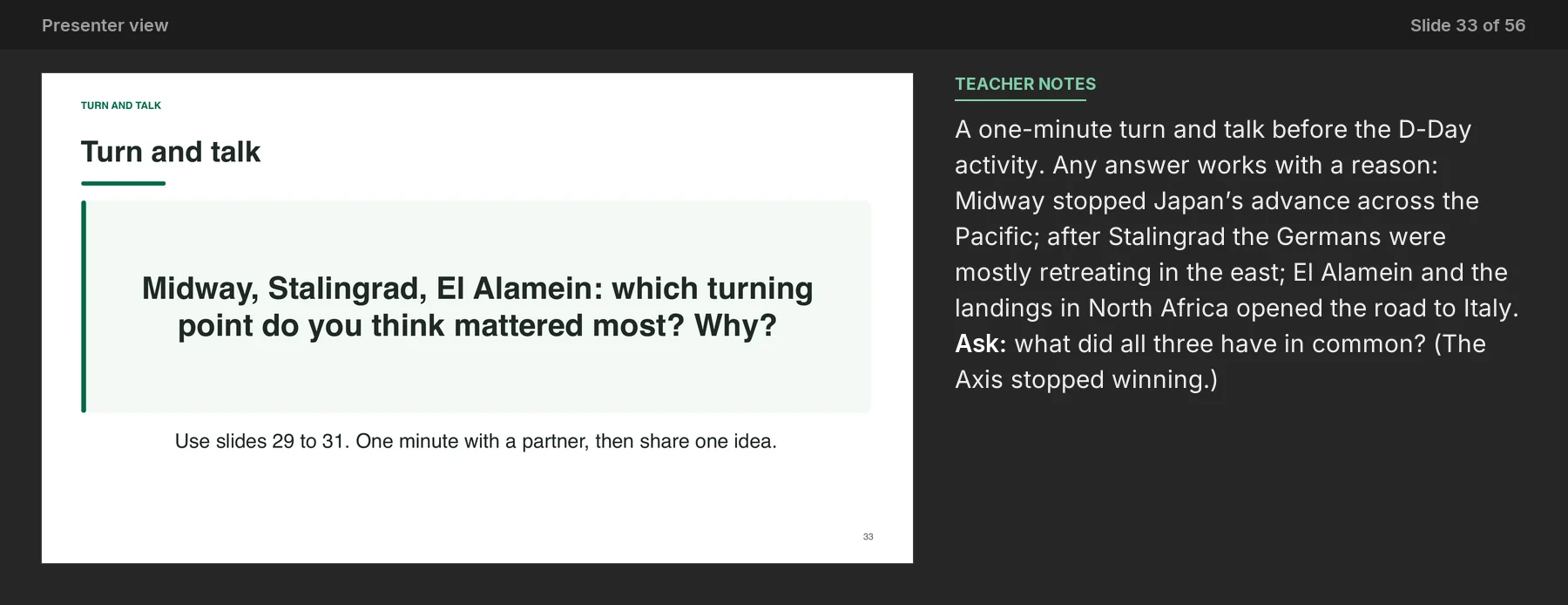
- Slides 29-33: the turning points of 1942 and 1943 (Midway, Stalingrad, North Africa and Italy), none of which gives the landing site away. Then the hook, slide 34: Where Should the Allies Land? Students read the four reports, check the needs and argue for a site. Keep the What Really Happened page for Day 7.
- Day 7
- Reading: Turning Points. Picture study: Into the Jaws of Death. Primary source: Eisenhower's Order of the Day. Reveal: What Really Happened; students compare it with their Day 6 choice. Slides 35-40.
- Day 8
- Reading: The Holocaust, 1933-1945, on its own, with time for students' questions. No other sheet today; a quiet turn and talk on slide 46 closes the day. Slides 41-46.
- Day 9
- Reading: Victory and After. Island Hopping in the Pacific. Finish Watch the War Change the Map (Europe 1942, Pacific 1942, Pacific 1945) and the chart. Slides 47-53.
- Day 10
- The War in Europe and the War in the Pacific compare sheet. Timeline sort. 15-question quiz. Use the answer keys to check every sheet. Slides 54-56.
How the Navajo code worked
Layer 1: code words
More than 400 military terms had their own Navajo code word, most taken from nature and Navajo life: a battleship was a whale (LO-TSO), a submarine an iron fish (BESH-LO), a tank a tortoise (CHAY-DA-GAHI).
Layer 2: the spelling alphabet
Each English letter had one or more Navajo words, such as WOL-LA-CHEE (ant) for A. Code Talkers spelled out names and any word that had no code word. Common letters had extra words so patterns were hard to spot.
Why it was never broken
Navajo had no common written form, it is a complex language, and very few outsiders knew it. The code was learned by heart, and even a Navajo speaker who had not been trained could not follow it.
The Code Talkers
About 400 Navajo Marines served as Code Talkers. The first 29 built the code in 1942. At Iwo Jima six Code Talkers sent and received more than 800 messages without an error. The code stayed secret until 1968; in 2001 the first 29 received the Congressional Gold Medal.
Frequently asked questions
Who were the Navajo Code Talkers?
Navajo Marines who sent and received secret radio messages in a code built on the Navajo language during World War II. About 400 served, starting with 29 recruits in 1942.
Was the Navajo code ever broken?
No. The Japanese never broke it. It used Navajo words with secret military meanings, so even Navajo speakers who were not trained could not understand it.
Where do the words on this sheet come from?
From the Navajo Code Talkers’ Dictionary (U.S. Navy, revised June 15, 1945, now declassified), spelled as printed there. The dictionary writes Navajo with English letters and hyphens, not in modern Navajo spelling.