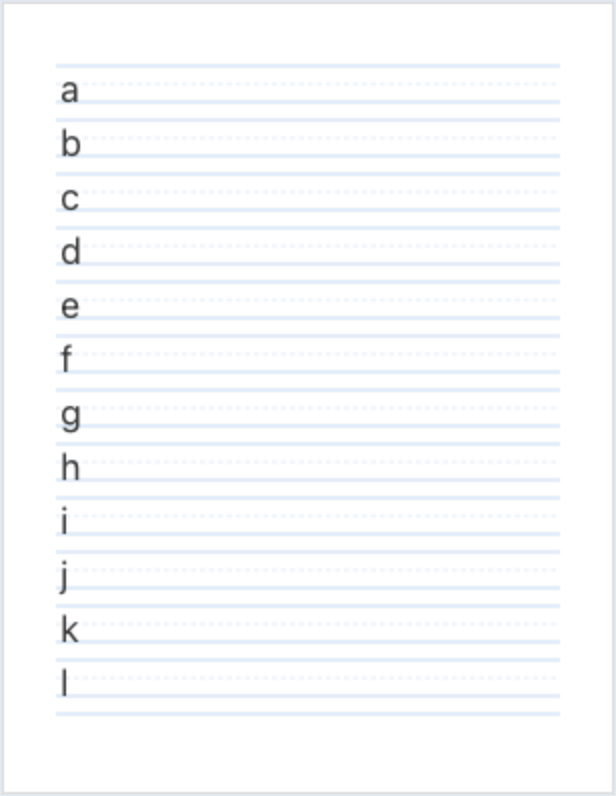
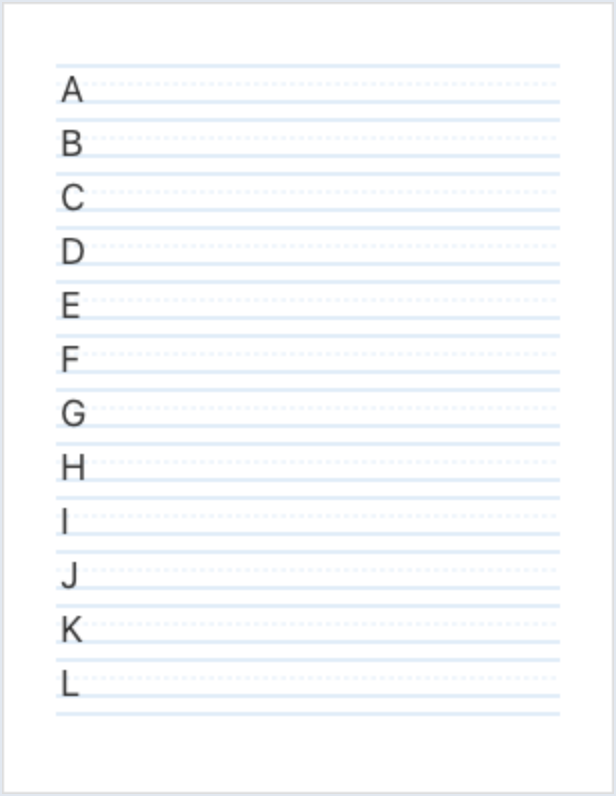
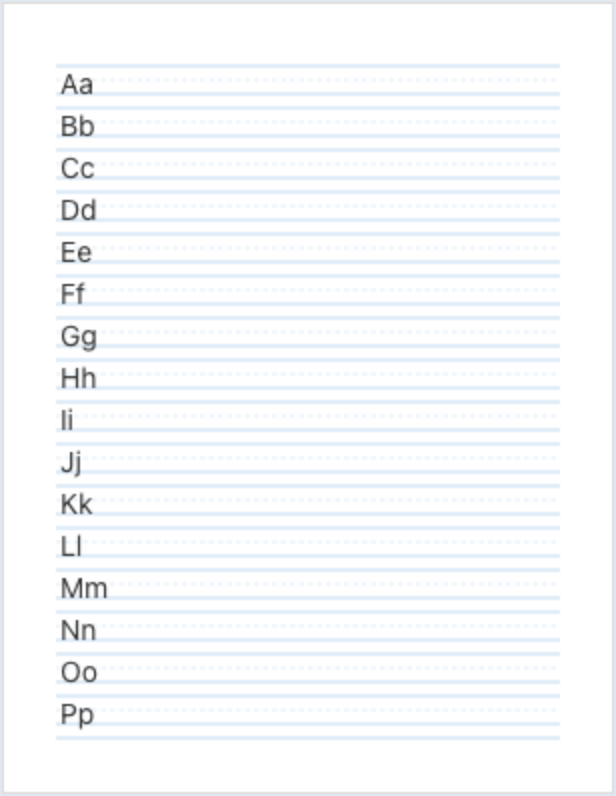
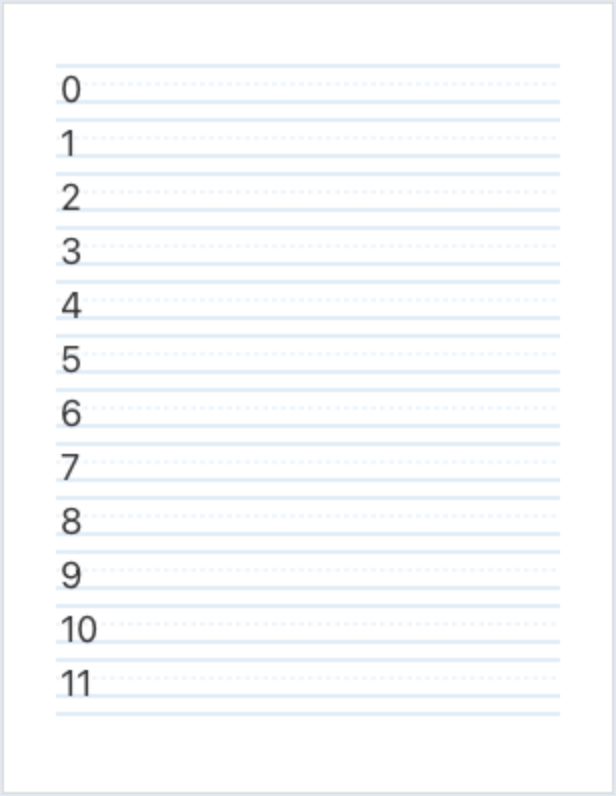
Free printable print (manuscript) handwriting worksheets with block letters and four-line guides. Grab a ready-made PDF below, or make your own with custom text — no sign-up needed.
Ready-Made Print Handwriting PDFs
Print-ready, US Letter, free — no sign-up. Want different letters or your own words? Use the generator below.
Cursive uses Playwrite US Trad, modeled on traditional US school cursive (trace letters use its lighter weight). D'Nealian uses a slanted D'Nealian-style manuscript font with the traditional letter tails. Copperplate uses Lavishly Yours with 52° slant guides — the traditional angle for pointed-pen copperplate. For best results with younger learners, print at full size (100%).
Preview
Generated in your browser. Nothing is uploaded.
Free Cursive Handwriting Practice Sheets & Print Worksheets
Our handwriting worksheet generator creates cursive handwriting practice sheets, print manuscript worksheets, and D'Nealian transitional worksheets that you can download as print-ready PDFs. Whether your student is just learning to form letters or refining their connected cursive, these cursive handwriting worksheets provide the structured practice lines and visual guides that build confident, legible handwriting.
Choose from three handwriting styles: traditional cursive (connected script), print manuscript (block letters), or D'Nealian (a transitional style that eases the shift from print to cursive). Use alphabet mode for letter-by-letter practice, type your own custom sentences, or select from pre-loaded pangrams and motivational phrases. Every worksheet includes four-line writing guides with a top line, dashed midline, solid baseline, and descender line drawn in light blue, just like professional print handwriting worksheets used in classrooms.
Every row starts with a dark example letter so students can see proper formation. Turn on “Trace letters” to add gray letters to trace over before writing independently, which helps beginners and anyone new to cursive. Adjust font size from large (ideal for early learners) to small (for older students refining their hand), and set 4 to 10 lines per page depending on the age group. All worksheets are completely free with no account or watermark required. Looking for more practice tools? Try our tracing worksheets, sight word worksheets, and printable paper generator.
Frequently Asked Questions
Most educators recommend introducing cursive in second or third grade (ages 7-9), after children have developed solid print handwriting skills. However, some programs like D'Nealian introduce transitional letterforms as early as kindergarten to ease the later switch to cursive. The key is that children should have good fine motor control and be comfortable forming print letters before starting cursive.
D'Nealian is a transitional handwriting style designed to bridge the gap between print and cursive. D'Nealian print letters are slightly slanted and include small tails (exit strokes) on most letters, making the transition to connected cursive writing much smoother. Traditional manuscript uses straight, vertical letters without connecting strokes. Many schools use D'Nealian because students only need to learn one basic letter shape that adapts to both styles.
Short, consistent practice sessions are more effective than long, infrequent ones. Most handwriting experts recommend 10 to 15 minutes of focused practice per day, 4 to 5 days per week. Young children (ages 5-7) may benefit from even shorter sessions of 5 to 10 minutes to maintain engagement. The goal is regular repetition without fatigue or frustration.
Cursive instruction varies widely by state and district. After the Common Core standards dropped cursive requirements in 2010, many schools reduced or eliminated cursive instruction. However, there has been a strong reversal: as of 2026, over 20 states have passed laws requiring cursive instruction in elementary schools. Research on the cognitive benefits of handwriting has driven much of this renewed emphasis.
Research consistently shows that handwriting practice improves letter recognition, reading comprehension, memory retention, and fine motor development. Studies have found that handwriting activates brain regions associated with learning more than typing does. For children, the physical act of forming letters reinforces letter-sound connections critical to early literacy. Cursive writing specifically may improve spelling and composition skills because the connected letters encourage thinking in whole words.