 Printable Scholar
States of Matter
Heat and cool a jar of particles and watch them melt, boil, freeze and condense.
How to play
Slide the lever to the right to heat the jar and to the left to cool it. The further you slide it, the faster the heat goes in or out, and it stays where you leave it (the middle is off). Watch the particles: they jiggle in place in a solid, slide around in a liquid and zoom around in a gas. The thermometer shows the real temperature, and the heating curve draws itself as you go. Pick water, dry ice, iron or oxygen above the jar, and press ⟲ to start over with ice.
Things to try
- Heat the ice slowly and watch the thermometer. At what temperature does it stop rising, and for how long?
- Keep heating until the water boils. Which flat part of the heating curve is longer, melting or boiling?
- Turn the heat down while the water is boiling. What is the change called now?
- Look at the particles in each state. What do they do in a solid, a liquid and a gas?
- Try dry ice. What is missing from its heating curve?
- Heat iron until it glows. What colour is it when it melts?
- Start with oxygen gas and cool it until you get liquid oxygen, then solid oxygen.
- Freeze the water again. Do the particles go back into the same pattern?
Teaching states of matter?
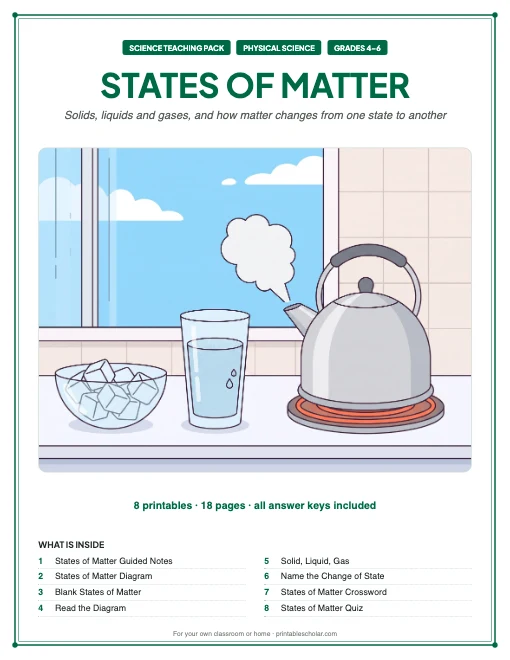
The States of Matter teaching pack has lesson slides, a labeled particle diagram, practice sheets and every answer key for grades 4 to 6. Use this game as the warm-up or the hands-on part. The states of matter diagram and the blank one to label are free.
Questions
What are the three states of matter?
Solid, liquid and gas. In a solid the particles are packed tightly in a pattern and only jiggle in place, so it keeps its shape. In a liquid they are still close together but can slide past each other, so it flows and takes the shape of its container. In a gas they are far apart and move fast in every direction, so a gas spreads out to fill the whole space.
Why does the temperature stop rising while ice melts?
While ice is melting, all the heat goes into breaking the particles free of their pattern, not into making them move faster. So the temperature stays at 0 °C until every bit of ice has melted, and only then starts to rise again. The same thing happens at 100 °C while water boils.
What is a heating curve?
A heating curve is a graph of temperature against time while something is heated steadily. It slopes up while one state warms, and it goes flat during each change of state: once at the melting point and once at the boiling point. The game draws one as you play. For water, the flat part at 100 °C is much longer than the one at 0 °C, because boiling takes about seven times as much energy as melting.
What is the difference between boiling and evaporation?
Both turn a liquid into a gas. Evaporation happens slowly at the surface of a liquid at any temperature, like a puddle drying up. Boiling happens all through the liquid at one temperature, the boiling point, which is 100 °C for water at sea level.
What is sublimation?
Sublimation is when a solid turns straight into a gas without becoming a liquid first. Dry ice (frozen carbon dioxide) does this at −78.5 °C, which is why it makes a smoky fog instead of a puddle. The opposite, a gas turning straight into a solid, is called deposition. Frost forming on a cold window is deposition.
Does iron really melt and boil?
Yes. Iron melts at 1,538 °C and boils at 2,862 °C. As it heats up it glows dull red, then orange, then yellow and white. That is how blacksmiths judge how hot their metal is.
Can oxygen be a liquid?
Yes. Oxygen is a gas at room temperature, but cooled to −183 °C it becomes a pale blue liquid, and at −218.8 °C it freezes into a pale blue solid. Liquid oxygen is used as rocket fuel.
Are the temperatures real?
Yes. Every melting, boiling and sublimation point is the real one at normal air pressure. To fit a lesson the changes of state are sped up, but the flat parts of the heating curve keep their real lengths compared with each other.
Is it really free?
Yes. No sign-up, no ads.