 Printable Scholar
Skate Park Energy
Grab the skater, let go, and watch potential, kinetic and thermal energy change as they roll.
How to play
Grab the skater anywhere on the ramp (or anywhere in the sky above it) and let go. They roll, fly and land with real physics. Watch the energy bars: Potential is the energy of height, Kinetic is the energy of motion, Thermal is heat made by friction and hard landings, and Total is all of it added up. Pick a ramp above the park, and use the buttons under it to turn on friction, change the gravity or swap the fox for the bear. Press ⟲ to start over.
Things to try
- Drop the skater from different heights on the half-pipe. How high do they come back up on the other side?
- Watch the energy bars as the skater rolls. Where is potential energy biggest? Where is kinetic energy biggest?
- Turn friction on. What happens to the Thermal bar, and where does the skater end up?
- Find the lowest drop that gets the skater round the loop. What happens if you start lower?
- Fly off the jump. How high do you need to start to clear the gap and land it?
- Race the bear against the fox from the same height. Who is faster? Who has more energy?
- Skate on the Moon, then on Jupiter. What changes, and what stays the same?
- Drop the skater from high above the ramp. What happens to all that energy when they land?
Teaching energy?
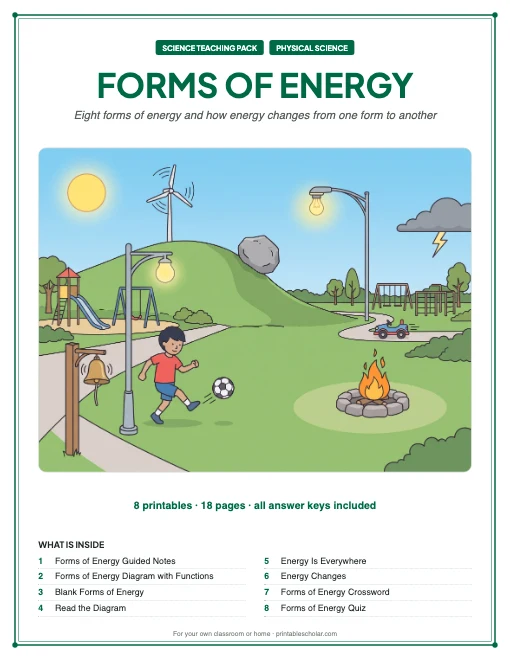
The Forms of Energy teaching pack has lesson slides, a labeled diagram of the forms of energy, practice sheets and every answer key for grades 4 to 6. Use this game as the warm-up or the hands-on part. The forms of energy diagram is free.
Questions
What is the difference between kinetic and potential energy?
Kinetic energy is the energy of motion: the faster something moves, the more it has. Potential energy is stored energy. Here it is gravitational potential energy, the energy of height: the higher the skater is, the more they have. As the skater rolls down, potential energy turns into kinetic energy, and as they roll up the other side it turns back again.
Why can't the skater go higher than where they were dropped?
Because energy can't be made from nothing. At the drop point all of the skater's energy is potential energy. To get higher they would need more potential energy than they started with. With no friction they come back up to exactly the drop height, every time.
Where does the energy go when there is friction?
Friction turns some of the energy into thermal energy (heat) in the wheels and the ramp. The skater comes back up a little lower each time, and the Thermal bar grows by exactly the amount the others lose. In the end the skater stops at the bottom and all of the energy is heat. The total never changes.
Does a heavier skater go faster?
No. Drop the bear and the fox from the same height and they reach the same speed. The bear is about three times heavier, so it has about three times the energy, but it also needs three times the energy to move at the same speed.
What changes on the Moon?
Gravity on the Moon is about one sixth of Earth's, so the skater rolls in slow motion. But they still come back up to the same height, because the height only depends on the energy they started with. On Jupiter gravity is about two and a half times Earth's, so everything happens faster.
How high do you need to start to get round the loop?
Without friction, a skater needs to start at least two and a half times the loop's radius above the bottom of the loop. Any lower and they are not going fast enough at the top, so they fall off. The loop here has a radius of 2.7 m, so the lowest start is about 6.75 m.
What is conservation of energy?
The law of conservation of energy says energy is never made or destroyed, only changed from one form to another. In the skate park it changes between potential, kinetic and thermal energy, and the Total bar always stays the same height.
Are the numbers real?
Yes. Heights are in metres, speeds in metres per second and energy in joules, using real gravity for Earth (9.8 m/s²), the Moon (1.62 m/s²) and Jupiter (24.8 m/s²). The fox weighs 30 kg and the bear 90 kg.
Is it really free?
Yes. No sign-up, no ads.