Academic Vocabulary Words

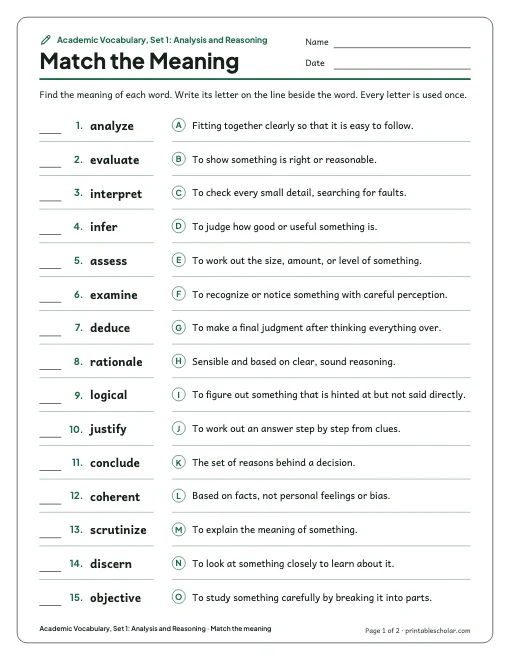
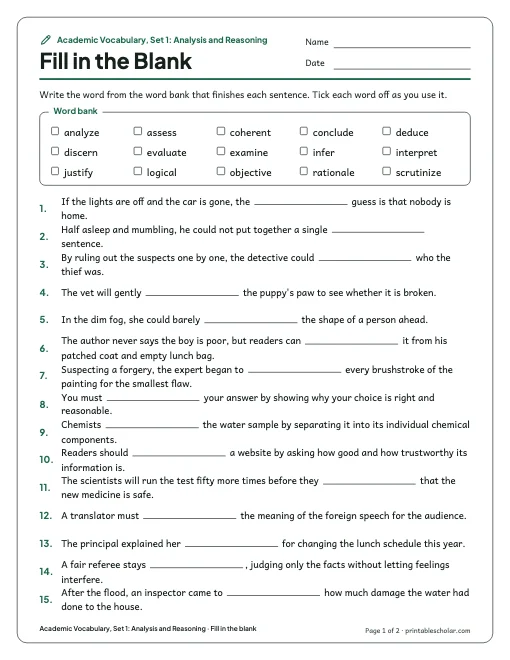
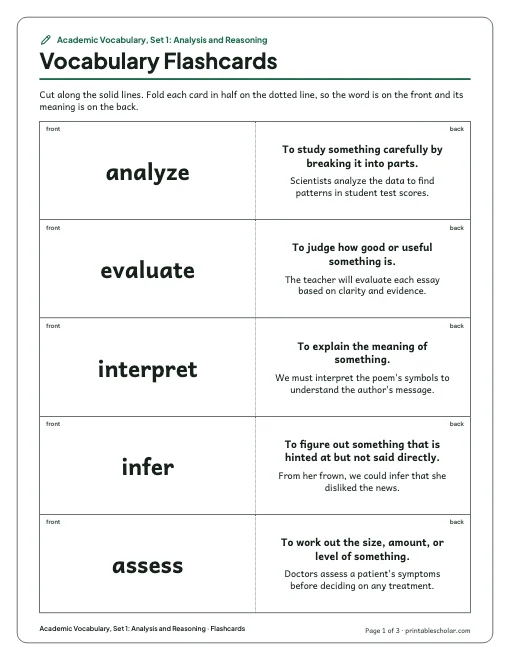
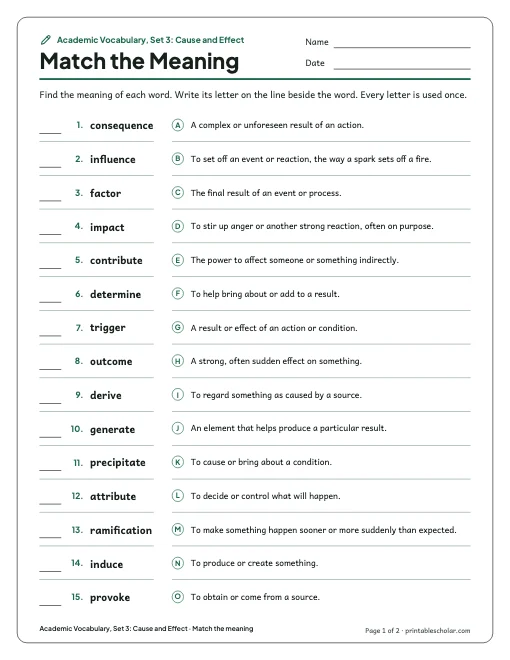
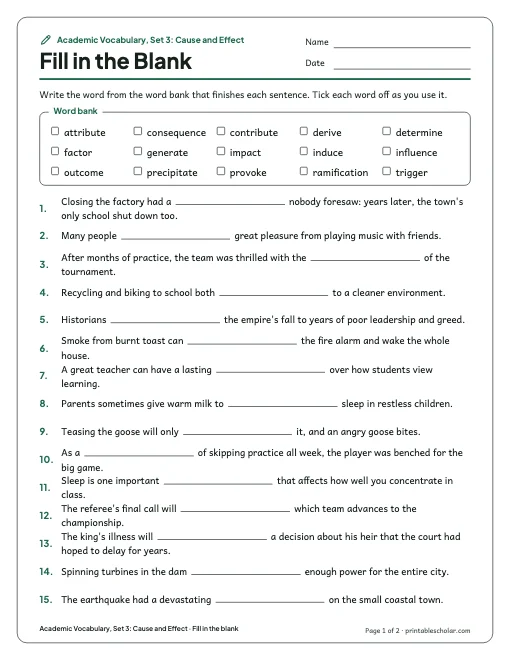
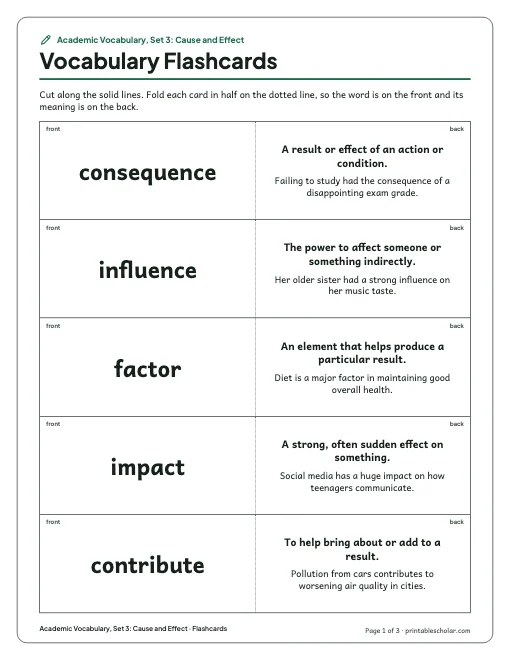
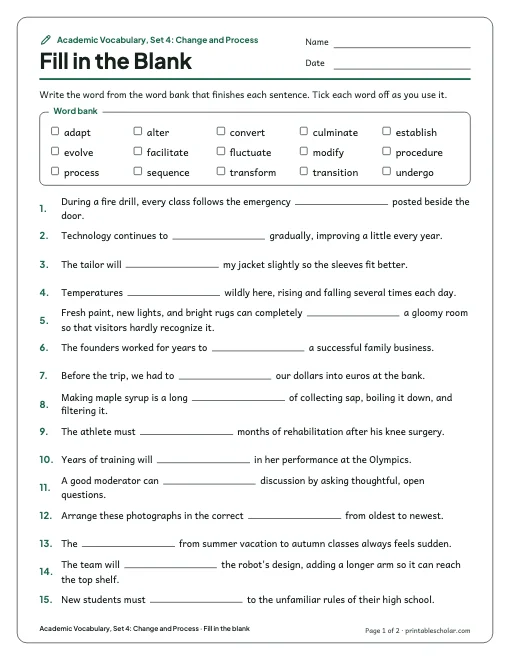
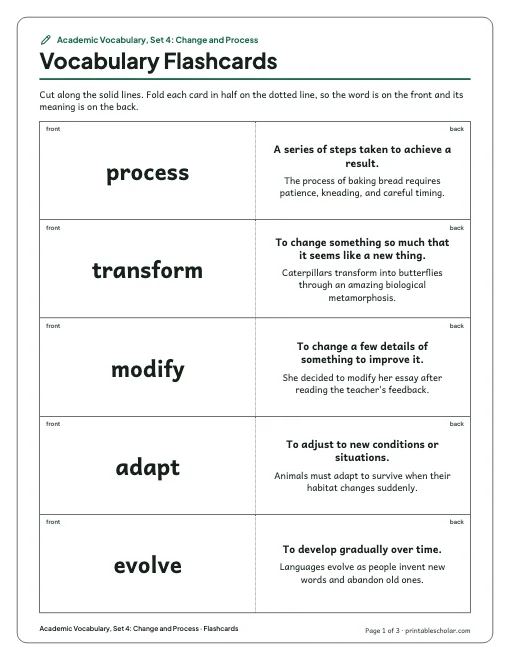
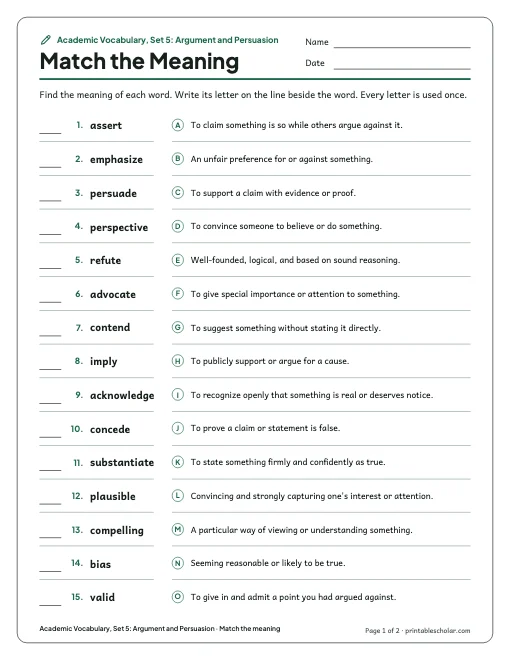
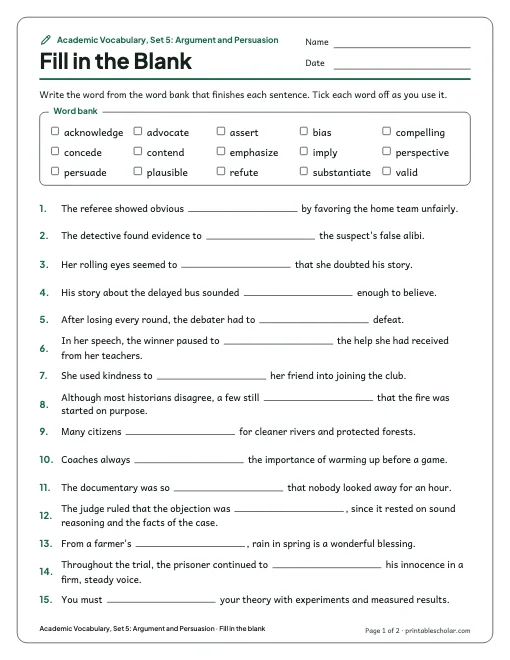
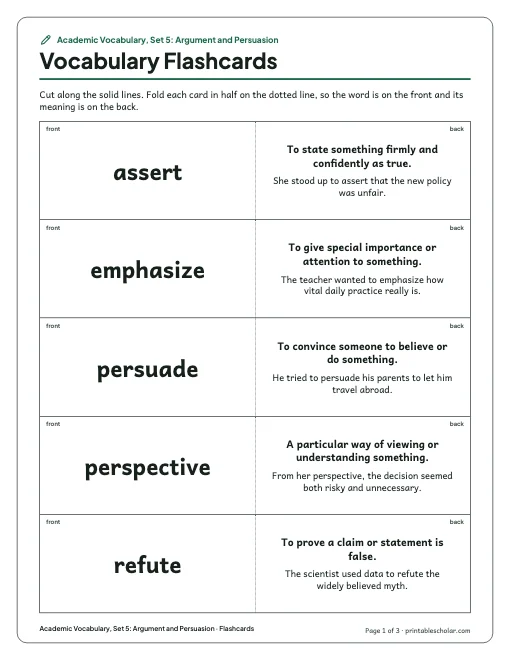
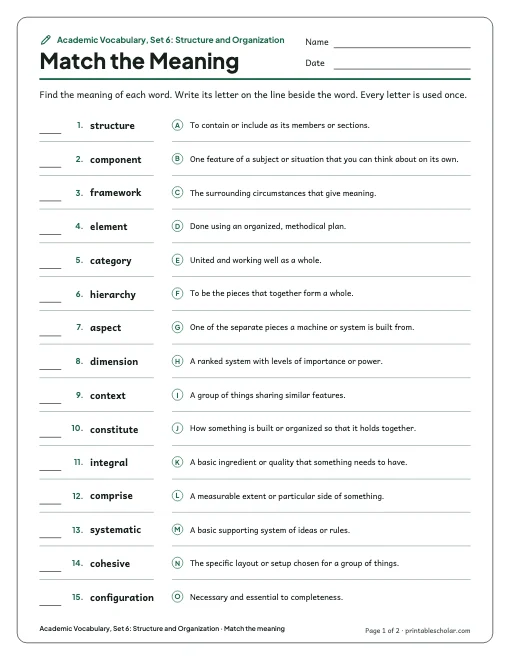
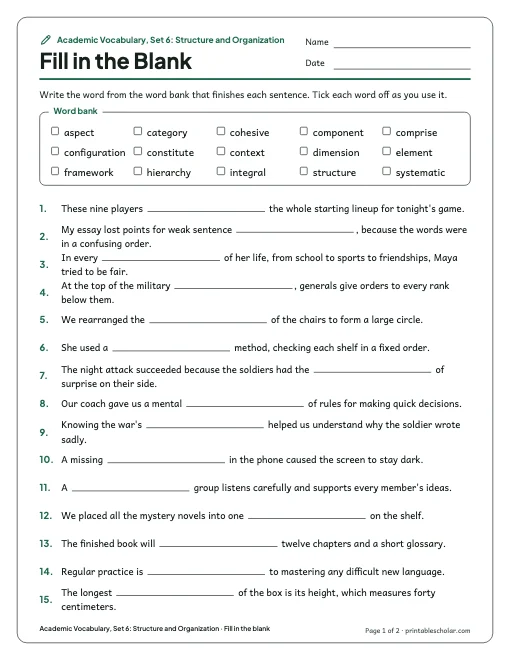
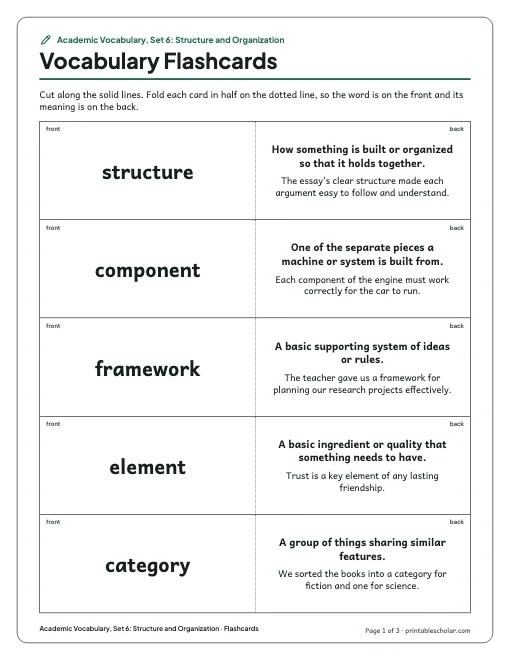
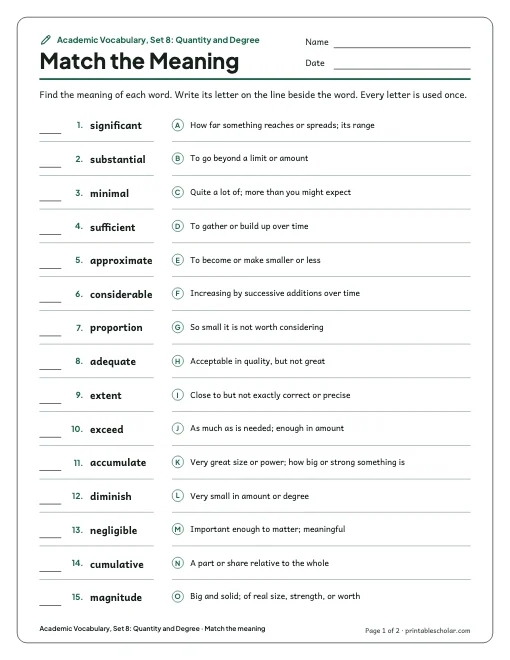
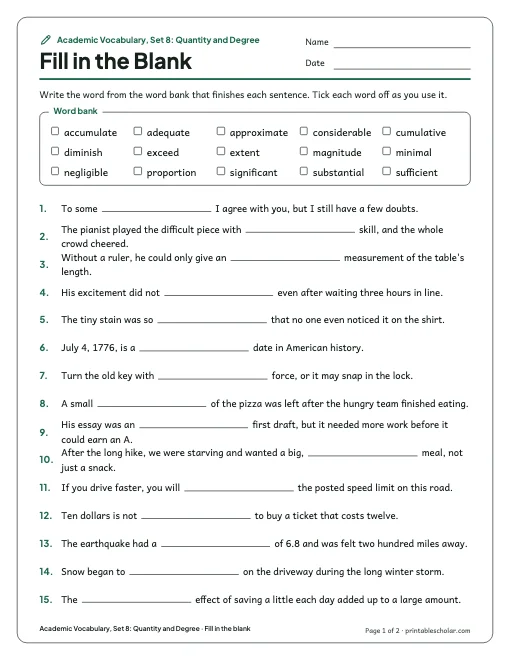
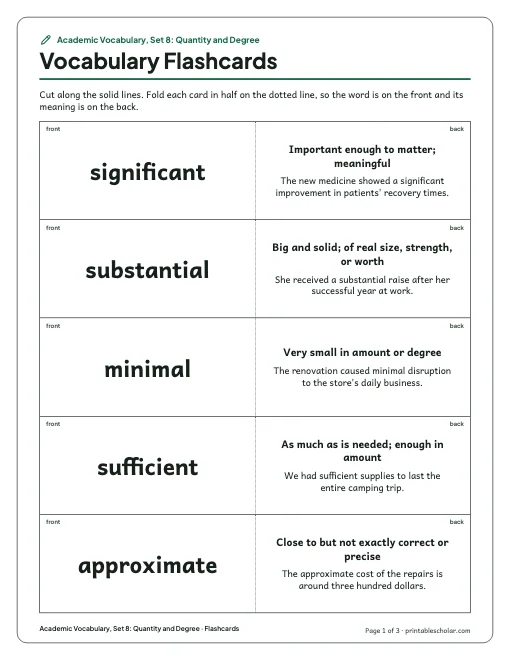
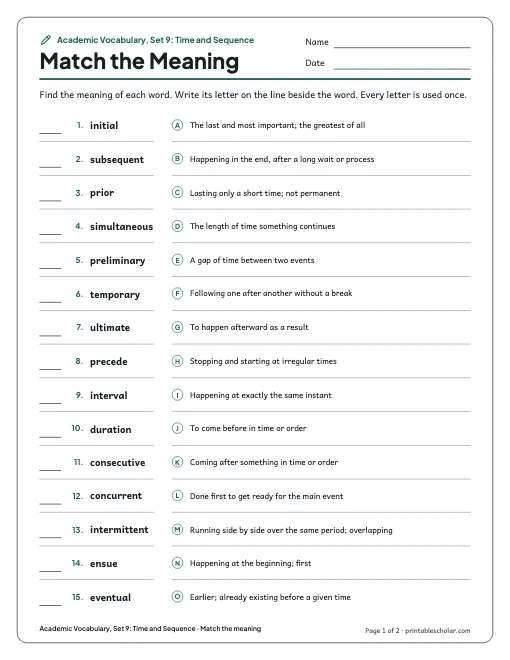
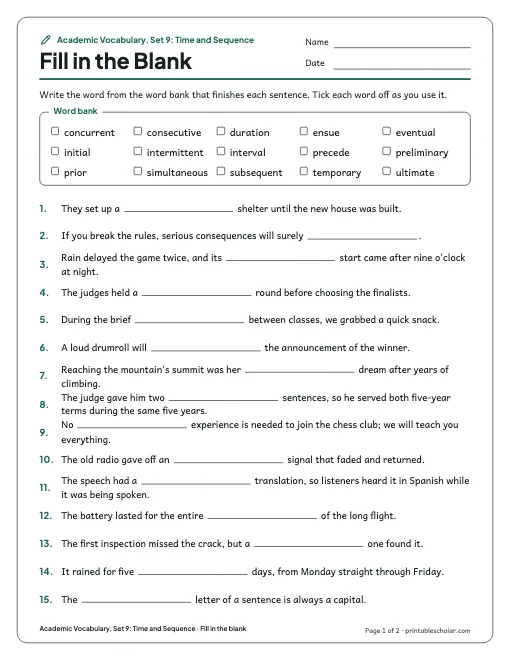
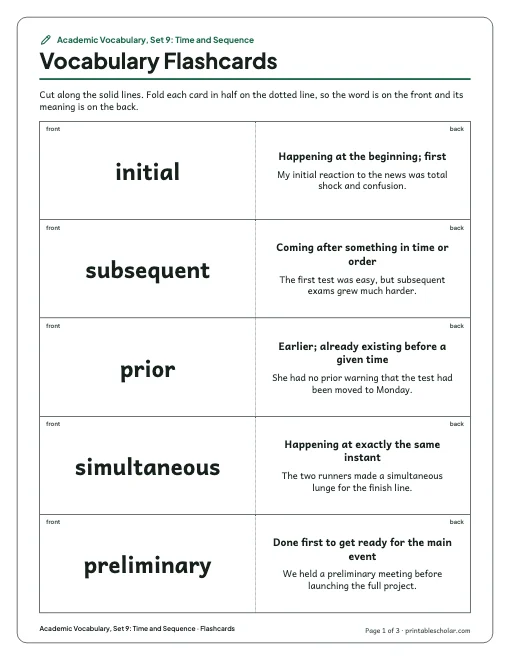
A printable list of academic vocabulary words for middle and high school students (grades 6-12) — the high-utility Tier-2 words students meet across every subject, from science and history to essays and test questions. Every word comes with a clear definition and example sentence, grouped into themed study sets you can print. The words are grouped into 10 themed study sets of about 15. Each set has its own printables built from that set’s words: a word list (with definitions and example sentences), flashcards, and a fill-in-the-blank worksheet.

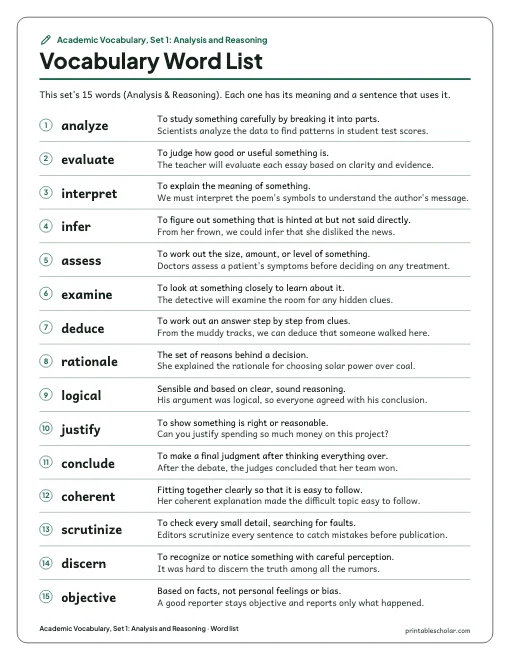
Analysis & Reasoning

15 words
analyze
To study something carefully by breaking it into parts.
“Scientists analyze the data to find patterns in student test scores.”
evaluate
To judge the value or quality of something.
“The teacher will evaluate each essay based on clarity and evidence.”
interpret
To explain the meaning of something.
“We must interpret the poem's symbols to understand the author's message.”
infer
To conclude something using evidence and reasoning.
“From her frown, we could infer that she disliked the news.”
assess
To measure or judge the amount or quality.
“Doctors assess a patient's symptoms before deciding on any treatment.”
examine
To inspect something closely and carefully.
“The detective will examine the room for any hidden clues.”
deduce
To reach a conclusion through careful logical reasoning.
“From the muddy tracks, we can deduce that someone walked here.”
rationale
The reasons or logic behind a decision.
“She explained the rationale for choosing solar power over coal.”
logical
Sensible and based on clear, sound reasoning.
“His argument was logical, so everyone agreed with his conclusion.”
justify
To show something is right or reasonable.
“Can you justify spending so much money on this project?”
conclude
To decide something after considering all the facts.
“After the debate, the judges concluded that her team won.”
coherent
Clear, logical, and well organized.
“Her coherent explanation made the difficult topic easy to follow.”
scrutinize
To examine something very closely and critically.
“Editors scrutinize every sentence to catch mistakes before publication.”
discern
To recognize or notice something with careful perception.
“It was hard to discern the truth among all the rumors.”
objective
Based on facts, not personal feelings or bias.
“A good reporter stays objective and reports only what happened.”

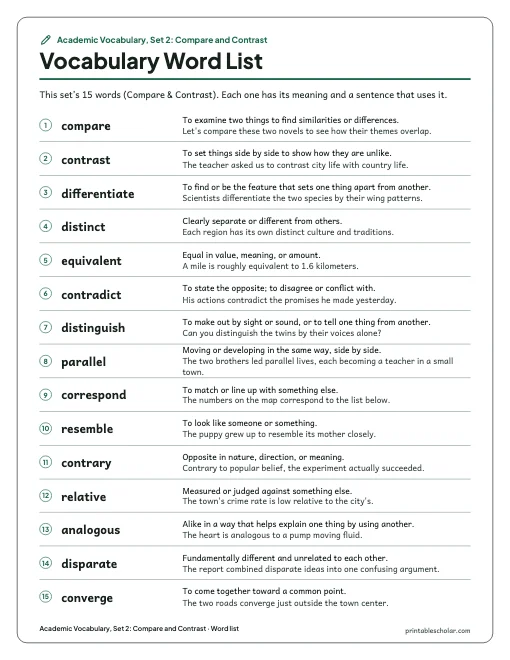
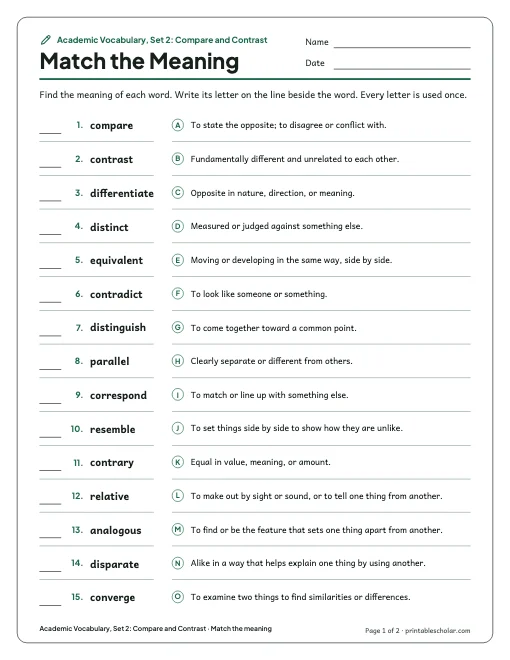
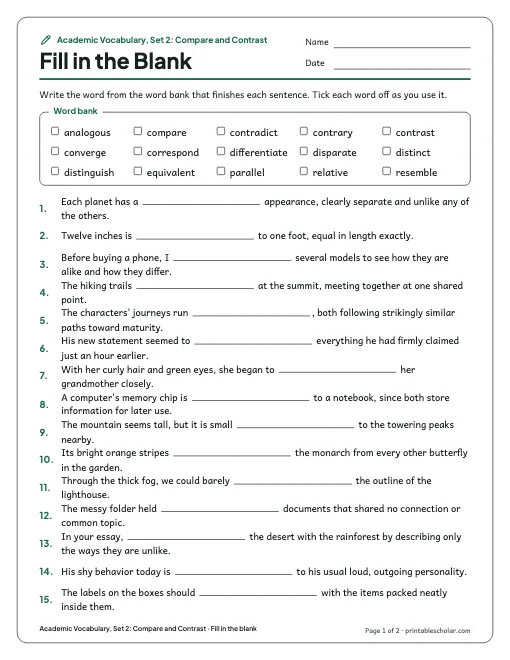
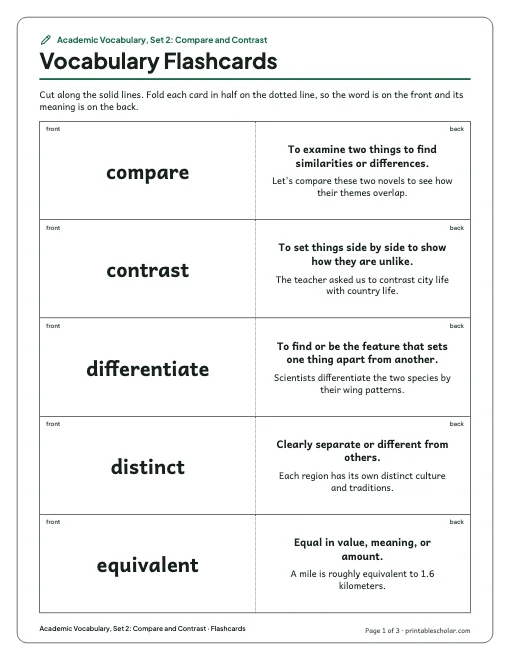
Compare & Contrast

15 words
compare
To examine two things to find similarities or differences.
“Let's compare these two novels to see how their themes overlap.”
contrast
To show differences between two or more things.
“The teacher asked us to contrast city life with country life.”
differentiate
To recognize or show what makes things different.
“Scientists differentiate the two species by their wing patterns.”
distinct
Clearly separate or different from others.
“Each region has its own distinct culture and traditions.”
equivalent
Equal in value, meaning, or amount.
“One dollar is roughly equivalent to a hundred cents.”
contradict
To state the opposite; to disagree or conflict with.
“His actions contradict the promises he made yesterday.”
distinguish
To perceive or point out differences between things.
“Can you distinguish the twins by their voices alone?”
parallel
Similar or corresponding in features or development.
“There is a striking parallel between the two historical events.”
correspond
To match, agree with, or be similar to something.
“The numbers on the map correspond to the list below.”
resemble
To look like or be similar to something.
“The puppy grew up to resemble its mother closely.”
contrary
Opposite in nature, direction, or meaning.
“Contrary to popular belief, the experiment actually succeeded.”
relative
Considered in comparison to something else.
“The town's crime rate is low relative to the city's.”
analogous
Similar in a way that allows comparison.
“The heart is analogous to a pump moving fluid.”
disparate
Fundamentally different and unrelated to each other.
“The report combined disparate ideas into one confusing argument.”
converge
To come together toward a common point.
“The two roads converge just outside the town center.”

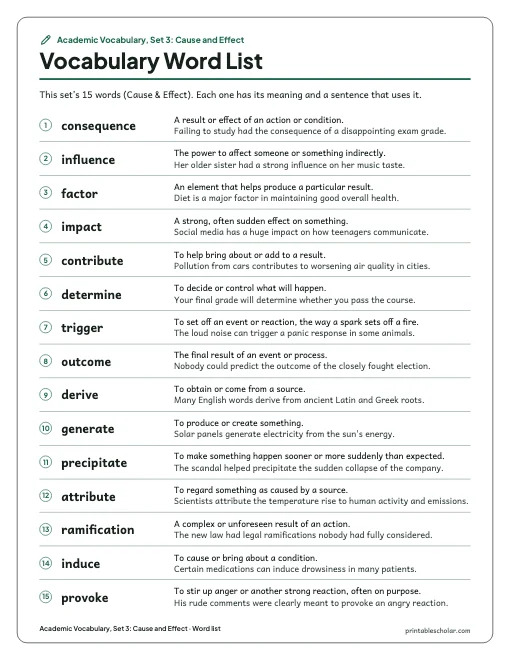
Cause & Effect

15 words
consequence
A result or effect of an action or condition.
“Failing to study had the consequence of a disappointing exam grade.”
influence
The power to affect someone or something indirectly.
“Her older sister had a strong influence on her music taste.”
factor
An element that helps produce a particular result.
“Diet is a major factor in maintaining good overall health.”
impact
A strong effect or influence on something.
“Social media has a huge impact on how teenagers communicate.”
contribute
To help bring about or add to a result.
“Pollution from cars contributes to worsening air quality in cities.”
determine
To decide or control what will happen.
“Your final grade will determine whether you pass the course.”
trigger
To cause something to start happening suddenly.
“The loud noise can trigger a panic response in some animals.”
outcome
The final result of an event or process.
“Nobody could predict the outcome of the closely fought election.”
derive
To obtain or come from a source.
“Many English words derive from ancient Latin and Greek roots.”
generate
To produce or create something.
“Solar panels generate electricity from the sun's energy.”
precipitate
To cause something to happen quickly or suddenly.
“The scandal helped precipitate the sudden collapse of the company.”
attribute
To regard something as caused by a source.
“Scientists attribute the temperature rise to human activity and emissions.”
ramification
A complex or unforeseen result of an action.
“The new law had legal ramifications nobody had fully considered.”
induce
To cause or bring about a condition.
“Certain medications can induce drowsiness in many patients.”
provoke
To stir up a reaction or strong response.
“His rude comments were clearly meant to provoke an angry reaction.”

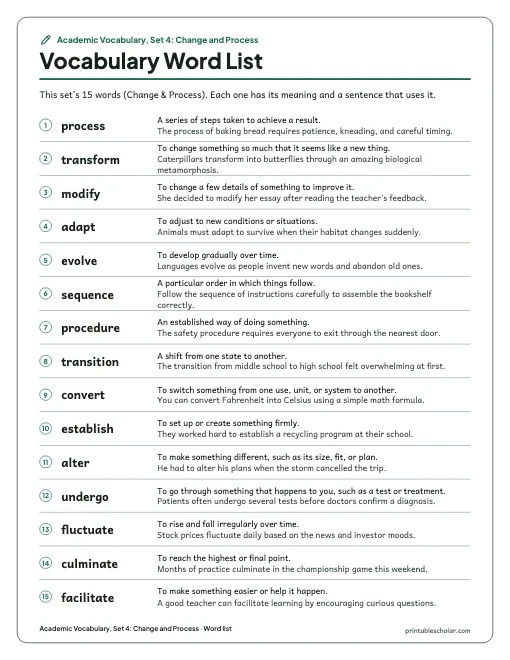
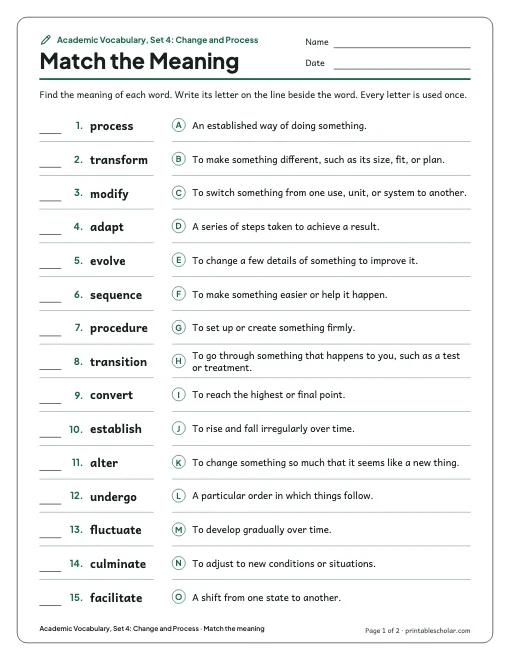
Change & Process

15 words
process
A series of steps taken to achieve a result.
“The process of baking bread requires patience, kneading, and careful timing.”
transform
To change completely in form or appearance.
“Caterpillars transform into butterflies through an amazing biological metamorphosis.”
modify
To make partial changes to something.
“She decided to modify her essay after reading the teacher's feedback.”
adapt
To adjust to new conditions or situations.
“Animals must adapt to survive when their habitat changes suddenly.”
evolve
To develop gradually over time.
“Languages evolve as people invent new words and abandon old ones.”
sequence
A particular order in which things follow.
“Follow the sequence of instructions carefully to assemble the bookshelf correctly.”
procedure
An established way of doing something.
“The safety procedure requires everyone to exit through the nearest door.”
transition
A shift from one state to another.
“The transition from middle school to high school felt overwhelming at first.”
convert
To change something into a different form.
“You can convert Fahrenheit into Celsius using a simple math formula.”
establish
To set up or create something firmly.
“They worked hard to establish a recycling program at their school.”
alter
To make something different without changing it completely.
“He had to alter his plans when the storm cancelled the trip.”
undergo
To experience or endure a change or process.
“Patients often undergo several tests before doctors confirm a diagnosis.”
fluctuate
To rise and fall irregularly over time.
“Stock prices fluctuate daily based on the news and investor moods.”
culminate
To reach the highest or final point.
“Months of practice culminate in the championship game this weekend.”
facilitate
To make something easier or help it happen.
“A good teacher can facilitate learning by encouraging curious questions.”

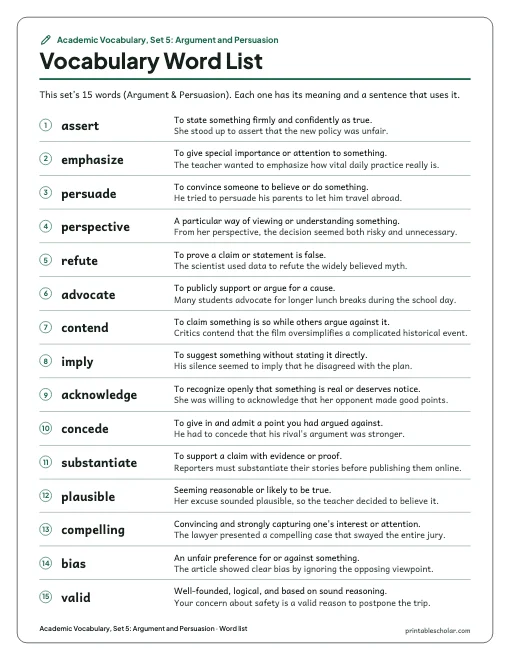
Argument & Persuasion

15 words
assert
To state something firmly and confidently as true.
“She stood up to assert that the new policy was unfair.”
emphasize
To give special importance or attention to something.
“The teacher wanted to emphasize how vital daily practice really is.”
persuade
To convince someone to believe or do something.
“He tried to persuade his parents to let him travel abroad.”
perspective
A particular way of viewing or understanding something.
“From her perspective, the decision seemed both risky and unnecessary.”
refute
To prove a claim or statement is false.
“The scientist used data to refute the widely believed myth.”
advocate
To publicly support or argue for a cause.
“Many students advocate for longer lunch breaks during the school day.”
contend
To argue or assert a position in debate.
“Critics contend that the film oversimplifies a complicated historical event.”
imply
To suggest something without stating it directly.
“His silence seemed to imply that he disagreed with the plan.”
acknowledge
To accept or admit the truth of something.
“She was willing to acknowledge that her opponent made good points.”
concede
To admit something is true, often reluctantly.
“He had to concede that his rival's argument was stronger.”
substantiate
To support a claim with evidence or proof.
“Reporters must substantiate their stories before publishing them online.”
plausible
Seeming reasonable or likely to be true.
“Her excuse sounded plausible, so the teacher decided to believe it.”
compelling
Convincing and strongly capturing one's interest or attention.
“The lawyer presented a compelling case that swayed the entire jury.”
bias
An unfair preference for or against something.
“The article showed clear bias by ignoring the opposing viewpoint.”
valid
Well-founded, logical, and based on sound reasoning.
“Your concern about safety is a valid reason to postpone the trip.”

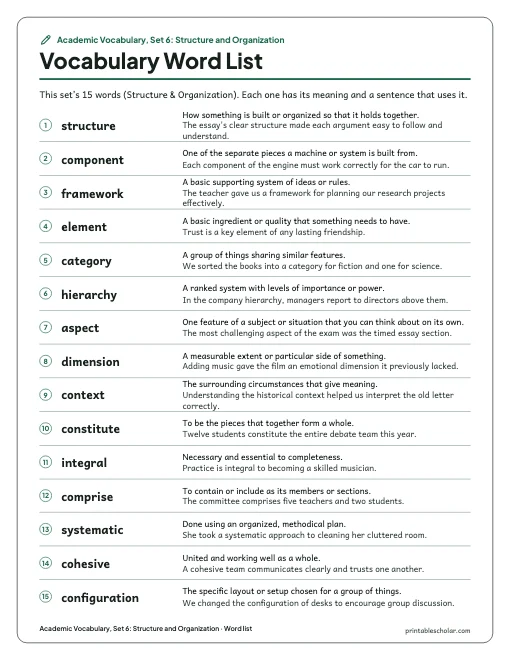
Structure & Organization

15 words
structure
The way parts are arranged or built together.
“The essay's clear structure made each argument easy to follow and understand.”
component
One individual part of a larger whole.
“Each component of the engine must work correctly for the car to run.”
framework
A basic supporting system of ideas or rules.
“The teacher gave us a framework for planning our research projects effectively.”
element
A basic or essential part of something.
“Trust is a key element of any lasting friendship.”
category
A group of things sharing similar features.
“We sorted the books into a category for fiction and one for science.”
hierarchy
A ranked system with levels of importance or power.
“In the company hierarchy, managers report to directors above them.”
aspect
A particular part or feature of something.
“The most challenging aspect of the exam was the timed essay section.”
dimension
A measurable extent or particular side of something.
“Adding music gave the film an emotional dimension it previously lacked.”
context
The surrounding circumstances that give meaning.
“Understanding the historical context helped us interpret the old letter correctly.”
constitute
To form or make up something as parts.
“Twelve students constitute the entire debate team this year.”
integral
Necessary and essential to completeness.
“Practice is integral to becoming a skilled musician.”
comprise
To consist of or be made up of.
“The committee comprises five teachers and two students.”
systematic
Done using an organized, methodical plan.
“She took a systematic approach to cleaning her cluttered room.”
cohesive
United and working well as a whole.
“A cohesive team communicates clearly and trusts one another.”
configuration
The particular arrangement of parts or settings.
“We changed the configuration of desks to encourage group discussion.”

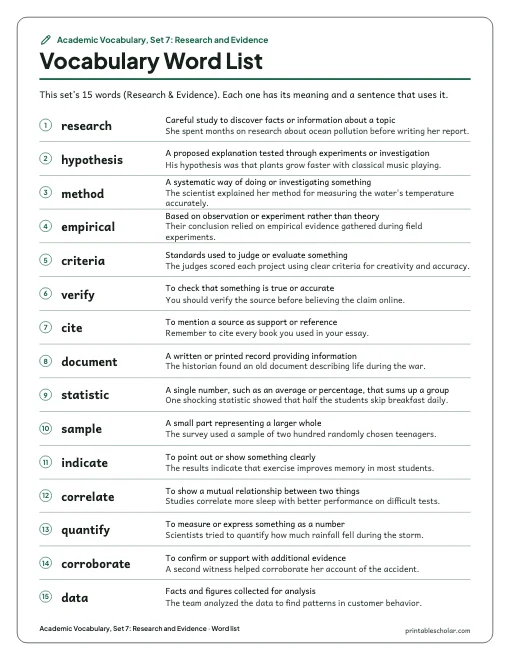
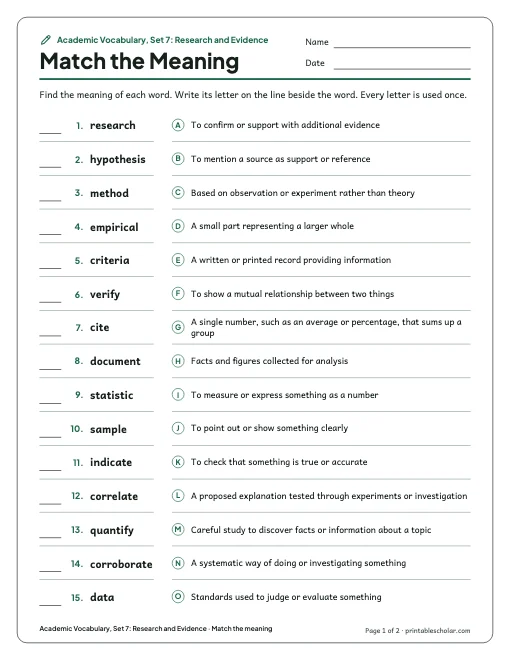
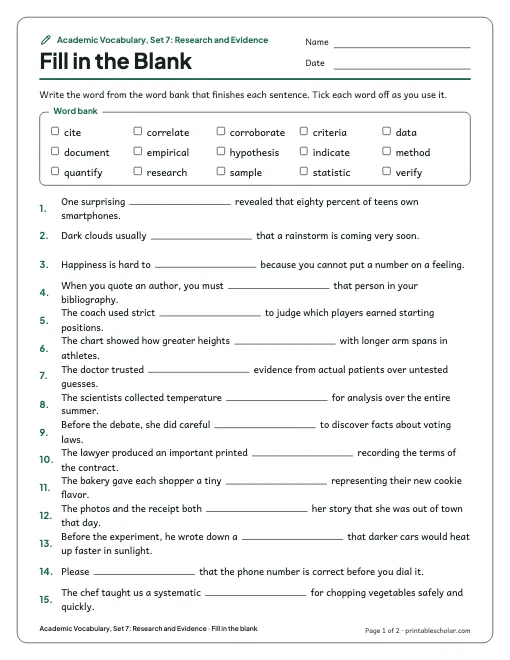
Research & Evidence

15 words
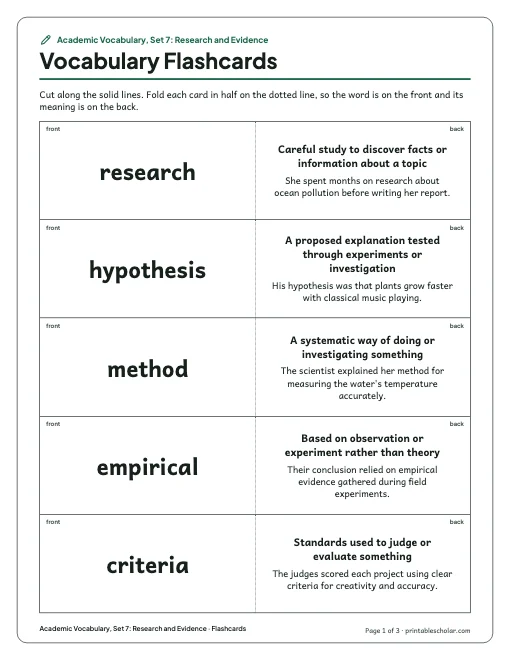
research
careful study to discover facts or information about a topic
“She spent months on research about ocean pollution before writing her report.”
hypothesis
a proposed explanation tested through experiments or investigation
“His hypothesis was that plants grow faster with classical music playing.”
method
a systematic way of doing or investigating something
“The scientist explained her method for measuring the water's temperature accurately.”
empirical
based on observation or experiment rather than theory
“Their conclusion relied on empirical evidence gathered during field experiments.”
criteria
standards used to judge or evaluate something
“The judges scored each project using clear criteria for creativity and accuracy.”
verify
to check that something is true or accurate
“You should verify the source before believing the claim online.”
cite
to mention a source as support or reference
“Remember to cite every book you used in your essay.”
document
a written or printed record providing information
“The historian found an old document describing life during the war.”
statistic
a numerical fact collected from studying data
“One shocking statistic showed that half the students skip breakfast daily.”
sample
a small part representing a larger whole
“The survey used a sample of two hundred randomly chosen teenagers.”
indicate
to point out or show something clearly
“The results indicate that exercise improves memory in most students.”
correlate
to show a mutual relationship between two things
“Studies correlate more sleep with better performance on difficult tests.”
quantify
to measure or express something as a number
“Scientists tried to quantify how much rainfall fell during the storm.”
corroborate
to confirm or support with additional evidence
“A second witness helped corroborate her account of the accident.”
data
facts and figures collected for analysis
“The team analyzed the data to find patterns in customer behavior.”

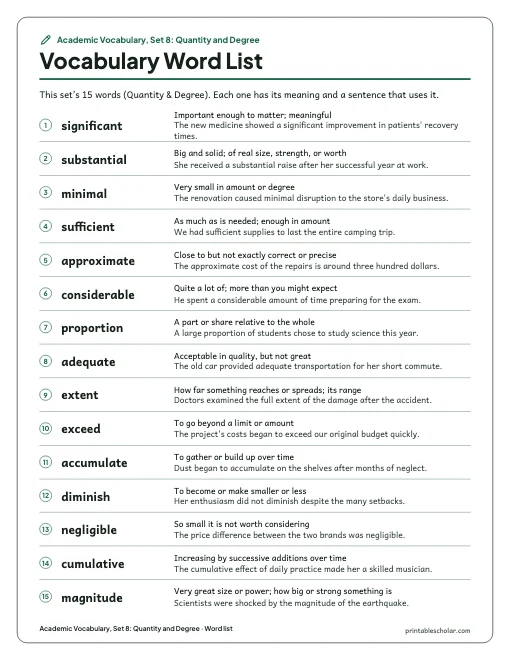
Quantity & Degree

15 words
significant
large or important enough to be noticed or matter
“The new medicine showed a significant improvement in patients' recovery times.”
substantial
large in size, amount, or importance
“She received a substantial raise after her successful year at work.”
minimal
very small in amount or degree
“The renovation caused minimal disruption to the store's daily business.”
sufficient
enough for a particular purpose or need
“We had sufficient supplies to last the entire camping trip.”
approximate
close to but not exactly correct or precise
“The approximate cost of the repairs is around three hundred dollars.”
considerable
fairly large in size, amount, or degree
“He spent a considerable amount of time preparing for the exam.”
proportion
a part or share relative to the whole
“A large proportion of students chose to study science this year.”
adequate
good enough or acceptable for a purpose
“The old car provided adequate transportation for her short commute.”
extent
the size, scope, or degree of something
“Doctors examined the full extent of the damage after the accident.”
exceed
to go beyond a limit or amount
“The project's costs began to exceed our original budget quickly.”
accumulate
to gather or build up over time
“Dust began to accumulate on the shelves after months of neglect.”
diminish
to become or make smaller or less
“Her enthusiasm did not diminish despite the many setbacks.”
negligible
so small it is not worth considering
“The price difference between the two brands was negligible.”
cumulative
increasing by successive additions over time
“The cumulative effect of daily practice made her a skilled musician.”
magnitude
the great size, importance, or extent of something
“Scientists were shocked by the magnitude of the earthquake.”

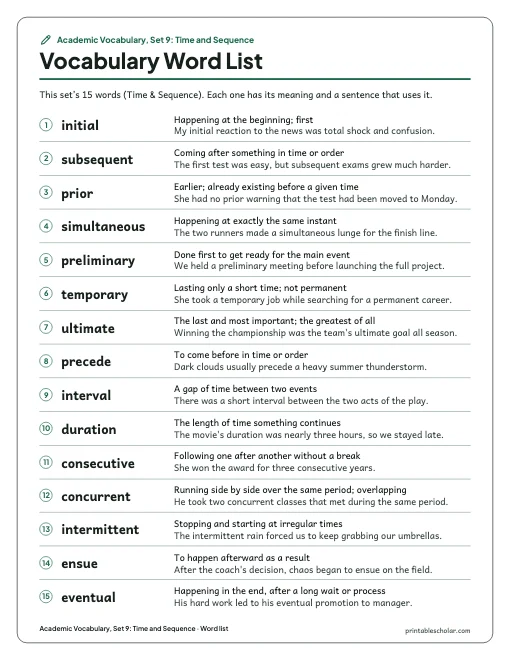
Time & Sequence

15 words
initial
happening at the beginning; first
“My initial reaction to the news was total shock and confusion.”
subsequent
coming after something in time or order
“The first test was easy, but subsequent exams grew much harder.”
prior
existing or occurring before something else
“You must finish your homework prior to watching any television tonight.”
simultaneous
happening at the same moment
“The two runners crossed the finish line in a simultaneous tie.”
preliminary
coming before the main part; introductory
“We held a preliminary meeting before launching the full project.”
temporary
lasting only a short time; not permanent
“She took a temporary job while searching for a permanent career.”
ultimate
final or last in a series
“Winning the championship was the team's ultimate goal all season.”
precede
to come before in time or order
“Dark clouds usually precede a heavy summer thunderstorm.”
interval
a gap of time between two events
“There was a short interval between the two acts of the play.”
duration
the length of time something continues
“The movie's duration was nearly three hours, so we stayed late.”
consecutive
following one after another without a break
“She won the award for three consecutive years in a row.”
concurrent
occurring or existing at the same time
“He took two concurrent classes that met during the same period.”
intermittent
stopping and starting at irregular times
“The intermittent rain forced us to keep grabbing our umbrellas.”
ensue
to happen afterward as a result
“After the coach's decision, chaos began to ensue on the field.”
eventual
happening at some later, final time
“His hard work led to his eventual promotion to manager.”

Communication & Explanation

15 words
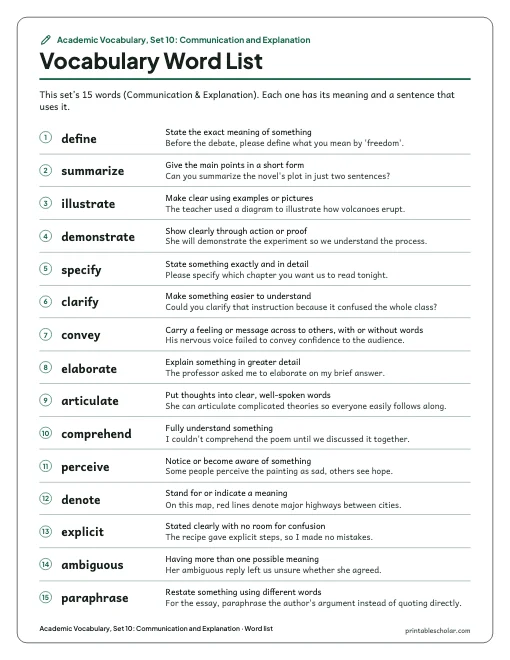
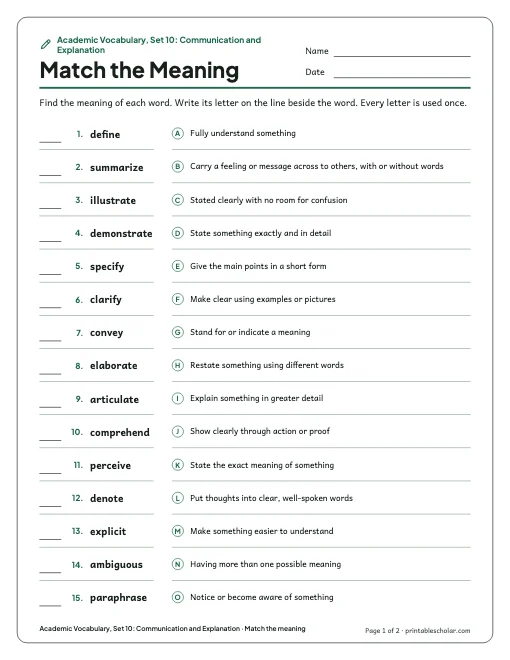
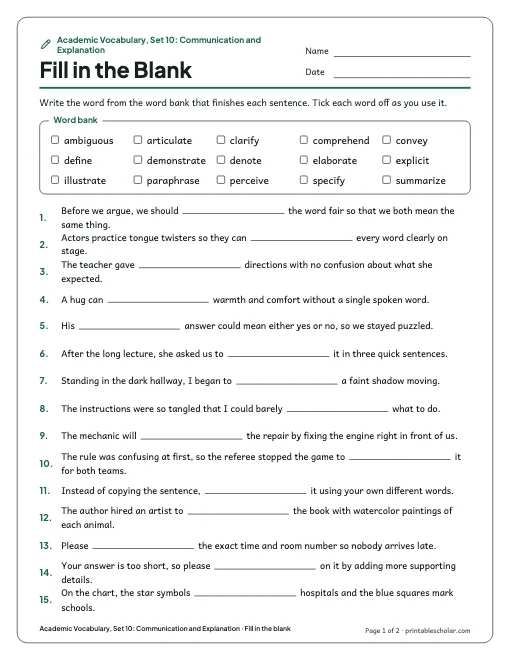
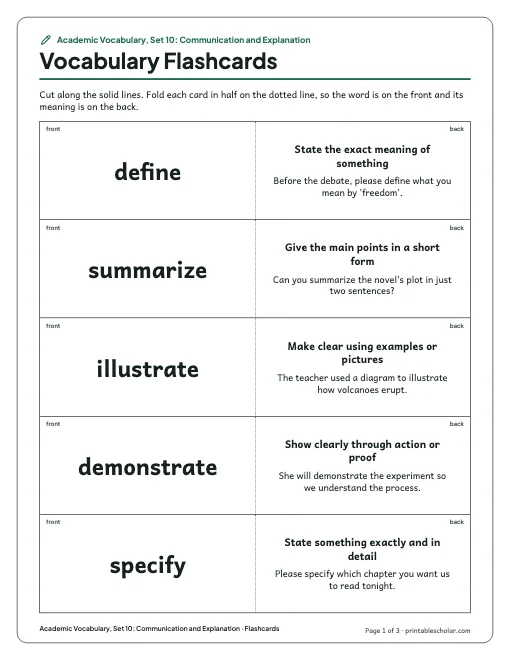
define
State the exact meaning of something
“Before the debate, please define what you mean by 'freedom'.”
summarize
Give the main points in a short form
“Can you summarize the novel's plot in just two sentences?”
illustrate
Make clear using examples or pictures
“The teacher used a diagram to illustrate how volcanoes erupt.”
demonstrate
Show clearly through action or proof
“She will demonstrate the experiment so we understand the process.”
specify
State something exactly and in detail
“Please specify which chapter you want us to read tonight.”
clarify
Make something easier to understand
“Could you clarify that instruction because it confused the whole class?”
convey
Communicate an idea or feeling to others
“His nervous voice failed to convey confidence to the audience.”
elaborate
Explain something in greater detail
“The professor asked me to elaborate on my brief answer.”
articulate
Express ideas clearly and effectively
“She can articulate complicated theories so everyone easily follows along.”
comprehend
Fully understand something
“I couldn't comprehend the poem until we discussed it together.”
perceive
Notice or become aware of something
“Some people perceive the painting as sad, others see hope.”
denote
Stand for or indicate a meaning
“On this map, red lines denote major highways between cities.”
explicit
Stated clearly with no room for confusion
“The recipe gave explicit steps, so I made no mistakes.”
ambiguous
Having more than one possible meaning
“Her ambiguous reply left us unsure whether she agreed.”
paraphrase
Restate something using different words
“For the essay, paraphrase the author's argument instead of quoting directly.”

Frequently Asked Questions

What grade level are these vocabulary words?

These academic (Tier-2) words are aimed at grades 6-12 — middle school, high school, and SAT/ACT prep. They are grouped by theme rather than by grade because the same high-utility words appear across every upper-grade subject. Younger, advanced readers can start with the easier sets.

What are academic vocabulary words?

Academic vocabulary (often called Tier-2 words) are the high-utility words that show up across every subject — reading, science, history, and test questions — like analyze, significant, and infer. Learning them helps students understand instructions, textbooks, and exam prompts in every class.

Are these good for SAT or ACT prep?

Yes. Many academic (Tier-2) words overlap with the vocabulary tested on the SAT and ACT, which now assess word meaning in context rather than rote memorized lists. These sets build the cross-subject vocabulary that context questions rely on.

How are the words organized?

The words are grouped into themed study sets — analysis, cause and effect, argument, and more — so related words are learned together. Each set has about 15 words with a definition, an example sentence, and a fill-in-the-blank worksheet.

Do these vocabulary words come with definitions?

Yes — every word has a clear definition and an example sentence on the printable word list and flashcards, so students learn what each word means and how to use it, not just how to recognize it.

More word study printables

Looking for grade-level lists? See our spelling words by grade (2nd–6th), or build fluency with sight words and phonics worksheets.