 Printable Scholar
Wisconsin State Report Kit
Everything a student needs to research and write a report on Wisconsin: the reading, the maps and the pages to fill in. Nothing else to look up.
- 3 reading pages: Wisconsin fun facts, History, and Land and Work
- 5 maps: landmarks, cities, county, outline, and rivers and lakes
- An 8-page My State Report booklet, from fast facts to a trip plan and a license plate to design
- A pennant to cut out and hang, two map skills sheets and a 10-question reading quiz
- Answer keys for the quiz, the fast facts and the map sheets
- One print-ready PDF, 23 pages, black and white, US Letter
Teaching all 50 states? Get every kit for $39.
Look inside
Read it, map it, write it.
The reading pages and maps hold every answer the booklet asks for. About one third of the booklet is looking things up. The rest asks students to choose, plan and explain.

What is in the Wisconsin kit
To read and study
- Wisconsin fun facts: six short true stories, By the Numbers and Did You Know
- History: the state’s story in order, with a timeline, people to know and words to know
- Land and Work: the land and climate, what the state grows, makes and mines, and how one leads to the other
- Five maps, including a rivers, lakes and neighbors map with a letter key
To fill in and make
- My State Report booklet: cover, Fast Facts, My Map, State Symbols, My Trip, Think Like a Geographer, Design a License Plate and Dig Deeper
- A pennant with the state’s name and outline, to color, cut out and hang
- Name the Cities and Name the Rivers and Lakes sheets, each with a word bank
- A 10-question reading quiz, with answer keys for everything that has one right answer
Free: the Wisconsin History reading page
One page on the history of Wisconsin for grades 3 to 5, free to print in color or black and white. It is the second reading page in the kit.
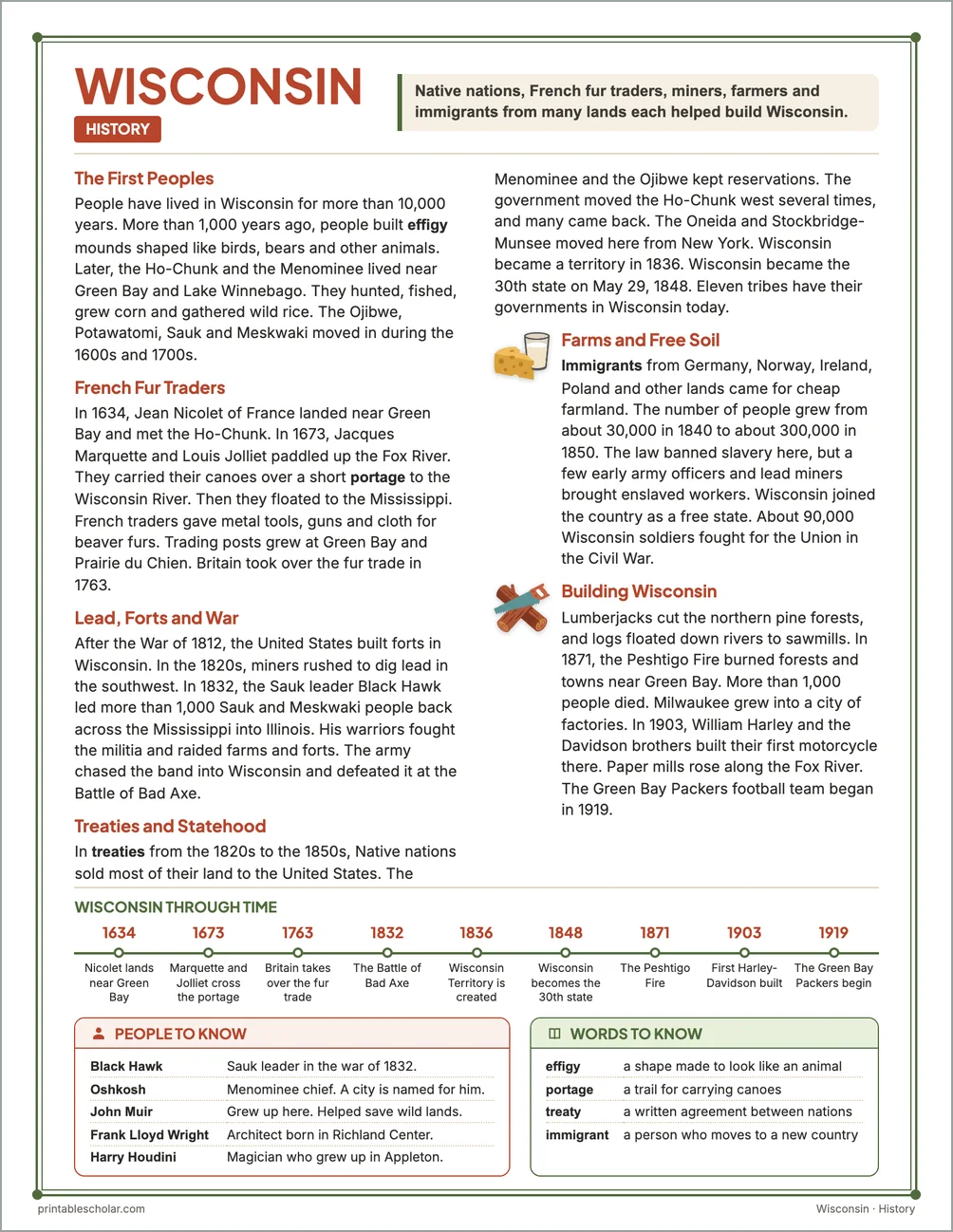
The First Peoples
People have lived in Wisconsin for more than 10,000 years. More than 1,000 years ago, people built effigy mounds shaped like birds, bears and other animals. Later, the Ho-Chunk and the Menominee lived near Green Bay and Lake Winnebago. They hunted, fished, grew corn and gathered wild rice. The Ojibwe, Potawatomi, Sauk and Meskwaki moved in during the 1600s and 1700s.
French Fur Traders
In 1634, Jean Nicolet of France landed near Green Bay and met the Ho-Chunk. In 1673, Jacques Marquette and Louis Jolliet paddled up the Fox River. They carried their canoes over a short portage to the Wisconsin River. Then they floated to the Mississippi. French traders gave metal tools, guns and cloth for beaver furs. Trading posts grew at Green Bay and Prairie du Chien. Britain took over the fur trade in 1763.
Lead, Forts and War
After the War of 1812, the United States built forts in Wisconsin. In the 1820s, miners rushed to dig lead in the southwest. In 1832, the Sauk leader Black Hawk led more than 1,000 Sauk and Meskwaki people back across the Mississippi into Illinois. His warriors fought the militia and raided farms and forts. The army chased the band into Wisconsin and defeated it at the Battle of Bad Axe.
Treaties and Statehood
In treaties from the 1820s to the 1850s, Native nations sold most of their land to the United States. The Menominee and the Ojibwe kept reservations. The government moved the Ho-Chunk west several times, and many came back. The Oneida and Stockbridge-Munsee moved here from New York. Wisconsin became a territory in 1836. Wisconsin became the 30th state on May 29, 1848. Eleven tribes have their governments in Wisconsin today.
Farms and Free Soil
Immigrants from Germany, Norway, Ireland, Poland and other lands came for cheap farmland. The number of people grew from about 30,000 in 1840 to about 300,000 in 1850. The law banned slavery here, but a few early army officers and lead miners brought enslaved workers. Wisconsin joined the country as a free state. About 90,000 Wisconsin soldiers fought for the Union in the Civil War.
Building Wisconsin
Lumberjacks cut the northern pine forests, and logs floated down rivers to sawmills. In 1871, the Peshtigo Fire burned forests and towns near Green Bay. More than 1,000 people died. Milwaukee grew into a city of factories. In 1903, William Harley and the Davidson brothers built their first motorcycle there. Paper mills rose along the Fox River. The Green Bay Packers football team began in 1919.
Wisconsin through time
- 1634 Nicolet lands near Green Bay
- 1673 Marquette and Jolliet cross the portage
- 1763 Britain takes over the fur trade
- 1832 The Battle of Bad Axe
- 1836 Wisconsin Territory is created
- 1848 Wisconsin becomes the 30th state
- 1871 The Peshtigo Fire
- 1903 First Harley-Davidson built
- 1919 The Green Bay Packers begin
People to know
- Black Hawk: Sauk leader in the war of 1832.
- Oshkosh: Menominee chief. A city is named for him.
- John Muir: Grew up here. Helped save wild lands.
- Frank Lloyd Wright: Architect born in Richland Center.
- Harry Houdini: Magician who grew up in Appleton.
Free Wisconsin maps
Each of these maps is free to print on its own page. The kit puts them in one file with the reading pages and the booklet.