
Texas State Report Kit
Everything a student needs to research and write a report on Texas: the reading, the maps and the pages to fill in. Nothing else to look up.
- 3 reading pages: Texas fun facts, History, and Land and Work
- 5 maps: landmarks, cities, county, outline, and rivers and lakes
- An 8-page My State Report booklet, from fast facts to a trip plan and a license plate to design
- A pennant to cut out and hang, two map skills sheets and a 10-question reading quiz
- Answer keys for the quiz, the fast facts and the map sheets
- One print-ready PDF, 23 pages, black and white, US Letter
Look inside
Read it, map it, write it.
The reading pages and maps hold every answer the booklet asks for. About one third of the booklet is looking things up. The rest asks students to choose, plan and explain.

What is in the Texas kit
To read and study
- Texas fun facts: six short true stories, By the Numbers and Did You Know
- History: the state’s story in order, with a timeline, people to know and words to know
- Land and Work: the land and climate, what the state grows, makes and mines, and how one leads to the other
- Five maps, including a rivers, lakes and neighbors map with a letter key
To fill in and make
- My State Report booklet: cover, Fast Facts, My Map, State Symbols, My Trip, Think Like a Geographer, Design a License Plate and Dig Deeper
- A pennant with the state’s name and outline, to color, cut out and hang
- Name the Cities and Name the Rivers and Lakes sheets, each with a word bank
- A 10-question reading quiz, with answer keys for everything that has one right answer
Free: the Texas History reading page
One page on the history of Texas for grades 3 to 5, free to print in color or black and white. It is the second reading page in the kit.
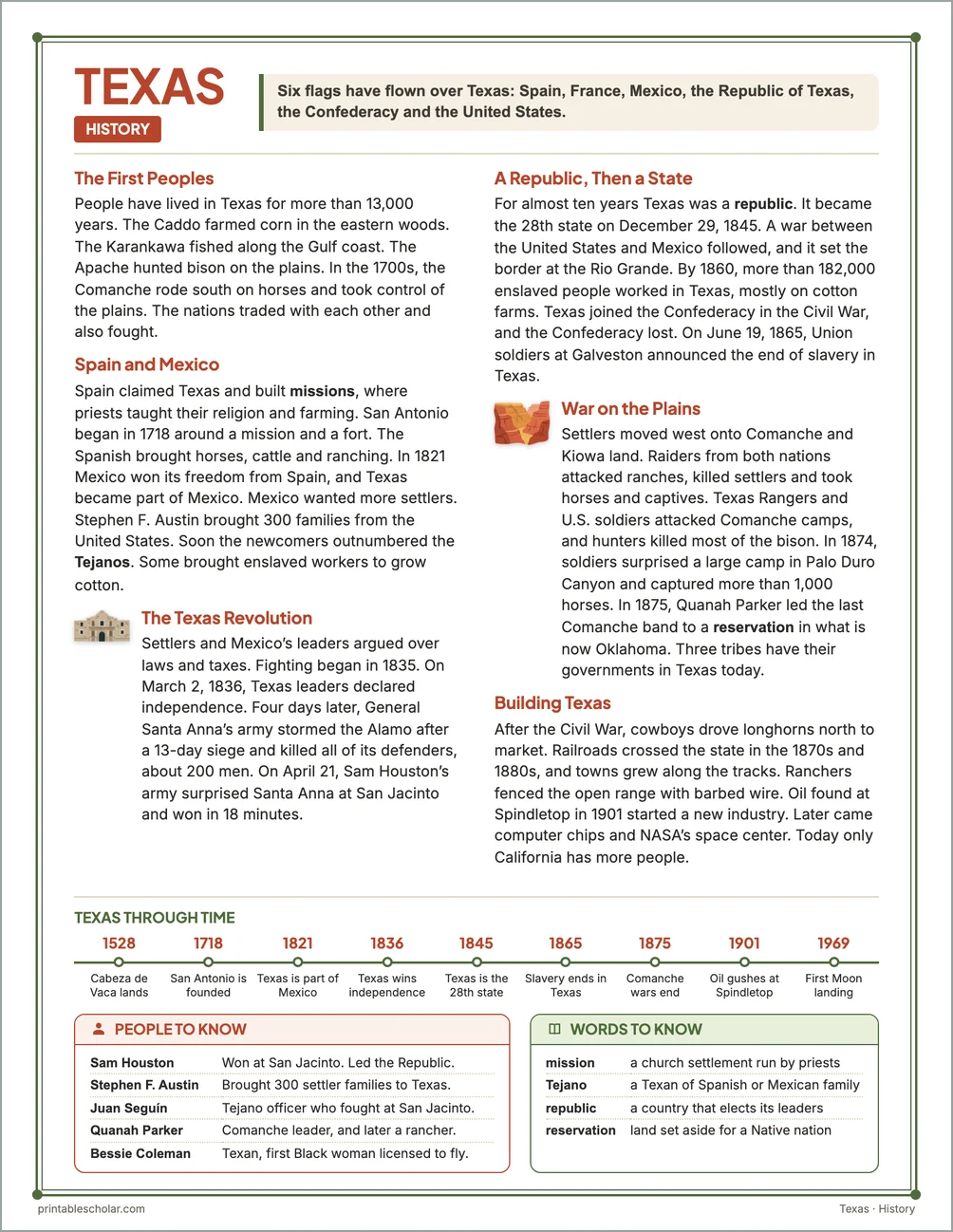
The First Peoples
People have lived in Texas for more than 13,000 years. The Caddo farmed corn in the eastern woods. The Karankawa fished along the Gulf coast. The Apache hunted bison on the plains. In the 1700s, the Comanche rode south on horses and took control of the plains. The nations traded with each other and also fought.
Spain and Mexico
Spain claimed Texas and built missions, where priests taught their religion and farming. San Antonio began in 1718 around a mission and a fort. The Spanish brought horses, cattle and ranching. In 1821 Mexico won its freedom from Spain, and Texas became part of Mexico. Mexico wanted more settlers. Stephen F. Austin brought 300 families from the United States. Soon the newcomers outnumbered the Tejanos. Some brought enslaved workers to grow cotton.
The Texas Revolution
Settlers and Mexico’s leaders argued over laws and taxes. Fighting began in 1835. On March 2, 1836, Texas leaders declared independence. Four days later, General Santa Anna’s army stormed the Alamo after a 13-day siege and killed all of its defenders, about 200 men. On April 21, Sam Houston’s army surprised Santa Anna at San Jacinto and won in 18 minutes.
A Republic, Then a State
For almost ten years Texas was a republic. It became the 28th state on December 29, 1845. A war between the United States and Mexico followed, and it set the border at the Rio Grande. By 1860, more than 182,000 enslaved people worked in Texas, mostly on cotton farms. Texas joined the Confederacy in the Civil War, and the Confederacy lost. On June 19, 1865, Union soldiers at Galveston announced the end of slavery in Texas.
War on the Plains
Settlers moved west onto Comanche and Kiowa land. Raiders from both nations attacked ranches, killed settlers and took horses and captives. Texas Rangers and U.S. soldiers attacked Comanche camps, and hunters killed most of the bison. In 1874, soldiers surprised a large camp in Palo Duro Canyon and captured more than 1,000 horses. In 1875, Quanah Parker led the last Comanche band to a reservation in what is now Oklahoma. Three tribes have their governments in Texas today.
Building Texas
After the Civil War, cowboys drove longhorns north to market. Railroads crossed the state in the 1870s and 1880s, and towns grew along the tracks. Ranchers fenced the open range with barbed wire. Oil found at Spindletop in 1901 started a new industry. Later came computer chips and NASA’s space center. Today only California has more people.
Texas through time
- 1528 Cabeza de Vaca lands
- 1718 San Antonio is founded
- 1821 Texas is part of Mexico
- 1836 Texas wins independence
- 1845 Texas is the 28th state
- 1865 Slavery ends in Texas
- 1875 Comanche wars end
- 1901 Oil gushes at Spindletop
- 1969 First Moon landing
People to know
- Sam Houston: Won at San Jacinto. Led the Republic.
- Stephen F. Austin: Brought 300 settler families to Texas.
- Juan Seguín: Tejano officer who fought at San Jacinto.
- Quanah Parker: Comanche leader, and later a rancher.
- Bessie Coleman: Texan, first Black woman licensed to fly.
Free Texas maps
Each of these maps is free to print on its own page. The kit puts them in one file with the reading pages and the booklet.