 Printable Scholar
South Dakota State Report Kit
Everything a student needs to research and write a report on South Dakota: the reading, the maps and the pages to fill in. Nothing else to look up.
- 3 reading pages: South Dakota fun facts, History, and Land and Work
- 5 maps: landmarks, cities, county, outline, and rivers and lakes
- An 8-page My State Report booklet, from fast facts to a trip plan and a license plate to design
- A pennant to cut out and hang, two map skills sheets and a 10-question reading quiz
- Answer keys for the quiz, the fast facts and the map sheets
- One print-ready PDF, 23 pages, black and white, US Letter
Teaching all 50 states? Get every kit for $39.
Look inside
Read it, map it, write it.
The reading pages and maps hold every answer the booklet asks for. About one third of the booklet is looking things up. The rest asks students to choose, plan and explain.

What is in the South Dakota kit
To read and study
- South Dakota fun facts: six short true stories, By the Numbers and Did You Know
- History: the state’s story in order, with a timeline, people to know and words to know
- Land and Work: the land and climate, what the state grows, makes and mines, and how one leads to the other
- Five maps, including a rivers, lakes and neighbors map with a letter key
To fill in and make
- My State Report booklet: cover, Fast Facts, My Map, State Symbols, My Trip, Think Like a Geographer, Design a License Plate and Dig Deeper
- A pennant with the state’s name and outline, to color, cut out and hang
- Name the Cities and Name the Rivers and Lakes sheets, each with a word bank
- A 10-question reading quiz, with answer keys for everything that has one right answer
Free: the South Dakota History reading page
One page on the history of South Dakota for grades 3 to 5, free to print in color or black and white. It is the second reading page in the kit.
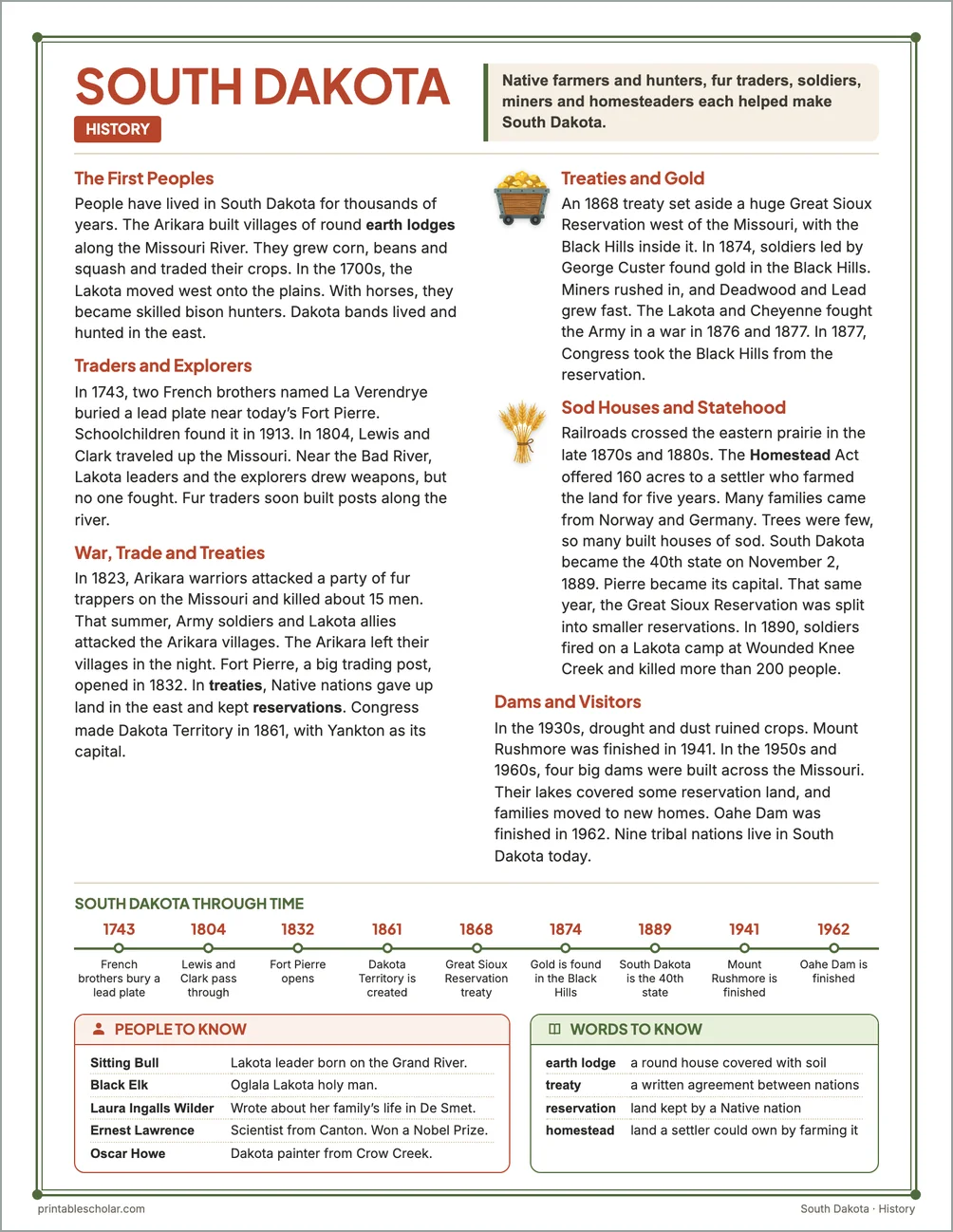
The First Peoples
People have lived in South Dakota for thousands of years. The Arikara built villages of round earth lodges along the Missouri River. They grew corn, beans and squash and traded their crops. In the 1700s, the Lakota moved west onto the plains. With horses, they became skilled bison hunters. Dakota bands lived and hunted in the east.
Traders and Explorers
In 1743, two French brothers named La Verendrye buried a lead plate near today’s Fort Pierre. Schoolchildren found it in 1913. In 1804, Lewis and Clark traveled up the Missouri. Near the Bad River, Lakota leaders and the explorers drew weapons, but no one fought. Fur traders soon built posts along the river.
War, Trade and Treaties
In 1823, Arikara warriors attacked a party of fur trappers on the Missouri and killed about 15 men. That summer, Army soldiers and Lakota allies attacked the Arikara villages. The Arikara left their villages in the night. Fort Pierre, a big trading post, opened in 1832. In treaties, Native nations gave up land in the east and kept reservations. Congress made Dakota Territory in 1861, with Yankton as its capital.
Treaties and Gold
An 1868 treaty set aside a huge Great Sioux Reservation west of the Missouri, with the Black Hills inside it. In 1874, soldiers led by George Custer found gold in the Black Hills. Miners rushed in, and Deadwood and Lead grew fast. The Lakota and Cheyenne fought the Army in a war in 1876 and 1877. In 1877, Congress took the Black Hills from the reservation.
Sod Houses and Statehood
Railroads crossed the eastern prairie in the late 1870s and 1880s. The Homestead Act offered 160 acres to a settler who farmed the land for five years. Many families came from Norway and Germany. Trees were few, so many built houses of sod. South Dakota became the 40th state on November 2, 1889. Pierre became its capital. That same year, the Great Sioux Reservation was split into smaller reservations. In 1890, soldiers fired on a Lakota camp at Wounded Knee Creek and killed more than 200 people.
Dams and Visitors
In the 1930s, drought and dust ruined crops. Mount Rushmore was finished in 1941. In the 1950s and 1960s, four big dams were built across the Missouri. Their lakes covered some reservation land, and families moved to new homes. Oahe Dam was finished in 1962. Nine tribal nations live in South Dakota today.
South Dakota through time
- 1743 French brothers bury a lead plate
- 1804 Lewis and Clark pass through
- 1832 Fort Pierre opens
- 1861 Dakota Territory is created
- 1868 Great Sioux Reservation treaty
- 1874 Gold is found in the Black Hills
- 1889 South Dakota is the 40th state
- 1941 Mount Rushmore is finished
- 1962 Oahe Dam is finished
People to know
- Sitting Bull: Lakota leader born on the Grand River.
- Black Elk: Oglala Lakota holy man.
- Laura Ingalls Wilder: Wrote about her family’s life in De Smet.
- Ernest Lawrence: Scientist from Canton. Won a Nobel Prize.
- Oscar Howe: Dakota painter from Crow Creek.
Free South Dakota maps
Each of these maps is free to print on its own page. The kit puts them in one file with the reading pages and the booklet.