
New York State Report Kit
Everything a student needs to research and write a report on New York: the reading, the maps and the pages to fill in. Nothing else to look up.
- 3 reading pages: New York fun facts, History, and Land and Work
- 5 maps: landmarks, cities, county, outline, and rivers and lakes
- An 8-page My State Report booklet, from fast facts to a trip plan and a license plate to design
- A pennant to cut out and hang, two map skills sheets and a 10-question reading quiz
- Answer keys for the quiz, the fast facts and the map sheets
- One print-ready PDF, 23 pages, black and white, US Letter
Teaching all 50 states? Get every kit for $39.
Look inside
Read it, map it, write it.
The reading pages and maps hold every answer the booklet asks for. About one third of the booklet is looking things up. The rest asks students to choose, plan and explain.

What is in the New York kit
To read and study
- New York fun facts: six short true stories, By the Numbers and Did You Know
- History: the state’s story in order, with a timeline, people to know and words to know
- Land and Work: the land and climate, what the state grows, makes and mines, and how one leads to the other
- Five maps, including a rivers, lakes and neighbors map with a letter key
To fill in and make
- My State Report booklet: cover, Fast Facts, My Map, State Symbols, My Trip, Think Like a Geographer, Design a License Plate and Dig Deeper
- A pennant with the state’s name and outline, to color, cut out and hang
- Name the Cities and Name the Rivers and Lakes sheets, each with a word bank
- A 10-question reading quiz, with answer keys for everything that has one right answer
Free: the New York History reading page
One page on the history of New York for grades 3 to 5, free to print in color or black and white. It is the second reading page in the kit.
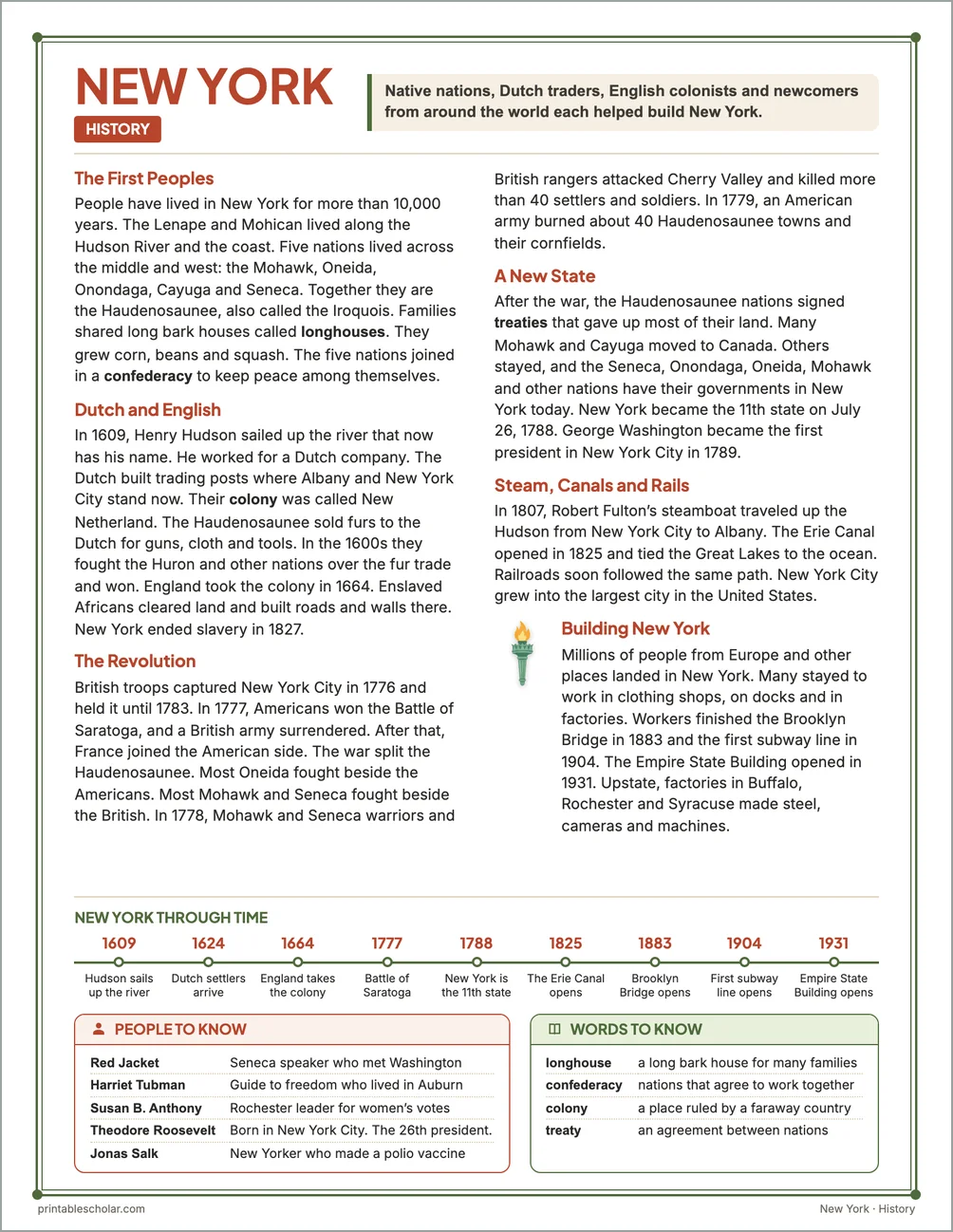
The First Peoples
People have lived in New York for more than 10,000 years. The Lenape and Mohican lived along the Hudson River and the coast. Five nations lived across the middle and west: the Mohawk, Oneida, Onondaga, Cayuga and Seneca. Together they are the Haudenosaunee, also called the Iroquois. Families shared long bark houses called longhouses. They grew corn, beans and squash. The five nations joined in a confederacy to keep peace among themselves.
Dutch and English
In 1609, Henry Hudson sailed up the river that now has his name. He worked for a Dutch company. The Dutch built trading posts where Albany and New York City stand now. Their colony was called New Netherland. The Haudenosaunee sold furs to the Dutch for guns, cloth and tools. In the 1600s they fought the Huron and other nations over the fur trade and won. England took the colony in 1664. Enslaved Africans cleared land and built roads and walls there. New York ended slavery in 1827.
The Revolution
British troops captured New York City in 1776 and held it until 1783. In 1777, Americans won the Battle of Saratoga, and a British army surrendered. After that, France joined the American side. The war split the Haudenosaunee. Most Oneida fought beside the Americans. Most Mohawk and Seneca fought beside the British. In 1778, Mohawk and Seneca warriors and British rangers attacked Cherry Valley and killed more than 40 settlers and soldiers. In 1779, an American army burned about 40 Haudenosaunee towns and their cornfields.
A New State
After the war, the Haudenosaunee nations signed treaties that gave up most of their land. Many Mohawk and Cayuga moved to Canada. Others stayed, and the Seneca, Onondaga, Oneida, Mohawk and other nations have their governments in New York today. New York became the 11th state on July 26, 1788. George Washington became the first president in New York City in 1789.
Steam, Canals and Rails
In 1807, Robert Fulton’s steamboat traveled up the Hudson from New York City to Albany. The Erie Canal opened in 1825 and tied the Great Lakes to the ocean. Railroads soon followed the same path. New York City grew into the largest city in the United States.
Building New York
Millions of people from Europe and other places landed in New York. Many stayed to work in clothing shops, on docks and in factories. Workers finished the Brooklyn Bridge in 1883 and the first subway line in 1904. The Empire State Building opened in 1931. Upstate, factories in Buffalo, Rochester and Syracuse made steel, cameras and machines.
New York through time
- 1609 Hudson sails up the river
- 1624 Dutch settlers arrive
- 1664 England takes the colony
- 1777 Battle of Saratoga
- 1788 New York is the 11th state
- 1825 The Erie Canal opens
- 1883 Brooklyn Bridge opens
- 1904 First subway line opens
- 1931 Empire State Building opens
People to know
- Red Jacket: Seneca speaker who met Washington
- Harriet Tubman: Guide to freedom who lived in Auburn
- Susan B. Anthony: Rochester leader for women’s votes
- Theodore Roosevelt: Born in New York City. The 26th president.
- Jonas Salk: New Yorker who made a polio vaccine
Free New York maps
Each of these maps is free to print on its own page. The kit puts them in one file with the reading pages and the booklet.