
Michigan State Report Kit
Everything a student needs to research and write a report on Michigan: the reading, the maps and the pages to fill in. Nothing else to look up.
- 3 reading pages: Michigan fun facts, History, and Land and Work
- 5 maps: landmarks, cities, county, outline, and rivers and lakes
- An 8-page My State Report booklet, from fast facts to a trip plan and a license plate to design
- A pennant to cut out and hang, two map skills sheets and a 10-question reading quiz
- Answer keys for the quiz, the fast facts and the map sheets
- One print-ready PDF, 23 pages, black and white, US Letter
Look inside
Read it, map it, write it.
The reading pages and maps hold every answer the booklet asks for. About one third of the booklet is looking things up. The rest asks students to choose, plan and explain.

What is in the Michigan kit
To read and study
- Michigan fun facts: six short true stories, By the Numbers and Did You Know
- History: the state’s story in order, with a timeline, people to know and words to know
- Land and Work: the land and climate, what the state grows, makes and mines, and how one leads to the other
- Five maps, including a rivers, lakes and neighbors map with a letter key
To fill in and make
- My State Report booklet: cover, Fast Facts, My Map, State Symbols, My Trip, Think Like a Geographer, Design a License Plate and Dig Deeper
- A pennant with the state’s name and outline, to color, cut out and hang
- Name the Cities and Name the Rivers and Lakes sheets, each with a word bank
- A 10-question reading quiz, with answer keys for everything that has one right answer
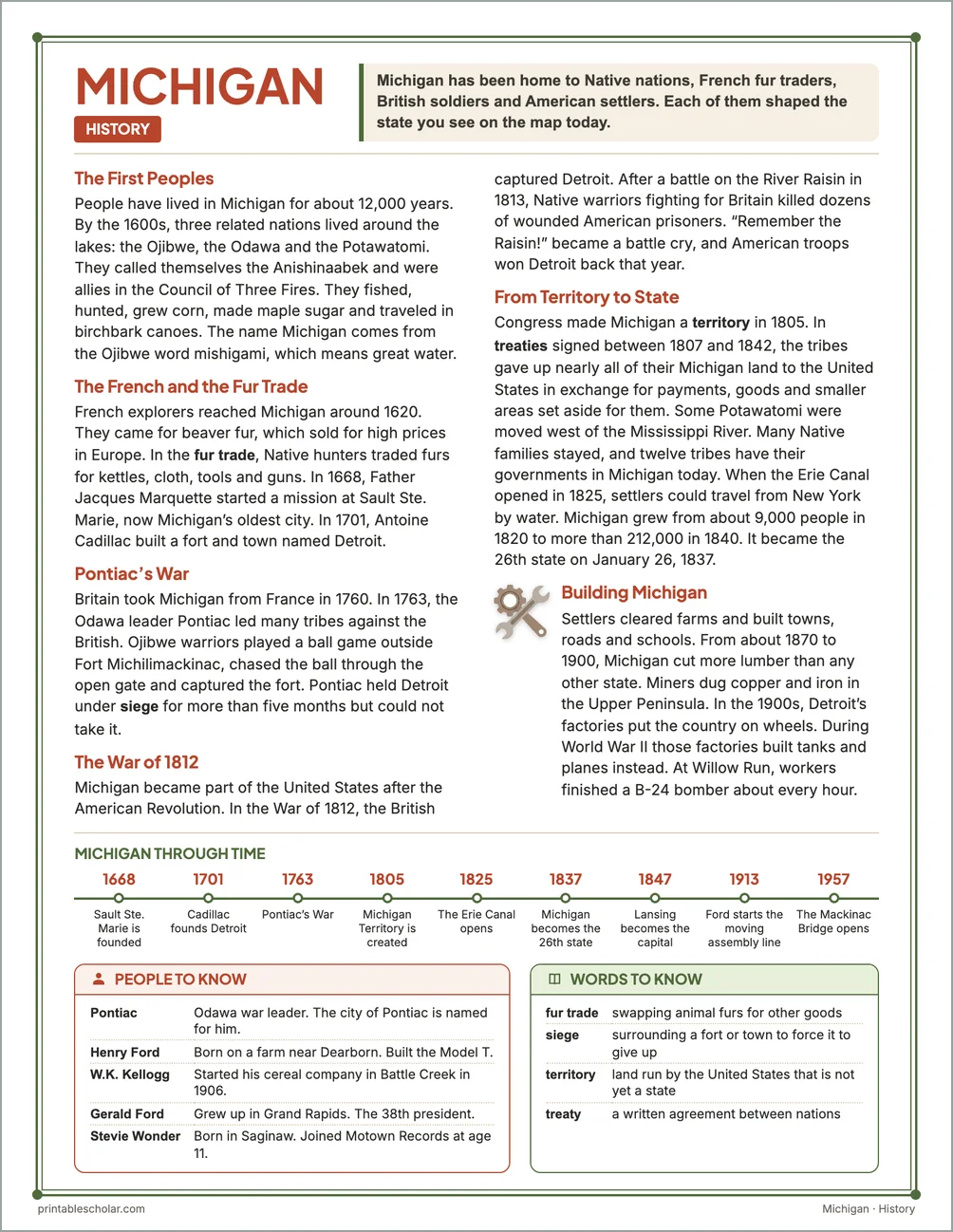
Free: the Michigan History reading page
One page on the history of Michigan for grades 3 to 5, free to print in color or black and white. It is the second reading page in the kit.
The First Peoples
People have lived in Michigan for about 12,000 years. By the 1600s, three related nations lived around the lakes: the Ojibwe, the Odawa and the Potawatomi. They called themselves the Anishinaabek and were allies in the Council of Three Fires. They fished, hunted, grew corn, made maple sugar and traveled in birchbark canoes. The name Michigan comes from the Ojibwe word mishigami, which means great water.
The French and the Fur Trade
French explorers reached Michigan around 1620. They came for beaver fur, which sold for high prices in Europe. In the fur trade, Native hunters traded furs for kettles, cloth, tools and guns. In 1668, Father Jacques Marquette started a mission at Sault Ste. Marie, now Michigan’s oldest city. In 1701, Antoine Cadillac built a fort and town named Detroit.
Pontiac’s War
Britain took Michigan from France in 1760. In 1763, the Odawa leader Pontiac led many tribes against the British. Ojibwe warriors played a ball game outside Fort Michilimackinac, chased the ball through the open gate and captured the fort. Pontiac held Detroit under siege for more than five months but could not take it.
The War of 1812
Michigan became part of the United States after the American Revolution. In the War of 1812, the British captured Detroit. After a battle on the River Raisin in 1813, Native warriors fighting for Britain killed dozens of wounded American prisoners. "Remember the Raisin!" became a battle cry, and American troops won Detroit back that year.
From Territory to State
Congress made Michigan a territory in 1805. In treaties signed between 1807 and 1842, the tribes gave up nearly all of their Michigan land to the United States in exchange for payments, goods and smaller areas set aside for them. Some Potawatomi were moved west of the Mississippi River. Many Native families stayed, and twelve tribes have their governments in Michigan today. When the Erie Canal opened in 1825, settlers could travel from New York by water. Michigan grew from about 9,000 people in 1820 to more than 212,000 in 1840. It became the 26th state on January 26, 1837.
Building Michigan
Settlers cleared farms and built towns, roads and schools. From about 1870 to 1900, Michigan cut more lumber than any other state. Miners dug copper and iron in the Upper Peninsula. In the 1900s, Detroit’s factories put the country on wheels. During World War II those factories built tanks and planes instead. At Willow Run, workers finished a B-24 bomber about every hour.
Michigan through time
- 1668 Sault Ste. Marie is founded
- 1701 Cadillac founds Detroit
- 1763 Pontiac’s War
- 1805 Michigan Territory is created
- 1825 The Erie Canal opens
- 1837 Michigan becomes the 26th state
- 1847 Lansing becomes the capital
- 1913 Ford starts the moving assembly line
- 1957 The Mackinac Bridge opens
People to know
- Pontiac: Odawa war leader. The city of Pontiac is named for him.
- Henry Ford: Born on a farm near Dearborn. Built the Model T.
- W.K. Kellogg: Started his cereal company in Battle Creek in 1906.
- Gerald Ford: Grew up in Grand Rapids. The 38th president.
- Stevie Wonder: Born in Saginaw. Joined Motown Records at age 11.
Free Michigan maps
Each of these maps is free to print on its own page. The kit puts them in one file with the reading pages and the booklet.