
Massachusetts State Report Kit
Everything a student needs to research and write a report on Massachusetts: the reading, the maps and the pages to fill in. Nothing else to look up.
- 3 reading pages: Massachusetts fun facts, History, and Land and Work
- 5 maps: landmarks, cities, county, outline, and rivers and lakes
- An 8-page My State Report booklet, from fast facts to a trip plan and a license plate to design
- A pennant to cut out and hang, two map skills sheets and a 10-question reading quiz
- Answer keys for the quiz, the fast facts and the map sheets
- One print-ready PDF, 23 pages, black and white, US Letter
Look inside
Read it, map it, write it.
The reading pages and maps hold every answer the booklet asks for. About one third of the booklet is looking things up. The rest asks students to choose, plan and explain.

What is in the Massachusetts kit
To read and study
- Massachusetts fun facts: six short true stories, By the Numbers and Did You Know
- History: the state’s story in order, with a timeline, people to know and words to know
- Land and Work: the land and climate, what the state grows, makes and mines, and how one leads to the other
- Five maps, including a rivers, lakes and neighbors map with a letter key
To fill in and make
- My State Report booklet: cover, Fast Facts, My Map, State Symbols, My Trip, Think Like a Geographer, Design a License Plate and Dig Deeper
- A pennant with the state’s name and outline, to color, cut out and hang
- Name the Cities and Name the Rivers and Lakes sheets, each with a word bank
- A 10-question reading quiz, with answer keys for everything that has one right answer
Free: the Massachusetts History reading page
One page on the history of Massachusetts for grades 3 to 5, free to print in color or black and white. It is the second reading page in the kit.
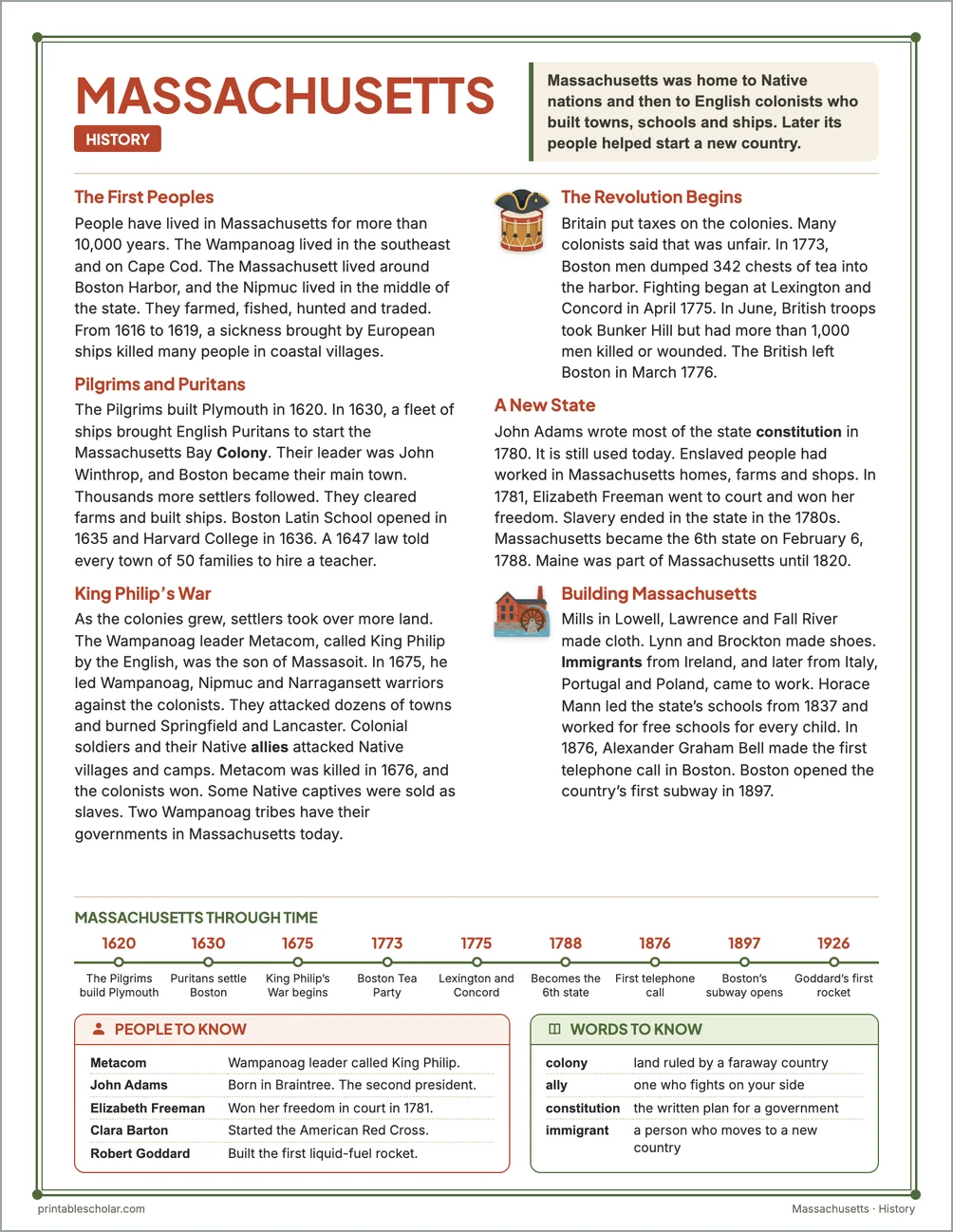
The First Peoples
People have lived in Massachusetts for more than 10,000 years. The Wampanoag lived in the southeast and on Cape Cod. The Massachusett lived around Boston Harbor, and the Nipmuc lived in the middle of the state. They farmed, fished, hunted and traded. From 1616 to 1619, a sickness brought by European ships killed many people in coastal villages.
Pilgrims and Puritans
The Pilgrims built Plymouth in 1620. In 1630, a fleet of ships brought English Puritans to start the Massachusetts Bay Colony. Their leader was John Winthrop, and Boston became their main town. Thousands more settlers followed. They cleared farms and built ships. Boston Latin School opened in 1635 and Harvard College in 1636. A 1647 law told every town of 50 families to hire a teacher.
King Philip’s War
As the colonies grew, settlers took over more land. The Wampanoag leader Metacom, called King Philip by the English, was the son of Massasoit. In 1675, he led Wampanoag, Nipmuc and Narragansett warriors against the colonists. They attacked dozens of towns and burned Springfield and Lancaster. Colonial soldiers and their Native allies attacked Native villages and camps. Metacom was killed in 1676, and the colonists won. Some Native captives were sold as slaves. Two Wampanoag tribes have their governments in Massachusetts today.
The Revolution Begins
Britain put taxes on the colonies. Many colonists said that was unfair. In 1773, Boston men dumped 342 chests of tea into the harbor. Fighting began at Lexington and Concord in April 1775. In June, British troops took Bunker Hill but had more than 1,000 men killed or wounded. The British left Boston in March 1776.
A New State
John Adams wrote most of the state constitution in 1780. It is still used today. Enslaved people had worked in Massachusetts homes, farms and shops. In 1781, Elizabeth Freeman went to court and won her freedom. Slavery ended in the state in the 1780s. Massachusetts became the 6th state on February 6, 1788. Maine was part of Massachusetts until 1820.
Building Massachusetts
Mills in Lowell, Lawrence and Fall River made cloth. Lynn and Brockton made shoes. Immigrants from Ireland, and later from Italy, Portugal and Poland, came to work. Horace Mann led the state’s schools from 1837 and worked for free schools for every child. In 1876, Alexander Graham Bell made the first telephone call in Boston. Boston opened the country’s first subway in 1897.
Massachusetts through time
- 1620 The Pilgrims build Plymouth
- 1630 Puritans settle Boston
- 1675 King Philip’s War begins
- 1773 Boston Tea Party
- 1775 Lexington and Concord
- 1788 Becomes the 6th state
- 1876 First telephone call
- 1897 Boston’s subway opens
- 1926 Goddard’s first rocket
People to know
- Metacom: Wampanoag leader called King Philip.
- John Adams: Born in Braintree. The second president.
- Elizabeth Freeman: Won her freedom in court in 1781.
- Clara Barton: Started the American Red Cross.
- Robert Goddard: Built the first liquid-fuel rocket.
Free Massachusetts maps
Each of these maps is free to print on its own page. The kit puts them in one file with the reading pages and the booklet.