
Louisiana State Report Kit
Everything a student needs to research and write a report on Louisiana: the reading, the maps and the pages to fill in. Nothing else to look up.
- 3 reading pages: Louisiana fun facts, History, and Land and Work
- 5 maps: landmarks, cities, parish, outline, and rivers and lakes
- An 8-page My State Report booklet, from fast facts to a trip plan and a license plate to design
- A pennant to cut out and hang, two map skills sheets and a 10-question reading quiz
- Answer keys for the quiz, the fast facts and the map sheets
- One print-ready PDF, 23 pages, black and white, US Letter
Look inside
Read it, map it, write it.
The reading pages and maps hold every answer the booklet asks for. About one third of the booklet is looking things up. The rest asks students to choose, plan and explain.

What is in the Louisiana kit
To read and study
- Louisiana fun facts: six short true stories, By the Numbers and Did You Know
- History: the state’s story in order, with a timeline, people to know and words to know
- Land and Work: the land and climate, what the state grows, makes and mines, and how one leads to the other
- Five maps, including a rivers, lakes and neighbors map with a letter key
To fill in and make
- My State Report booklet: cover, Fast Facts, My Map, State Symbols, My Trip, Think Like a Geographer, Design a License Plate and Dig Deeper
- A pennant with the state’s name and outline, to color, cut out and hang
- Name the Cities and Name the Rivers and Lakes sheets, each with a word bank
- A 10-question reading quiz, with answer keys for everything that has one right answer
Free: the Louisiana History reading page
One page on the history of Louisiana for grades 3 to 5, free to print in color or black and white. It is the second reading page in the kit.
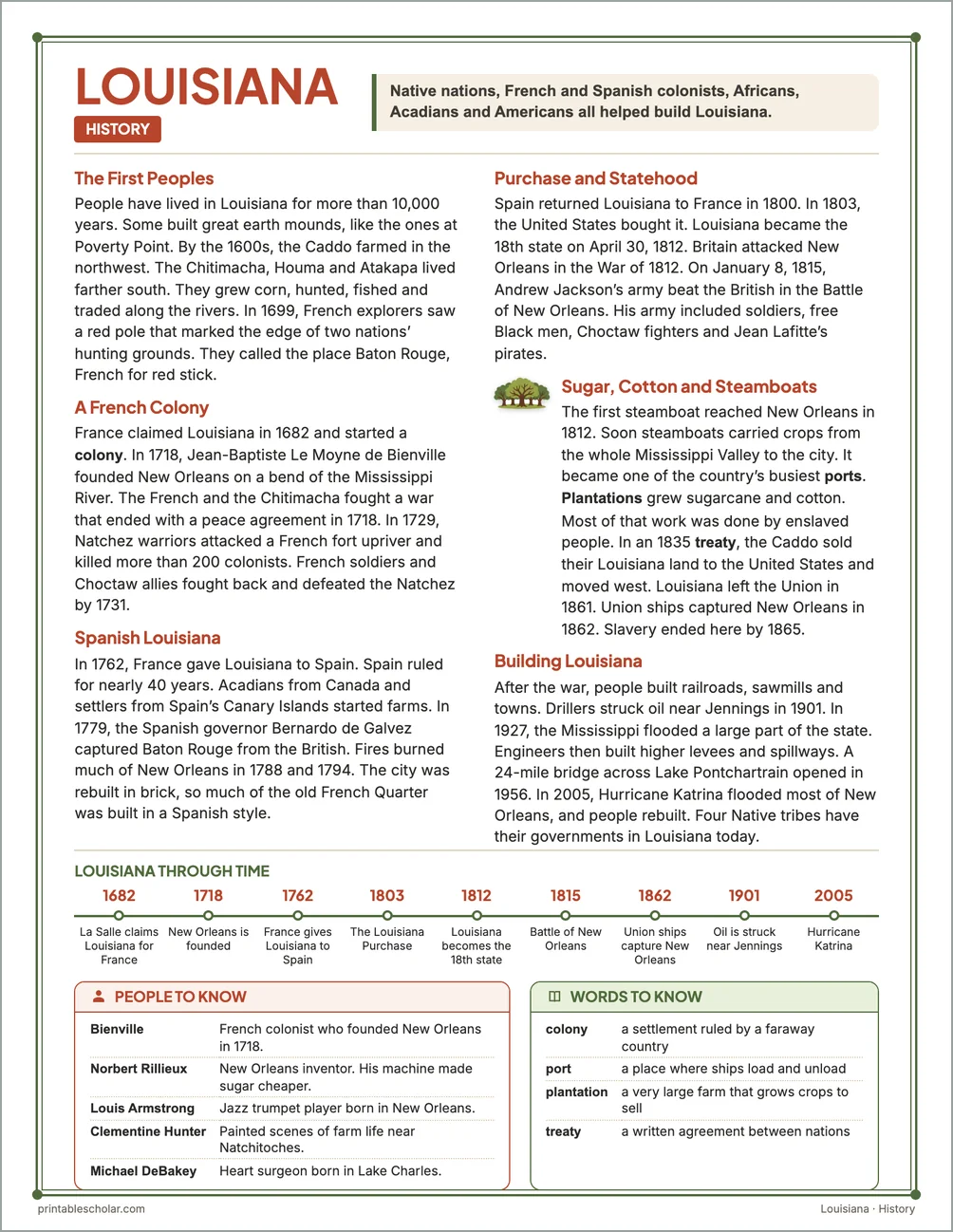
The First Peoples
People have lived in Louisiana for more than 10,000 years. Some built great earth mounds, like the ones at Poverty Point. By the 1600s, the Caddo farmed in the northwest. The Chitimacha, Houma and Atakapa lived farther south. They grew corn, hunted, fished and traded along the rivers. In 1699, French explorers saw a red pole that marked the edge of two nations’ hunting grounds. They called the place Baton Rouge, French for red stick.
A French Colony
France claimed Louisiana in 1682 and started a colony. In 1718, Jean-Baptiste Le Moyne de Bienville founded New Orleans on a bend of the Mississippi River. The French and the Chitimacha fought a war that ended with a peace agreement in 1718. In 1729, Natchez warriors attacked a French fort upriver and killed more than 200 colonists. French soldiers and Choctaw allies fought back and defeated the Natchez by 1731.
Spanish Louisiana
In 1762, France gave Louisiana to Spain. Spain ruled for nearly 40 years. Acadians from Canada and settlers from Spain’s Canary Islands started farms. In 1779, the Spanish governor Bernardo de Galvez captured Baton Rouge from the British. Fires burned much of New Orleans in 1788 and 1794. The city was rebuilt in brick, so much of the old French Quarter was built in a Spanish style.
Purchase and Statehood
Spain returned Louisiana to France in 1800. In 1803, the United States bought it. Louisiana became the 18th state on April 30, 1812. Britain attacked New Orleans in the War of 1812. On January 8, 1815, Andrew Jackson’s army beat the British in the Battle of New Orleans. His army included soldiers, free Black men, Choctaw fighters and Jean Lafitte’s pirates.
Sugar, Cotton and Steamboats
The first steamboat reached New Orleans in 1812. Soon steamboats carried crops from the whole Mississippi Valley to the city. It became one of the country’s busiest ports. Plantations grew sugarcane and cotton. Most of that work was done by enslaved people. In an 1835 treaty, the Caddo sold their Louisiana land to the United States and moved west. Louisiana left the Union in 1861. Union ships captured New Orleans in 1862. Slavery ended here by 1865.
Building Louisiana
After the war, people built railroads, sawmills and towns. Drillers struck oil near Jennings in 1901. In 1927, the Mississippi flooded a large part of the state. Engineers then built higher levees and spillways. A 24-mile bridge across Lake Pontchartrain opened in 1956. In 2005, Hurricane Katrina flooded most of New Orleans, and people rebuilt. Four Native tribes have their governments in Louisiana today.
Louisiana through time
- 1682 La Salle claims Louisiana for France
- 1718 New Orleans is founded
- 1762 France gives Louisiana to Spain
- 1803 The Louisiana Purchase
- 1812 Louisiana becomes the 18th state
- 1815 Battle of New Orleans
- 1862 Union ships capture New Orleans
- 1901 Oil is struck near Jennings
- 2005 Hurricane Katrina
People to know
- Bienville: French colonist who founded New Orleans in 1718.
- Norbert Rillieux: New Orleans inventor. His machine made sugar cheaper.
- Louis Armstrong: Jazz trumpet player born in New Orleans.
- Clementine Hunter: Painted scenes of farm life near Natchitoches.
- Michael DeBakey: Heart surgeon born in Lake Charles.
Free Louisiana maps
Each of these maps is free to print on its own page. The kit puts them in one file with the reading pages and the booklet.