
Illinois State Report Kit
Everything a student needs to research and write a report on Illinois: the reading, the maps and the pages to fill in. Nothing else to look up.
- 3 reading pages: Illinois fun facts, History, and Land and Work
- 5 maps: landmarks, cities, county, outline, and rivers and lakes
- An 8-page My State Report booklet, from fast facts to a trip plan and a license plate to design
- A pennant to cut out and hang, two map skills sheets and a 10-question reading quiz
- Answer keys for the quiz, the fast facts and the map sheets
- One print-ready PDF, 23 pages, black and white, US Letter
Look inside
Read it, map it, write it.
The reading pages and maps hold every answer the booklet asks for. About one third of the booklet is looking things up. The rest asks students to choose, plan and explain.

What is in the Illinois kit
To read and study
- Illinois fun facts: six short true stories, By the Numbers and Did You Know
- History: the state’s story in order, with a timeline, people to know and words to know
- Land and Work: the land and climate, what the state grows, makes and mines, and how one leads to the other
- Five maps, including a rivers, lakes and neighbors map with a letter key
To fill in and make
- My State Report booklet: cover, Fast Facts, My Map, State Symbols, My Trip, Think Like a Geographer, Design a License Plate and Dig Deeper
- A pennant with the state’s name and outline, to color, cut out and hang
- Name the Cities and Name the Rivers and Lakes sheets, each with a word bank
- A 10-question reading quiz, with answer keys for everything that has one right answer
Free: the Illinois History reading page
One page on the history of Illinois for grades 3 to 5, free to print in color or black and white. It is the second reading page in the kit.
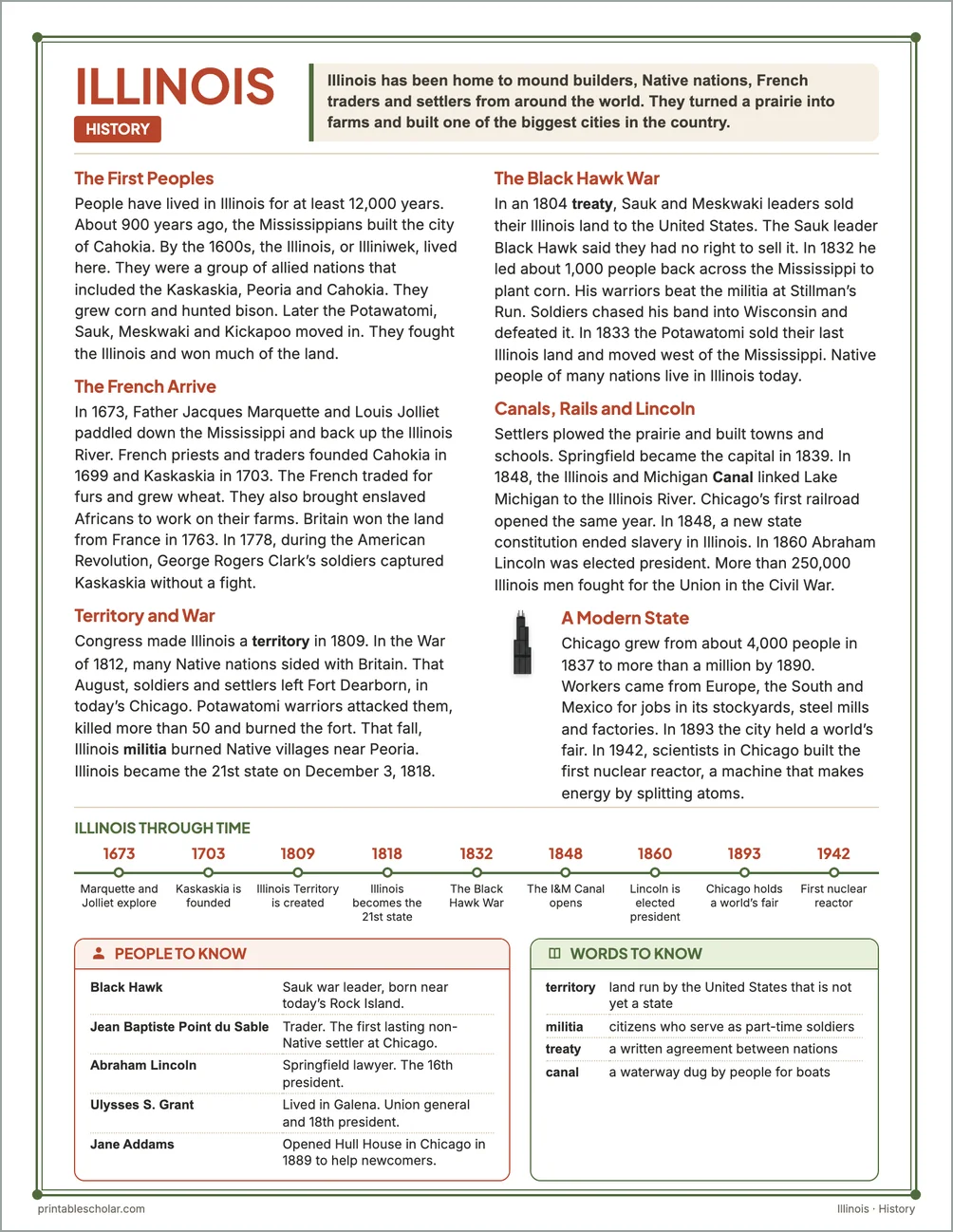
The First Peoples
People have lived in Illinois for at least 12,000 years. About 900 years ago, the Mississippians built the city of Cahokia. By the 1600s, the Illinois, or Illiniwek, lived here. They were a group of allied nations that included the Kaskaskia, Peoria and Cahokia. They grew corn and hunted bison. Later the Potawatomi, Sauk, Meskwaki and Kickapoo moved in. They fought the Illinois and won much of the land.
The French Arrive
In 1673, Father Jacques Marquette and Louis Jolliet paddled down the Mississippi and back up the Illinois River. French priests and traders founded Cahokia in 1699 and Kaskaskia in 1703. The French traded for furs and grew wheat. They also brought enslaved Africans to work on their farms. Britain won the land from France in 1763. In 1778, during the American Revolution, George Rogers Clark’s soldiers captured Kaskaskia without a fight.
Territory and War
Congress made Illinois a territory in 1809. In the War of 1812, many Native nations sided with Britain. That August, soldiers and settlers left Fort Dearborn, in today’s Chicago. Potawatomi warriors attacked them, killed more than 50 and burned the fort. That fall, Illinois militia burned Native villages near Peoria. Illinois became the 21st state on December 3, 1818.
The Black Hawk War
In an 1804 treaty, Sauk and Meskwaki leaders sold their Illinois land to the United States. The Sauk leader Black Hawk said they had no right to sell it. In 1832 he led about 1,000 people back across the Mississippi to plant corn. His warriors beat the militia at Stillman’s Run. Soldiers chased his band into Wisconsin and defeated it. In 1833 the Potawatomi sold their last Illinois land and moved west of the Mississippi. Native people of many nations live in Illinois today.
Canals, Rails and Lincoln
Settlers plowed the prairie and built towns and schools. Springfield became the capital in 1839. In 1848, the Illinois and Michigan Canal linked Lake Michigan to the Illinois River. Chicago’s first railroad opened the same year. In 1848, a new state constitution ended slavery in Illinois. In 1860 Abraham Lincoln was elected president. More than 250,000 Illinois men fought for the Union in the Civil War.
A Modern State
Chicago grew from about 4,000 people in 1837 to more than a million by 1890. Workers came from Europe, the South and Mexico for jobs in its stockyards, steel mills and factories. In 1893 the city held a world’s fair. In 1942, scientists in Chicago built the first nuclear reactor, a machine that makes energy by splitting atoms.
Illinois through time
- 1673 Marquette and Jolliet explore
- 1703 Kaskaskia is founded
- 1809 Illinois Territory is created
- 1818 Illinois becomes the 21st state
- 1832 The Black Hawk War
- 1848 The I&M Canal opens
- 1860 Lincoln is elected president
- 1893 Chicago holds a world’s fair
- 1942 First nuclear reactor
People to know
- Black Hawk: Sauk war leader, born near today’s Rock Island.
- Jean Baptiste Point du Sable: Trader. The first lasting non-Native settler at Chicago.
- Abraham Lincoln: Springfield lawyer. The 16th president.
- Ulysses S. Grant: Lived in Galena. Union general and 18th president.
- Jane Addams: Opened Hull House in Chicago in 1889 to help newcomers.
Free Illinois maps
Each of these maps is free to print on its own page. The kit puts them in one file with the reading pages and the booklet.