 Printable Scholar
Hawaii State Report Kit
Everything a student needs to research and write a report on Hawaii: the reading, the maps and the pages to fill in. Nothing else to look up.
- 3 reading pages: Hawaii fun facts, History, and Land and Work
- 5 maps: landmarks, cities, county, outline, and rivers and lakes
- An 8-page My State Report booklet, from fast facts to a trip plan and a license plate to design
- A pennant to cut out and hang, two map skills sheets and a 10-question reading quiz
- Answer keys for the quiz, the fast facts and the map sheets
- One print-ready PDF, 23 pages, black and white, US Letter
Teaching all 50 states? Get every kit for $39.
Look inside
Read it, map it, write it.
The reading pages and maps hold every answer the booklet asks for. About one third of the booklet is looking things up. The rest asks students to choose, plan and explain.

What is in the Hawaii kit
To read and study
- Hawaii fun facts: six short true stories, By the Numbers and Did You Know
- History: the state’s story in order, with a timeline, people to know and words to know
- Land and Work: the land and climate, what the state grows, makes and mines, and how one leads to the other
- Five maps, including a rivers, lakes and neighbors map with a letter key
To fill in and make
- My State Report booklet: cover, Fast Facts, My Map, State Symbols, My Trip, Think Like a Geographer, Design a License Plate and Dig Deeper
- A pennant with the state’s name and outline, to color, cut out and hang
- Name the Cities and Name the Rivers and Lakes sheets, each with a word bank
- A 10-question reading quiz, with answer keys for everything that has one right answer
Free: the Hawaii History reading page
One page on the history of Hawaii for grades 3 to 5, free to print in color or black and white. It is the second reading page in the kit.
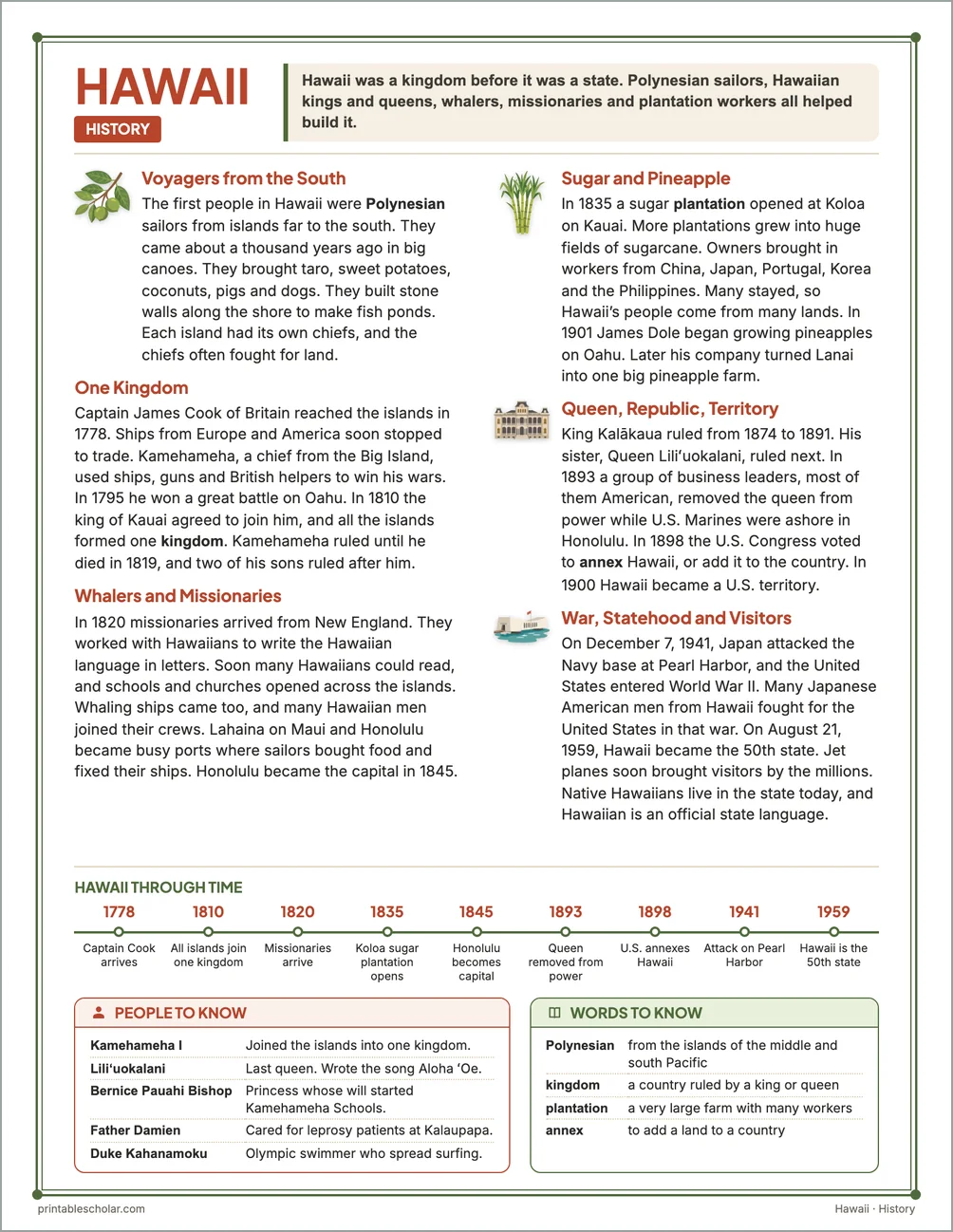
Voyagers from the South
The first people in Hawaii were Polynesian sailors from islands far to the south. They came about a thousand years ago in big canoes. They brought taro, sweet potatoes, coconuts, pigs and dogs. They built stone walls along the shore to make fish ponds. Each island had its own chiefs, and the chiefs often fought for land.
One Kingdom
Captain James Cook of Britain reached the islands in 1778. Ships from Europe and America soon stopped to trade. Kamehameha, a chief from the Big Island, used ships, guns and British helpers to win his wars. In 1795 he won a great battle on Oahu. In 1810 the king of Kauai agreed to join him, and all the islands formed one kingdom. Kamehameha ruled until he died in 1819, and two of his sons ruled after him.
Whalers and Missionaries
In 1820 missionaries arrived from New England. They worked with Hawaiians to write the Hawaiian language in letters. Soon many Hawaiians could read, and schools and churches opened across the islands. Whaling ships came too, and many Hawaiian men joined their crews. Lahaina on Maui and Honolulu became busy ports where sailors bought food and fixed their ships. Honolulu became the capital in 1845.
Sugar and Pineapple
In 1835 a sugar plantation opened at Koloa on Kauai. More plantations grew into huge fields of sugarcane. Owners brought in workers from China, Japan, Portugal, Korea and the Philippines. Many stayed, so Hawaii’s people come from many lands. In 1901 James Dole began growing pineapples on Oahu. Later his company turned Lanai into one big pineapple farm.
Queen, Republic, Territory
King Kalākaua ruled from 1874 to 1891. His sister, Queen Lili‘uokalani, ruled next. In 1893 a group of business leaders, most of them American, removed the queen from power while U.S. Marines were ashore in Honolulu. In 1898 the U.S. Congress voted to annex Hawaii, or add it to the country. In 1900 Hawaii became a U.S. territory.
War, Statehood and Visitors
On December 7, 1941, Japan attacked the Navy base at Pearl Harbor, and the United States entered World War II. Many Japanese American men from Hawaii fought for the United States in that war. On August 21, 1959, Hawaii became the 50th state. Jet planes soon brought visitors by the millions. Native Hawaiians live in the state today, and Hawaiian is an official state language.
Hawaii through time
- 1778 Captain Cook arrives
- 1810 All islands join one kingdom
- 1820 Missionaries arrive
- 1835 Koloa sugar plantation opens
- 1845 Honolulu becomes capital
- 1893 Queen removed from power
- 1898 U.S. annexes Hawaii
- 1941 Attack on Pearl Harbor
- 1959 Hawaii is the 50th state
People to know
- Kamehameha I: Joined the islands into one kingdom.
- Lili‘uokalani: Last queen. Wrote the song Aloha ‘Oe.
- Bernice Pauahi Bishop: Princess whose will started Kamehameha Schools.
- Father Damien: Cared for leprosy patients at Kalaupapa.
- Duke Kahanamoku: Olympic swimmer who spread surfing.
Free Hawaii maps
Each of these maps is free to print on its own page. The kit puts them in one file with the reading pages and the booklet.