
Georgia State Report Kit
Everything a student needs to research and write a report on Georgia: the reading, the maps and the pages to fill in. Nothing else to look up.
- 3 reading pages: Georgia fun facts, History, and Land and Work
- 5 maps: landmarks, cities, county, outline, and rivers and lakes
- An 8-page My State Report booklet, from fast facts to a trip plan and a license plate to design
- A pennant to cut out and hang, two map skills sheets and a 10-question reading quiz
- Answer keys for the quiz, the fast facts and the map sheets
- One print-ready PDF, 23 pages, black and white, US Letter
Look inside
Read it, map it, write it.
The reading pages and maps hold every answer the booklet asks for. About one third of the booklet is looking things up. The rest asks students to choose, plan and explain.

What is in the Georgia kit
To read and study
- Georgia fun facts: six short true stories, By the Numbers and Did You Know
- History: the state’s story in order, with a timeline, people to know and words to know
- Land and Work: the land and climate, what the state grows, makes and mines, and how one leads to the other
- Five maps, including a rivers, lakes and neighbors map with a letter key
To fill in and make
- My State Report booklet: cover, Fast Facts, My Map, State Symbols, My Trip, Think Like a Geographer, Design a License Plate and Dig Deeper
- A pennant with the state’s name and outline, to color, cut out and hang
- Name the Cities and Name the Rivers and Lakes sheets, each with a word bank
- A 10-question reading quiz, with answer keys for everything that has one right answer
Free: the Georgia History reading page
One page on the history of Georgia for grades 3 to 5, free to print in color or black and white. It is the second reading page in the kit.
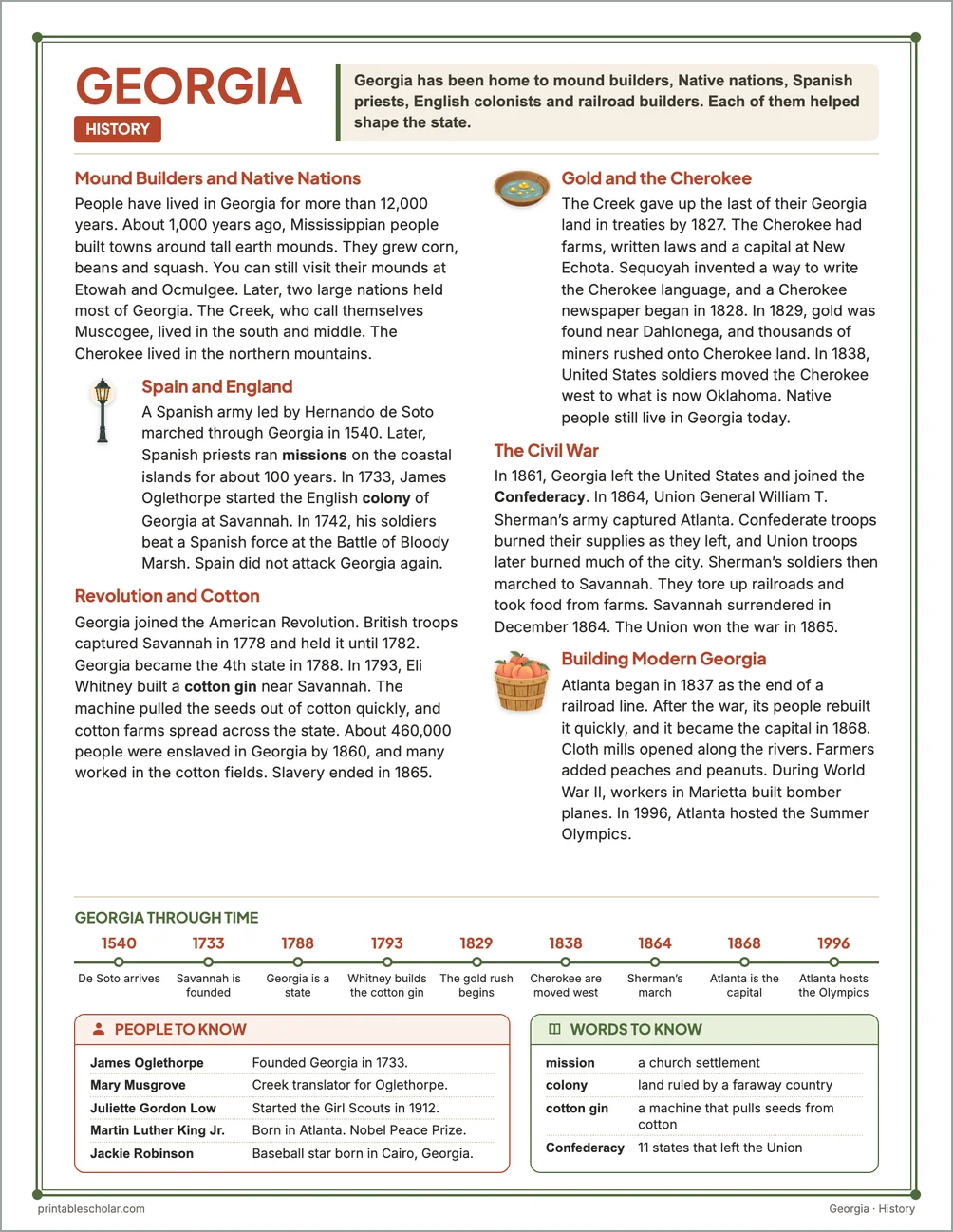
Mound Builders and Native Nations
People have lived in Georgia for more than 12,000 years. About 1,000 years ago, Mississippian people built towns around tall earth mounds. They grew corn, beans and squash. You can still visit their mounds at Etowah and Ocmulgee. Later, two large nations held most of Georgia. The Creek, who call themselves Muscogee, lived in the south and middle. The Cherokee lived in the northern mountains.
Spain and England
A Spanish army led by Hernando de Soto marched through Georgia in 1540. Later, Spanish priests ran missions on the coastal islands for about 100 years. In 1733, James Oglethorpe started the English colony of Georgia at Savannah. In 1742, his soldiers beat a Spanish force at the Battle of Bloody Marsh. Spain did not attack Georgia again.
Revolution and Cotton
Georgia joined the American Revolution. British troops captured Savannah in 1778 and held it until 1782. Georgia became the 4th state in 1788. In 1793, Eli Whitney built a cotton gin near Savannah. The machine pulled the seeds out of cotton quickly, and cotton farms spread across the state. About 460,000 people were enslaved in Georgia by 1860, and many worked in the cotton fields. Slavery ended in 1865.
Gold and the Cherokee
The Creek gave up the last of their Georgia land in treaties by 1827. The Cherokee had farms, written laws and a capital at New Echota. Sequoyah invented a way to write the Cherokee language, and a Cherokee newspaper began in 1828. In 1829, gold was found near Dahlonega, and thousands of miners rushed onto Cherokee land. In 1838, United States soldiers moved the Cherokee west to what is now Oklahoma. Native people still live in Georgia today.
The Civil War
In 1861, Georgia left the United States and joined the Confederacy. In 1864, Union General William T. Sherman’s army captured Atlanta. Confederate troops burned their supplies as they left, and Union troops later burned much of the city. Sherman’s soldiers then marched to Savannah. They tore up railroads and took food from farms. Savannah surrendered in December 1864. The Union won the war in 1865.
Building Modern Georgia
Atlanta began in 1837 as the end of a railroad line. After the war, its people rebuilt it quickly, and it became the capital in 1868. Cloth mills opened along the rivers. Farmers added peaches and peanuts. During World War II, workers in Marietta built bomber planes. In 1996, Atlanta hosted the Summer Olympics.
Georgia through time
- 1540 De Soto arrives
- 1733 Savannah is founded
- 1788 Georgia is a state
- 1793 Whitney builds the cotton gin
- 1829 The gold rush begins
- 1838 Cherokee are moved west
- 1864 Sherman’s march
- 1868 Atlanta is the capital
- 1996 Atlanta hosts the Olympics
People to know
- James Oglethorpe: Founded Georgia in 1733.
- Mary Musgrove: Creek translator for Oglethorpe.
- Juliette Gordon Low: Started the Girl Scouts in 1912.
- Martin Luther King Jr.: Born in Atlanta. Nobel Peace Prize.
- Jackie Robinson: Baseball star born in Cairo, Georgia.
Free Georgia maps
Each of these maps is free to print on its own page. The kit puts them in one file with the reading pages and the booklet.