
Florida State Report Kit
Everything a student needs to research and write a report on Florida: the reading, the maps and the pages to fill in. Nothing else to look up.
- 3 reading pages: Florida fun facts, History, and Land and Work
- 5 maps: landmarks, cities, county, outline, and rivers and lakes
- An 8-page My State Report booklet, from fast facts to a trip plan and a license plate to design
- A pennant to cut out and hang, two map skills sheets and a 10-question reading quiz
- Answer keys for the quiz, the fast facts and the map sheets
- One print-ready PDF, 23 pages, black and white, US Letter
Look inside
Read it, map it, write it.
The reading pages and maps hold every answer the booklet asks for. About one third of the booklet is looking things up. The rest asks students to choose, plan and explain.

What is in the Florida kit
To read and study
- Florida fun facts: six short true stories, By the Numbers and Did You Know
- History: the state’s story in order, with a timeline, people to know and words to know
- Land and Work: the land and climate, what the state grows, makes and mines, and how one leads to the other
- Five maps, including a rivers, lakes and neighbors map with a letter key
To fill in and make
- My State Report booklet: cover, Fast Facts, My Map, State Symbols, My Trip, Think Like a Geographer, Design a License Plate and Dig Deeper
- A pennant with the state’s name and outline, to color, cut out and hang
- Name the Cities and Name the Rivers and Lakes sheets, each with a word bank
- A 10-question reading quiz, with answer keys for everything that has one right answer
Free: the Florida History reading page
One page on the history of Florida for grades 3 to 5, free to print in color or black and white. It is the second reading page in the kit.
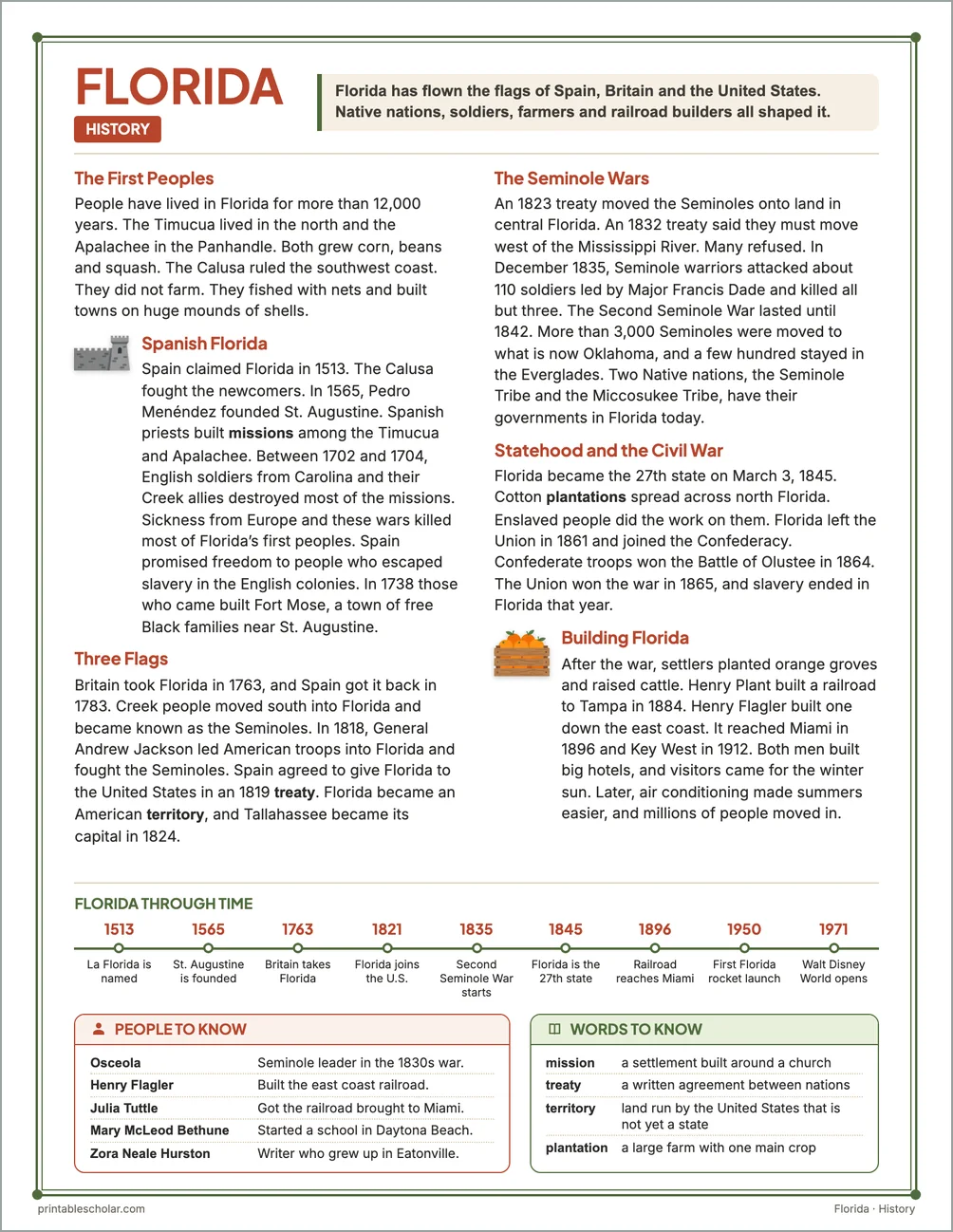
The First Peoples
People have lived in Florida for more than 12,000 years. The Timucua lived in the north and the Apalachee in the Panhandle. Both grew corn, beans and squash. The Calusa ruled the southwest coast. They did not farm. They fished with nets and built towns on huge mounds of shells.
Spanish Florida
Spain claimed Florida in 1513. The Calusa fought the newcomers. In 1565, Pedro Menéndez founded St. Augustine. Spanish priests built missions among the Timucua and Apalachee. Between 1702 and 1704, English soldiers from Carolina and their Creek allies destroyed most of the missions. Sickness from Europe and these wars killed most of Florida’s first peoples. Spain promised freedom to people who escaped slavery in the English colonies. In 1738 those who came built Fort Mose, a town of free Black families near St. Augustine.
Three Flags
Britain took Florida in 1763, and Spain got it back in 1783. Creek people moved south into Florida and became known as the Seminoles. In 1818, General Andrew Jackson led American troops into Florida and fought the Seminoles. Spain agreed to give Florida to the United States in an 1819 treaty. Florida became an American territory, and Tallahassee became its capital in 1824.
The Seminole Wars
An 1823 treaty moved the Seminoles onto land in central Florida. An 1832 treaty said they must move west of the Mississippi River. Many refused. In December 1835, Seminole warriors attacked about 110 soldiers led by Major Francis Dade and killed all but three. The Second Seminole War lasted until 1842. More than 3,000 Seminoles were moved to what is now Oklahoma, and a few hundred stayed in the Everglades. Two Native nations, the Seminole Tribe and the Miccosukee Tribe, have their governments in Florida today.
Statehood and the Civil War
Florida became the 27th state on March 3, 1845. Cotton plantations spread across north Florida. Enslaved people did the work on them. Florida left the Union in 1861 and joined the Confederacy. Confederate troops won the Battle of Olustee in 1864. The Union won the war in 1865, and slavery ended in Florida that year.
Building Florida
After the war, settlers planted orange groves and raised cattle. Henry Plant built a railroad to Tampa in 1884. Henry Flagler built one down the east coast. It reached Miami in 1896 and Key West in 1912. Both men built big hotels, and visitors came for the winter sun. Later, air conditioning made summers easier, and millions of people moved in.
Florida through time
- 1513 La Florida is named
- 1565 St. Augustine is founded
- 1763 Britain takes Florida
- 1821 Florida joins the U.S.
- 1835 Second Seminole War starts
- 1845 Florida is the 27th state
- 1896 Railroad reaches Miami
- 1950 First Florida rocket launch
- 1971 Walt Disney World opens
People to know
- Osceola: Seminole leader in the 1830s war.
- Henry Flagler: Built the east coast railroad.
- Julia Tuttle: Got the railroad brought to Miami.
- Mary McLeod Bethune: Started a school in Daytona Beach.
- Zora Neale Hurston: Writer who grew up in Eatonville.
Free Florida maps
Each of these maps is free to print on its own page. The kit puts them in one file with the reading pages and the booklet.