
Connecticut State Report Kit
Everything a student needs to research and write a report on Connecticut: the reading, the maps and the pages to fill in. Nothing else to look up.
- 3 reading pages: Connecticut fun facts, History, and Land and Work
- 5 maps: landmarks, cities, county, outline, and rivers and lakes
- An 8-page My State Report booklet, from fast facts to a trip plan and a license plate to design
- A pennant to cut out and hang, two map skills sheets and a 10-question reading quiz
- Answer keys for the quiz, the fast facts and the map sheets
- One print-ready PDF, 23 pages, black and white, US Letter
Look inside
Read it, map it, write it.
The reading pages and maps hold every answer the booklet asks for. About one third of the booklet is looking things up. The rest asks students to choose, plan and explain.

What is in the Connecticut kit
To read and study
- Connecticut fun facts: six short true stories, By the Numbers and Did You Know
- History: the state’s story in order, with a timeline, people to know and words to know
- Land and Work: the land and climate, what the state grows, makes and mines, and how one leads to the other
- Five maps, including a rivers, lakes and neighbors map with a letter key
To fill in and make
- My State Report booklet: cover, Fast Facts, My Map, State Symbols, My Trip, Think Like a Geographer, Design a License Plate and Dig Deeper
- A pennant with the state’s name and outline, to color, cut out and hang
- Name the Cities and Name the Rivers and Lakes sheets, each with a word bank
- A 10-question reading quiz, with answer keys for everything that has one right answer
Free: the Connecticut History reading page
One page on the history of Connecticut for grades 3 to 5, free to print in color or black and white. It is the second reading page in the kit.
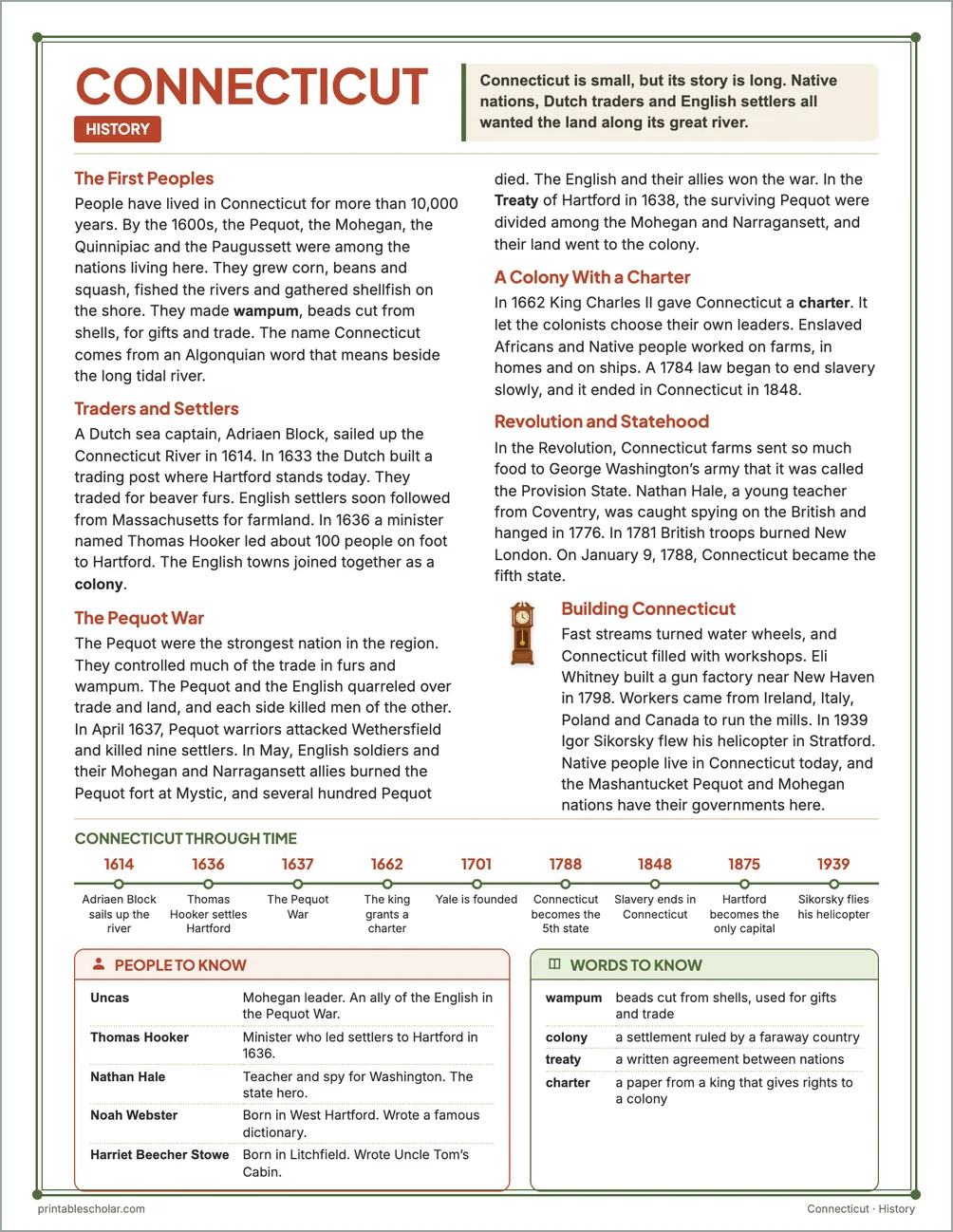
The First Peoples
People have lived in Connecticut for more than 10,000 years. By the 1600s, the Pequot, the Mohegan, the Quinnipiac and the Paugussett were among the nations living here. They grew corn, beans and squash, fished the rivers and gathered shellfish on the shore. They made wampum, beads cut from shells, for gifts and trade. The name Connecticut comes from an Algonquian word that means beside the long tidal river.
Traders and Settlers
A Dutch sea captain, Adriaen Block, sailed up the Connecticut River in 1614. In 1633 the Dutch built a trading post where Hartford stands today. They traded for beaver furs. English settlers soon followed from Massachusetts for farmland. In 1636 a minister named Thomas Hooker led about 100 people on foot to Hartford. The English towns joined together as a colony.
The Pequot War
The Pequot were the strongest nation in the region. They controlled much of the trade in furs and wampum. The Pequot and the English quarreled over trade and land, and each side killed men of the other. In April 1637, Pequot warriors attacked Wethersfield and killed nine settlers. In May, English soldiers and their Mohegan and Narragansett allies burned the Pequot fort at Mystic, and several hundred Pequot died. The English and their allies won the war. In the Treaty of Hartford in 1638, the surviving Pequot were divided among the Mohegan and Narragansett, and their land went to the colony.
A Colony With a Charter
In 1662 King Charles II gave Connecticut a charter. It let the colonists choose their own leaders. Enslaved Africans and Native people worked on farms, in homes and on ships. A 1784 law began to end slavery slowly, and it ended in Connecticut in 1848.
Revolution and Statehood
In the Revolution, Connecticut farms sent so much food to George Washington’s army that it was called the Provision State. Nathan Hale, a young teacher from Coventry, was caught spying on the British and hanged in 1776. In 1781 British troops burned New London. On January 9, 1788, Connecticut became the fifth state.
Building Connecticut
Fast streams turned water wheels, and Connecticut filled with workshops. Eli Whitney built a gun factory near New Haven in 1798. Workers came from Ireland, Italy, Poland and Canada to run the mills. In 1939 Igor Sikorsky flew his helicopter in Stratford. Native people live in Connecticut today, and the Mashantucket Pequot and Mohegan nations have their governments here.
Connecticut through time
- 1614 Adriaen Block sails up the river
- 1636 Thomas Hooker settles Hartford
- 1637 The Pequot War
- 1662 The king grants a charter
- 1701 Yale is founded
- 1788 Connecticut becomes the 5th state
- 1848 Slavery ends in Connecticut
- 1875 Hartford becomes the only capital
- 1939 Sikorsky flies his helicopter
People to know
- Uncas: Mohegan leader. An ally of the English in the Pequot War.
- Thomas Hooker: Minister who led settlers to Hartford in 1636.
- Nathan Hale: Teacher and spy for Washington. The state hero.
- Noah Webster: Born in West Hartford. Wrote a famous dictionary.
- Harriet Beecher Stowe: Born in Litchfield. Wrote Uncle Tom’s Cabin.
Free Connecticut maps
Each of these maps is free to print on its own page. The kit puts them in one file with the reading pages and the booklet.