
Alabama State Report Kit
Everything a student needs to research and write a report on Alabama: the reading, the maps and the pages to fill in. Nothing else to look up.
- 3 reading pages: Alabama fun facts, History, and Land and Work
- 5 maps: landmarks, cities, county, outline, and rivers and lakes
- An 8-page My State Report booklet, from fast facts to a trip plan and a license plate to design
- A pennant to cut out and hang, two map skills sheets and a 10-question reading quiz
- Answer keys for the quiz, the fast facts and the map sheets
- One print-ready PDF, 23 pages, black and white, US Letter
Look inside
Read it, map it, write it.
The reading pages and maps hold every answer the booklet asks for. About one third of the booklet is looking things up. The rest asks students to choose, plan and explain.

What is in the Alabama kit
To read and study
- Alabama fun facts: six short true stories, By the Numbers and Did You Know
- History: the state’s story in order, with a timeline, people to know and words to know
- Land and Work: the land and climate, what the state grows, makes and mines, and how one leads to the other
- Five maps, including a rivers, lakes and neighbors map with a letter key
To fill in and make
- My State Report booklet: cover, Fast Facts, My Map, State Symbols, My Trip, Think Like a Geographer, Design a License Plate and Dig Deeper
- A pennant with the state’s name and outline, to color, cut out and hang
- Name the Cities and Name the Rivers and Lakes sheets, each with a word bank
- A 10-question reading quiz, with answer keys for everything that has one right answer
Free: the Alabama History reading page
One page on the history of Alabama for grades 3 to 5, free to print in color or black and white. It is the second reading page in the kit.
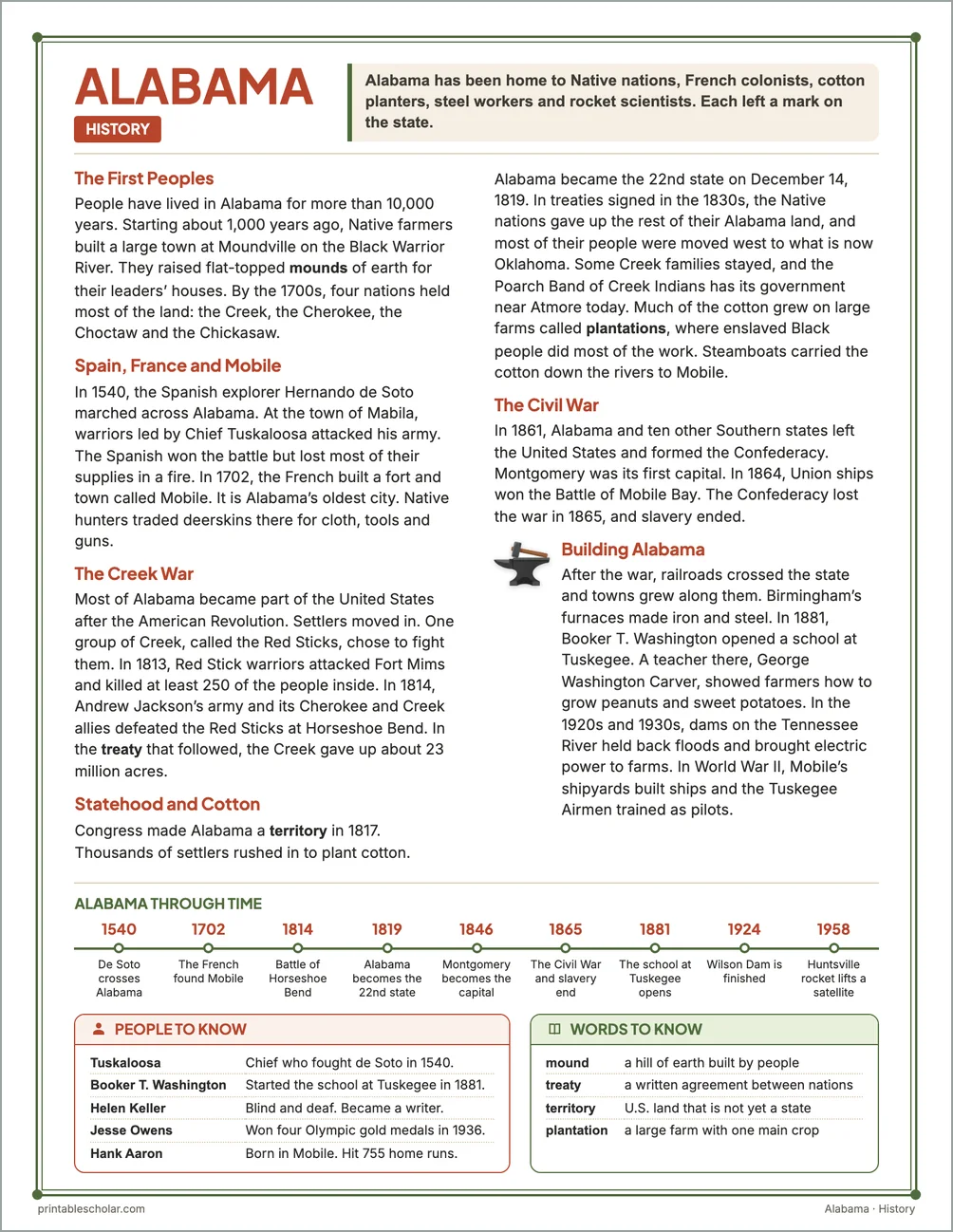
The First Peoples
People have lived in Alabama for more than 10,000 years. Starting about 1,000 years ago, Native farmers built a large town at Moundville on the Black Warrior River. They raised flat-topped mounds of earth for their leaders’ houses. By the 1700s, four nations held most of the land: the Creek, the Cherokee, the Choctaw and the Chickasaw.
Spain, France and Mobile
In 1540, the Spanish explorer Hernando de Soto marched across Alabama. At the town of Mabila, warriors led by Chief Tuskaloosa attacked his army. The Spanish won the battle but lost most of their supplies in a fire. In 1702, the French built a fort and town called Mobile. It is Alabama’s oldest city. Native hunters traded deerskins there for cloth, tools and guns.
The Creek War
Most of Alabama became part of the United States after the American Revolution. Settlers moved in. One group of Creek, called the Red Sticks, chose to fight them. In 1813, Red Stick warriors attacked Fort Mims and killed at least 250 of the people inside. In 1814, Andrew Jackson’s army and its Cherokee and Creek allies defeated the Red Sticks at Horseshoe Bend. In the treaty that followed, the Creek gave up about 23 million acres.
Statehood and Cotton
Congress made Alabama a territory in 1817. Thousands of settlers rushed in to plant cotton. Alabama became the 22nd state on December 14, 1819. In treaties signed in the 1830s, the Native nations gave up the rest of their Alabama land, and most of their people were moved west to what is now Oklahoma. Some Creek families stayed, and the Poarch Band of Creek Indians has its government near Atmore today. Much of the cotton grew on large farms called plantations, where enslaved Black people did most of the work. Steamboats carried the cotton down the rivers to Mobile.
The Civil War
In 1861, Alabama and ten other Southern states left the United States and formed the Confederacy. Montgomery was its first capital. In 1864, Union ships won the Battle of Mobile Bay. The Confederacy lost the war in 1865, and slavery ended.
Building Alabama
After the war, railroads crossed the state and towns grew along them. Birmingham’s furnaces made iron and steel. In 1881, Booker T. Washington opened a school at Tuskegee. A teacher there, George Washington Carver, showed farmers how to grow peanuts and sweet potatoes. In the 1920s and 1930s, dams on the Tennessee River held back floods and brought electric power to farms. In World War II, Mobile’s shipyards built ships and the Tuskegee Airmen trained as pilots.
Alabama through time
- 1540 De Soto crosses Alabama
- 1702 The French found Mobile
- 1814 Battle of Horseshoe Bend
- 1819 Alabama becomes the 22nd state
- 1846 Montgomery becomes the capital
- 1865 The Civil War and slavery end
- 1881 The school at Tuskegee opens
- 1924 Wilson Dam is finished
- 1958 Huntsville rocket lifts a satellite
People to know
- Tuskaloosa: Chief who fought de Soto in 1540.
- Booker T. Washington: Started the school at Tuskegee in 1881.
- Helen Keller: Blind and deaf. Became a writer.
- Jesse Owens: Won four Olympic gold medals in 1936.
- Hank Aaron: Born in Mobile. Hit 755 home runs.
Free Alabama maps
Each of these maps is free to print on its own page. The kit puts them in one file with the reading pages and the booklet.