A hundred chart with the 25 prime numbers from 1 to 100 circled, the same primes as a large-print list, and all 168 primes below 1,000 on one page. A blank hundred chart lets students find the primes themselves. Everything prints in black and white.
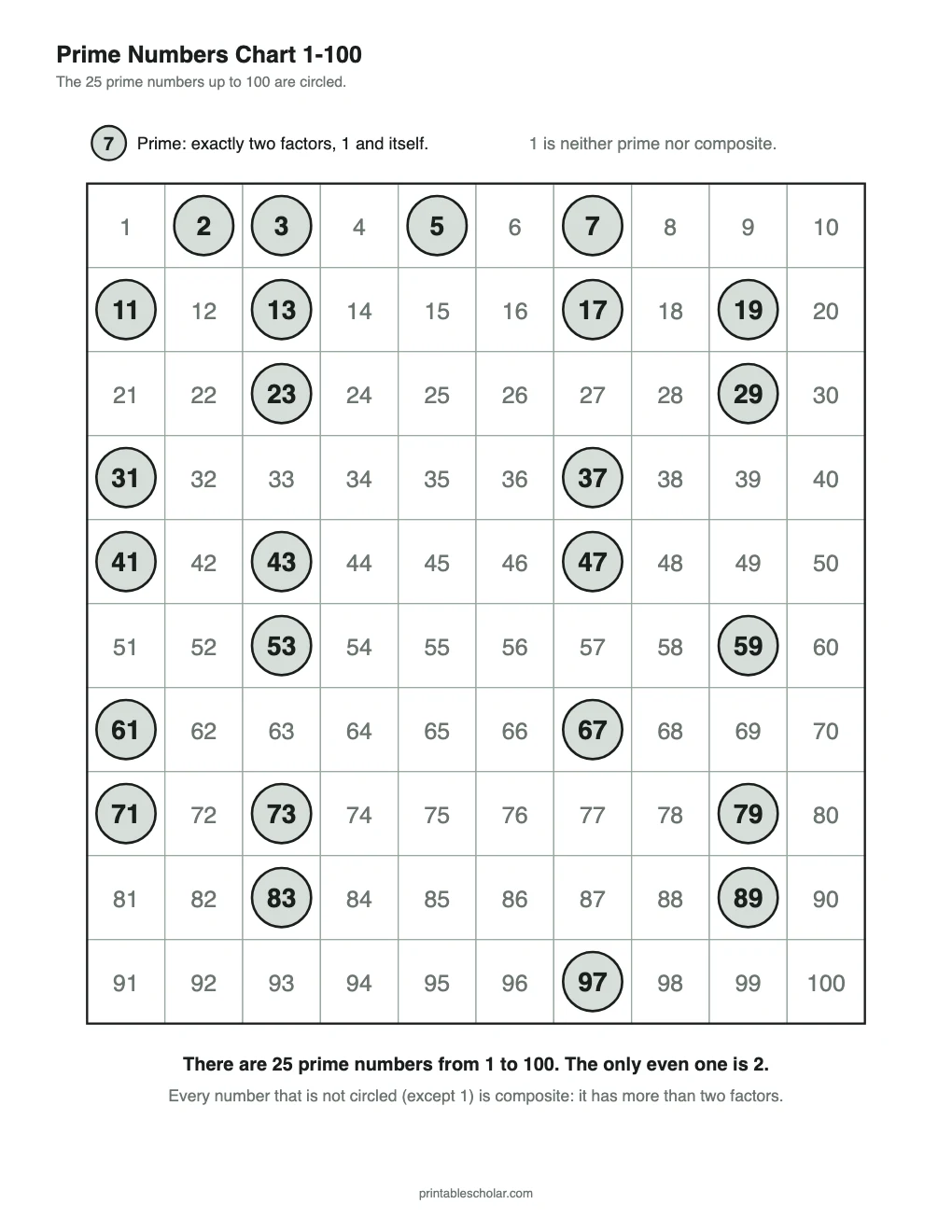
A hundred chart with the 25 primes circled and shaded. Easy to see that they thin out and that 2 is the only even one.
Download PDF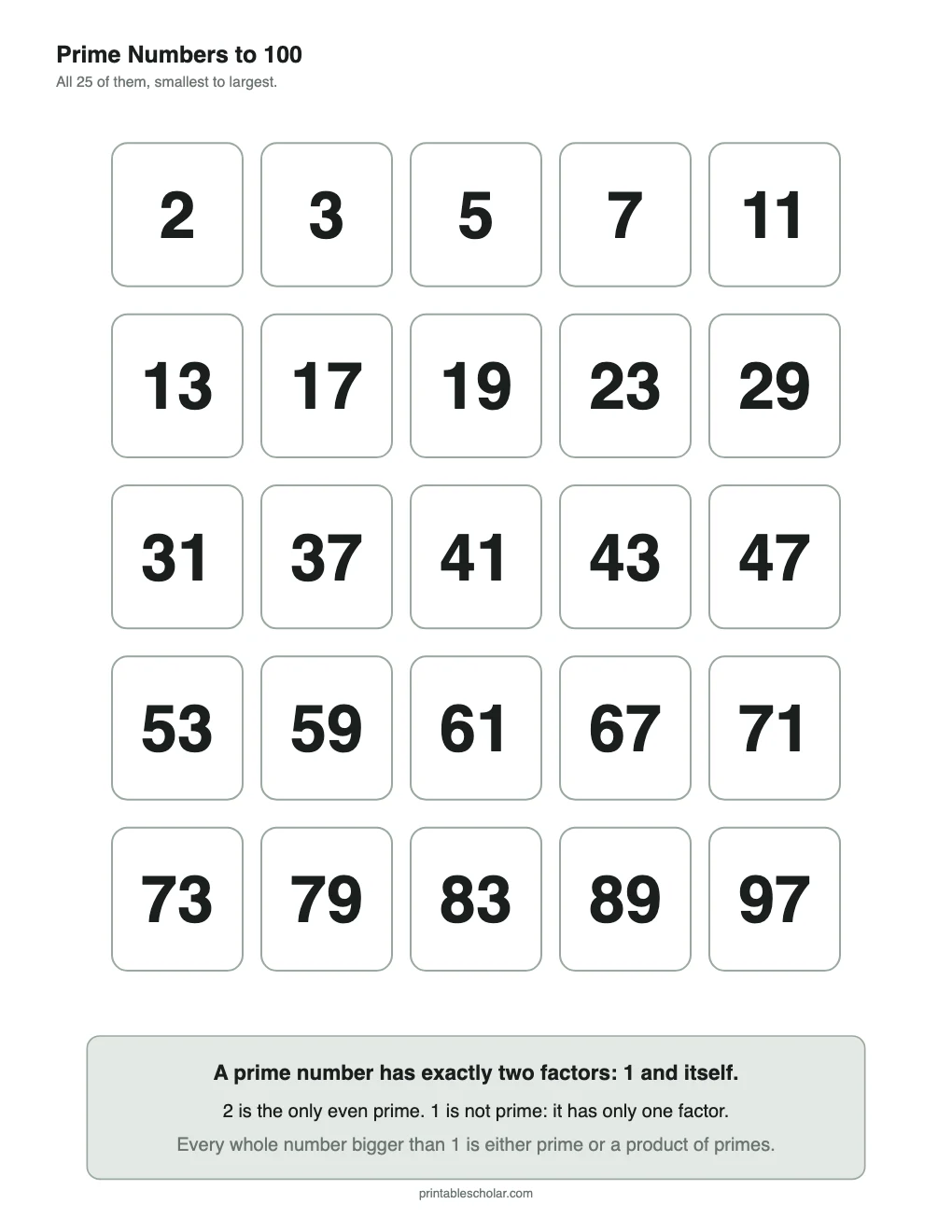
The 25 primes in large type, five to a row, with what a prime number is. Big enough for a wall or a binder.
Download PDF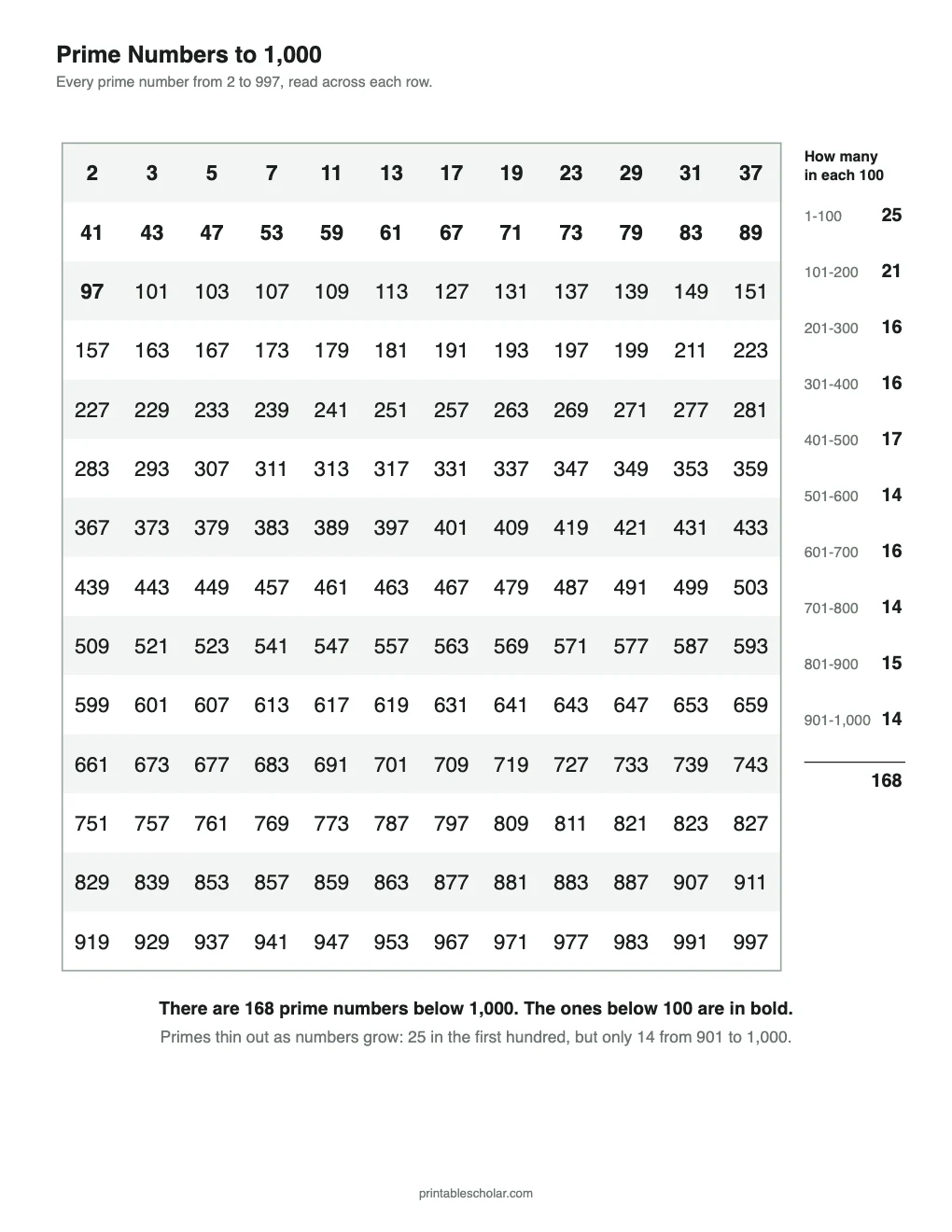
All 168 primes from 2 to 997, twelve to a row, with how many fall in each hundred.
Download PDF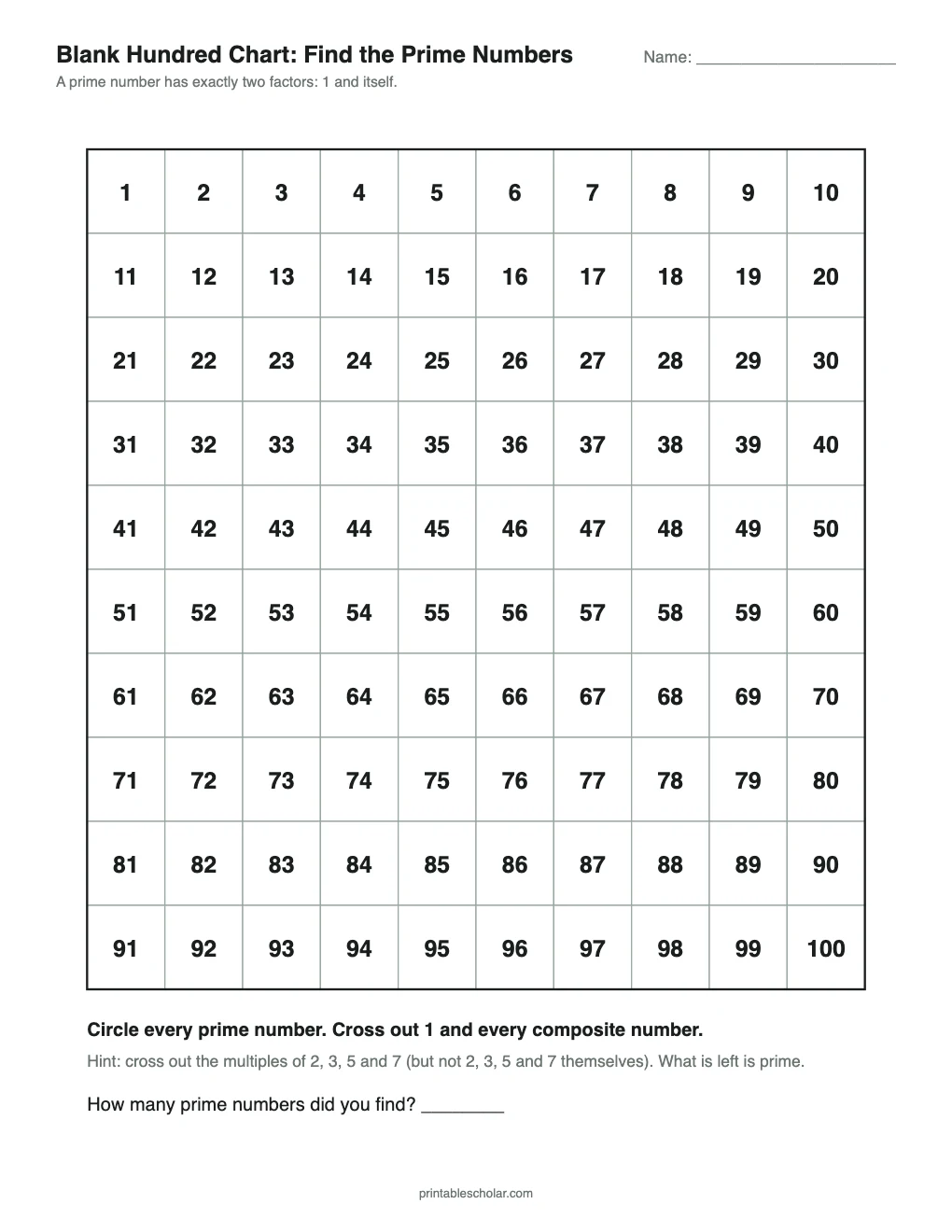
A plain hundred chart to circle the primes and cross out the rest. The 1-100 chart is the answer key.
Download PDFA prime number has exactly two factors: 1 and itself. 7 is prime because only 1 × 7 makes it. A composite number has more than two factors: 12 is 1 × 12, 2 × 6 and 3 × 4. The number 1 is neither, because it has only one factor.
There are 25 prime numbers from 1 to 100: 2, 3, 5, 7, 11, 13, 17, 19, 23, 29, 31, 37, 41, 43, 47, 53, 59, 61, 67, 71, 73, 79, 83, 89 and 97. On the chart they sit almost entirely in four columns, the ones ending in 1, 3, 7 and 9. Apart from 2 and 5, no prime can end in an even digit or a 5.
The list to 1,000 shows all 168 primes below one thousand, with a count for each hundred. The counts fall from 25 in the first hundred to 14 in the last, which is a good starting point for a conversation about why primes get rarer.
To find the primes on the blank chart, cross out 1, then cross out the multiples of 2, 3, 5 and 7 (but not those four numbers). Whatever is left is prime. This method is called the sieve of Eratosthenes. A step-by-step version with an answer key, and a Prime or Composite? worksheet, are on the factors and multiples worksheets page. The hundreds chart and multiplication chart are useful alongside.
 Printable Scholar