Subitizing: The Missing Step Between Counting on Fingers and Mental Math
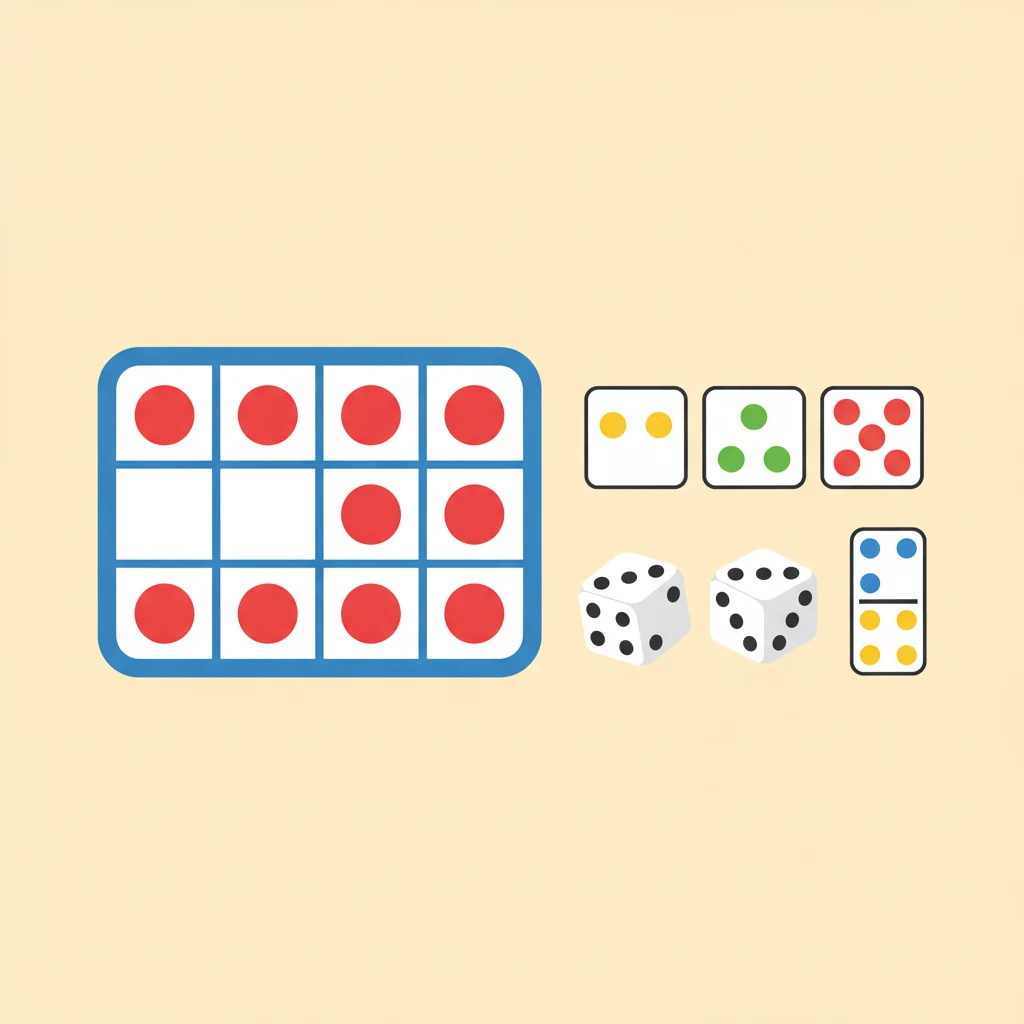
Here's a scene every parent of a first grader knows. The problem is 6 + 3. Your child holds up six fingers, then three more, then goes back and counts all nine from the very beginning — "one, two, three…" — as if she'd never seen the six she just made. Give her 6 + 4 a minute later and she does the whole thing again from one.
The instinct is to think she needs to drill her math facts harder. Usually she doesn't. What's missing isn't memorized answers — it's a quieter skill underneath them, one most parents have never heard named: subitizing, the ability to see a small quantity and just know how many without counting. It's the step between counting on fingers and doing math in your head, and it's the part that most "just practice your facts" advice skips right over.
First: finger counting is normal (and even useful)
Before we treat fingers as a symptom, it's worth saying plainly: counting on fingers is a healthy, effective stage of early math, not a bad habit. There's a whole line of research on finger gnosia — a child's awareness and mental map of their own fingers — showing that using fingers to represent numbers helps build the brain's sense of quantity, and that early finger sense actually correlates with later math achievement. Fingers are a child's first ten-frame. Banning them tends to backfire.
So the useful question isn't "how do I get her to stop using fingers?" It's "what has to develop so she doesn't need them for every problem?" The thing worth watching isn't the fingers themselves — it's counting-all: starting from one, every single time, even for quantities the child has counted a hundred times before. Most kids move past count-all during first grade and into second, swapping it for faster strategies like counting on and, eventually, just knowing. The child who's still counting every object from one long after that is the one whose number sense hasn't caught up yet — and subitizing is usually the piece that's missing.
What subitizing actually is
Researchers split it into two kinds, and the difference is the whole point.
Perceptual subitizing is the instant, effortless recognition of very small amounts — the two dots on a domino, the three candles you see without counting. It's close to innate, and for most people it tops out around three or four items before the brain has to start counting.
Conceptual subitizing is the powerful one. It's seeing a larger quantity as a combination of smaller groups: the six on a die read instantly as two threes, or eight dots seen as a five and a three. The term was formalized for early-childhood math by researchers Douglas Clements and Julie Sarama, who describe how this quick mental partitioning is exactly what lets children compose and decompose numbers. And composing and decomposing numbers is not a side skill — it is mental arithmetic.
Why it's the step between fingers and mental math
Watch what the count-all child and the subitizing child do differently with 6 + 3.
- The count-all child treats six as six separate things and three as three more, then re-counts all nine. Nothing is a unit; everything is a sequence. There is nothing to "just know."
- The subitizing child sees six as a chunk and counts on — "six… seven, eight, nine." Better still, shown 6 and 4, she sees them snap together into ten. She isn't recalling a memorized fact so much as seeing the relationship.
Every efficient strategy we want kids to reach — counting on, making ten, using doubles, part-whole thinking — depends on seeing quantities as units you can take apart and put back together. That's conceptual subitizing doing its job. Without it, telling a child to "memorize your facts" is asking her to memorize noise: the answers have nothing underneath them to stick to. It's the same reason we argue that you only really have to memorize a handful of multiplication facts once a child can see the structure — and the same pattern as reading, where fluency comes from understanding, not from a stopwatch. Automaticity is what you get after the meaning is there, not instead of it.
How strong is the evidence? Honest answer: the link is real but still firming up. A large 2022 study of about 3,600 kindergartners found that the children who were better subitizers had substantially better arithmetic in first grade. But a strong correlation isn't proof that teaching subitizing causes the gains — the controlled intervention studies so far are small (one 2024 study had just 14 preschoolers), and researchers are clear that larger trials are needed. So the sensible read is this: subitizing practice is quick, free, playful, and endorsed by the field's leading early-math researchers, who recommend using it right through elementary school. Build it because it's low-cost and well-grounded — not because it's a guaranteed fix for finger counting.
Why bother this early at all? Because the stakes are quietly high. In a landmark analysis of six long-term studies, Duncan and colleagues (2007) found that school-entry math skills were the single strongest predictor of later academic achievement — ahead of even early reading. Number sense is the soil the rest grows in, and subitizing is one of the cheapest ways to enrich it.
How to build it — five minutes, no worksheets required at first
Subitizing is about instant recognition, so the golden rule is fast and playful. If a child is counting, the arrangement was shown too long or has too many dots.
- Flash dot cards. Show a card with a small dot arrangement for about a second, hide it, and ask "how many?" Then ask the real question: "How did you see it?" When a child says "I saw three and two," that's conceptual subitizing out loud — that's the move you're growing.
- Play with dice and dominoes. Any game where you read the pips without counting is subitizing practice in disguise. Dominoes are especially good because each tile is already two groups.
- Use a ten-frame. This is the bridge to make-ten strategies. Show seven counters on a ten-frame and ask "how many? how many empty? so seven and how many more make ten?" You've just turned a picture into a fact.
- Flash your fingers — yes, fingers. Hold up seven fingers for a second and ask how many, without them counting. Fingers as instant quantities are subitizing; fingers counted one-by-one are not. Same tool, different job.
Five minutes a day, kept light, does more than a worksheet marathon. Once quantities feel solid, printable practice is a good next layer — our kindergarten math worksheets and addition worksheets lean on ten-frames and grouping rather than rote drill, so they reinforce the seeing, not just the answering.
When it's more than a stage
Most children shed count-all on their own through first and second grade with ordinary exposure. It's worth a closer look — and a conversation with your child's teacher — if, well into second grade and beyond, a child still counts every object from one every single time, can't recognize two or three without counting, has no feel for which of two small numbers is bigger, or keeps losing track partway through counting.
Persistent trouble like that can point to a working-memory load the child is compensating for, or to the kind of learning difference that benefits from early support — dyscalculia, the math counterpart to dyslexia, is real and often missed. And sometimes a perfectly capable child retreats to slow, safe counting because of math anxiety, not ability. None of this is something to diagnose at the kitchen table. It's simply information — and getting a knowledgeable set of eyes on it early is never the wrong call.
Start with quantity, not answers
Build the seeing first, then let the facts follow. Our free kindergarten math and addition worksheets use ten-frames and grouping to strengthen number sense — the foundation subitizing is quietly building.
Browse the free math worksheetsFrequently asked questions
At what age should a child be able to subitize? Most children can perceptually subitize small amounts (two, three, sometimes four) by around age four or five. Conceptual subitizing — seeing groups within groups — develops later and keeps growing through early elementary. Researchers recommend using subitizing activities right through the elementary years, not just in preschool.
Is it bad that my child counts on their fingers? No. Finger counting is a normal, useful stage and even helps build number sense. Watch the pattern, not the fingers: the thing to notice is a child still counting everything from one, every time, well past second grade — not the fingers themselves.
How is subitizing different from counting? Counting is a one-by-one sequence — "one, two, three." Subitizing is seeing the amount all at once, or as familiar groups, without stepping through it. Counting tells you how many; subitizing lets you skip the count.
We already drill math facts every day. Isn't that enough? Drilling builds speed once quantities mean something. If a child has little number sense underneath, memorizing facts is memorizing noise — it doesn't transfer. Build the seeing and the facts together; the drills stick far better when they have structure to attach to.
How much practice does it take? A few minutes a day, kept fast and playful, is plenty. Subitizing is trained by frequent short exposures, not long sessions — a couple of rounds of dot cards or a dice game beats a page of problems.