How to Teach Multiplication: You Only Have to Memorize 21 Facts
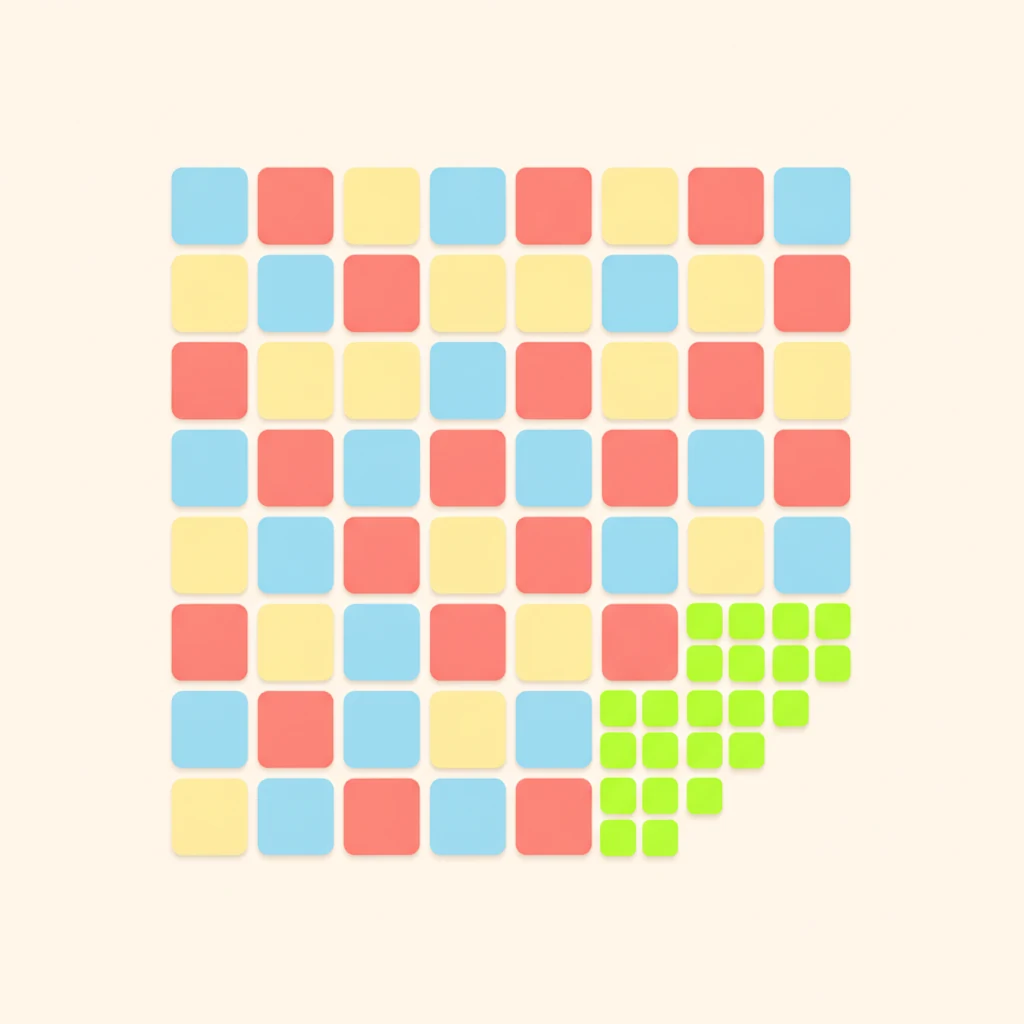
Stare at a 12×12 multiplication chart and it looks like a wall: 144 cells, 144 facts to drill into a six-year-old. That number is why multiplication feels like the hardest stretch of elementary math for a lot of families. It is also, mostly, an illusion. Once you account for how the chart is built, the real memorization load is about 21 facts — not 144. The rest follow rules a child can apply on sight.
To be clear up front: "21 facts" doesn't mean the other 123 cells are free of effort. It means only about 21 are arbitrary pairs a child has to commit to memory the hard way. The remaining facts come from a handful of patterns — and those patterns still need practice to become fast. But practicing six rules is a very different job than brute-forcing 144 unrelated answers, and knowing the difference is what lets you spend your teaching time where it actually matters. It's the same logic behind a structured approach to teaching phonics — teach the rules that generalize, and reserve real drilling for the handful of cases that are genuinely arbitrary.
Here is how the 144 collapses, and how to teach what's left.
Move 1: Commutativity cuts the chart in half
The single most important fact about the times table is that it's symmetric. 6×7 and 7×6 are the same fact — same answer, learned once. This is the commutative property, and on the chart it means the grid is a mirror image of itself along the diagonal that runs from the top-left corner down to the bottom-right.
So a child never has to learn 144 facts. They have to learn one of each pair, plus the squares that sit on the diagonal (3×3, 4×4, and so on). That alone takes the genuine memory work down to 78 distinct facts before we've done anything clever. Teach your child to see the symmetry early: if they know 8×3, they already know 3×8. Many kids carry the load of both halves of the chart simply because no one told them the two triangles are identical.
Move 2: Six rows are patterns, not memory work
Of the numbers 1 through 12, six of them produce answers a child can generate from a rule instead of recalling a memorized pair. Think of these as pattern facts: still worth practicing for speed, but governed by something a child can reason out rather than a fact they either know or don't.
- ×1 — the identity. Any number times 1 is itself. Nothing to memorize.
- ×2 — doubling. If a child can add a number to itself, they can multiply by 2. Most kids reach multiplication already able to double.
- ×5 — ends in 0 or 5. The answers march 5, 10, 15, 20… and every one ends in a 5 or a 0. A useful bridge: 5×n is always half of 10×n.
- ×10 — append a zero. 10×7 is 7 with a 0 after it. The easiest rule on the chart.
- ×9 — the digit-sum and finger trick. For 9×1 through 9×10, the two digits of the answer add up to 9 (9×4 = 36, and 3+6 = 9), and the classic "fold down the fourth finger" trick gives the answer directly. One honest caveat: this clean pattern covers 9×1 to 9×10. It does not hold for 9×11 (99), so don't promise your child it works forever.
- ×11 — the repeated digit. For single-digit factors, 11×n is just n written twice: 11×4 = 44, 11×7 = 77. This is one of the most satisfying patterns for a young learner — but it only works cleanly for factors 1 through 9. At 11×10, 11×11, and 11×12 the pattern breaks (110, 121, 132), so treat those three as separate.
None of these are literally effortless — a child still has to learn the rule and practice applying it until it's quick. But that's six rules, not dozens of arbitrary answers. A printable multiplication chart is the ideal place to make the patterns visible: have your child trace the 9s and watch the digits flip, or read the 5s aloud and hear the 0–5 rhythm.
What's actually left: about 21 hard facts
Strip out the pattern rows (×1, ×2, ×5, ×9, ×10, ×11) and collapse the commutative duplicates, and the genuinely-must-memorize facts on a 12×12 chart come down to the products of just six numbers: 3, 4, 6, 7, 8, and 12. That's 21 facts in total.
Here they are — the entire real workload of the times table:
| Group | The facts to memorize |
|---|---|
| 3s | 3×3, 3×4, 3×6, 3×7, 3×8, 3×12 |
| 4s | 4×4, 4×6, 4×7, 4×8, 4×12 |
| 6s | 6×6, 6×7, 6×8, 6×12 |
| 7s | 7×7, 7×8, 7×12 |
| 8s | 8×8, 8×12 |
| 12s | 12×12 |
Twenty-one facts. The notorious hard ones — 6×7, 7×8, 8×7 — are all in here, which is exactly why they feel hard: they're the cells with no shortcut. If you're keeping score, leaving the 9s out as a "trick" is what gets you to 21. If you'd rather have your child simply memorize the 9s like any other fact, add their seven products back and the number is 28. Either way, you've gone from a wall of 144 to a list you can write on an index card.
How to teach the 21 with a printable chart
The chart isn't just a reference to hang on the wall — used right, it's the practice tool. Here's a sequence that works:
- Color-code a blank chart. Print a 1–12 multiplication chart and have your child shade the pattern rows (1, 2, 5, 9, 10, 11) in one color. What's left uncolored is the 21 hard facts. Seeing the small island of "real" work is genuinely motivating — the scary chart suddenly looks manageable.
- Teach the patterns first, in order. ×1, ×10, ×2, ×5, then ×9 and ×11. Each is a quick win, and quick wins build the confidence a child needs before the grind.
- Drill the 21 in small batches. Three or four facts a week, not all at once. Start with the 3s and 4s (smaller numbers, easier to model with arrays or skip-counting) and save the 6s, 7s, and 8s for when fluency is building. Targeted multiplication worksheets let you practice one group at a time instead of re-drilling facts they already own.
- Give the hardest tables their own time. The 7 times table and 8 times table are where most kids stall, because almost every fact in them is on the must-memorize list. A few extra minutes a day on just those two pays off more than another pass through the whole chart.
Frequently asked questions
If the patterns still need practice, why bother separating them out? Because it changes how you spend your minutes. A child who has internalized the six rules can answer roughly 100 of the 144 cells without ever "studying" them — freeing your drilling time for the 21 that have no shortcut. It's triage, not a loophole.
What order should I teach the 21 hard facts? Smallest factors first: the 3s and 4s, then 6s, then 7s and 8s, and the 12s last (or via the 10n+2n decomposition). Smaller numbers are easier to picture as arrays and easier to reach by skip-counting, so they build the reasoning that makes the bigger facts stick.
Should we even bother with 11 and 12, or stop at 10? Most state standards expect fluency to 10×10, and some go to 12×12. The 11s are nearly free (the repeated-digit pattern), so they're worth the five minutes. The 12s add only two new memory facts (12×12, plus 8×12 and the like), and the 10n+2n trick handles the rest — so reaching 12 costs very little.
My child knows the chart but is slow. What now? Slowness almost always traces back to the 21 hard facts — especially 6×7, 7×8, and 8×9. Pull those onto flashcards or a blank chart and time just those. Fixing the handful of genuinely-hard cells is usually what turns "knows it" into "knows it fast." If recall stays effortful even after focused practice, the multisensory drills in our worksheets for dyslexic and ADHD kids can give a child a different way in.
Print a chart, shade the pattern rows, and look at what's left. That small uncolored cluster — about 21 facts — is the entire job. Teach those, practice the patterns to speed, and the wall of 144 stops being a wall.