
Oregon State Report Kit
Everything a student needs to research and write a report on Oregon: the reading, the maps and the pages to fill in. Nothing else to look up.
- 3 reading pages: Oregon fun facts, History, and Land and Work
- 5 maps: landmarks, cities, county, outline, and rivers and lakes
- An 8-page My State Report booklet, from fast facts to a trip plan and a license plate to design
- A pennant to cut out and hang, two map skills sheets and a 10-question reading quiz
- Answer keys for the quiz, the fast facts and the map sheets
- One print-ready PDF, 23 pages, black and white, US Letter
Teaching all 50 states? Get every kit for $39.
Look inside
Read it, map it, write it.
The reading pages and maps hold every answer the booklet asks for. About one third of the booklet is looking things up. The rest asks students to choose, plan and explain.

What is in the Oregon kit
To read and study
- Oregon fun facts: six short true stories, By the Numbers and Did You Know
- History: the state’s story in order, with a timeline, people to know and words to know
- Land and Work: the land and climate, what the state grows, makes and mines, and how one leads to the other
- Five maps, including a rivers, lakes and neighbors map with a letter key
To fill in and make
- My State Report booklet: cover, Fast Facts, My Map, State Symbols, My Trip, Think Like a Geographer, Design a License Plate and Dig Deeper
- A pennant with the state’s name and outline, to color, cut out and hang
- Name the Cities and Name the Rivers and Lakes sheets, each with a word bank
- A 10-question reading quiz, with answer keys for everything that has one right answer
Free: the Oregon History reading page
One page on the history of Oregon for grades 3 to 5, free to print in color or black and white. It is the second reading page in the kit.
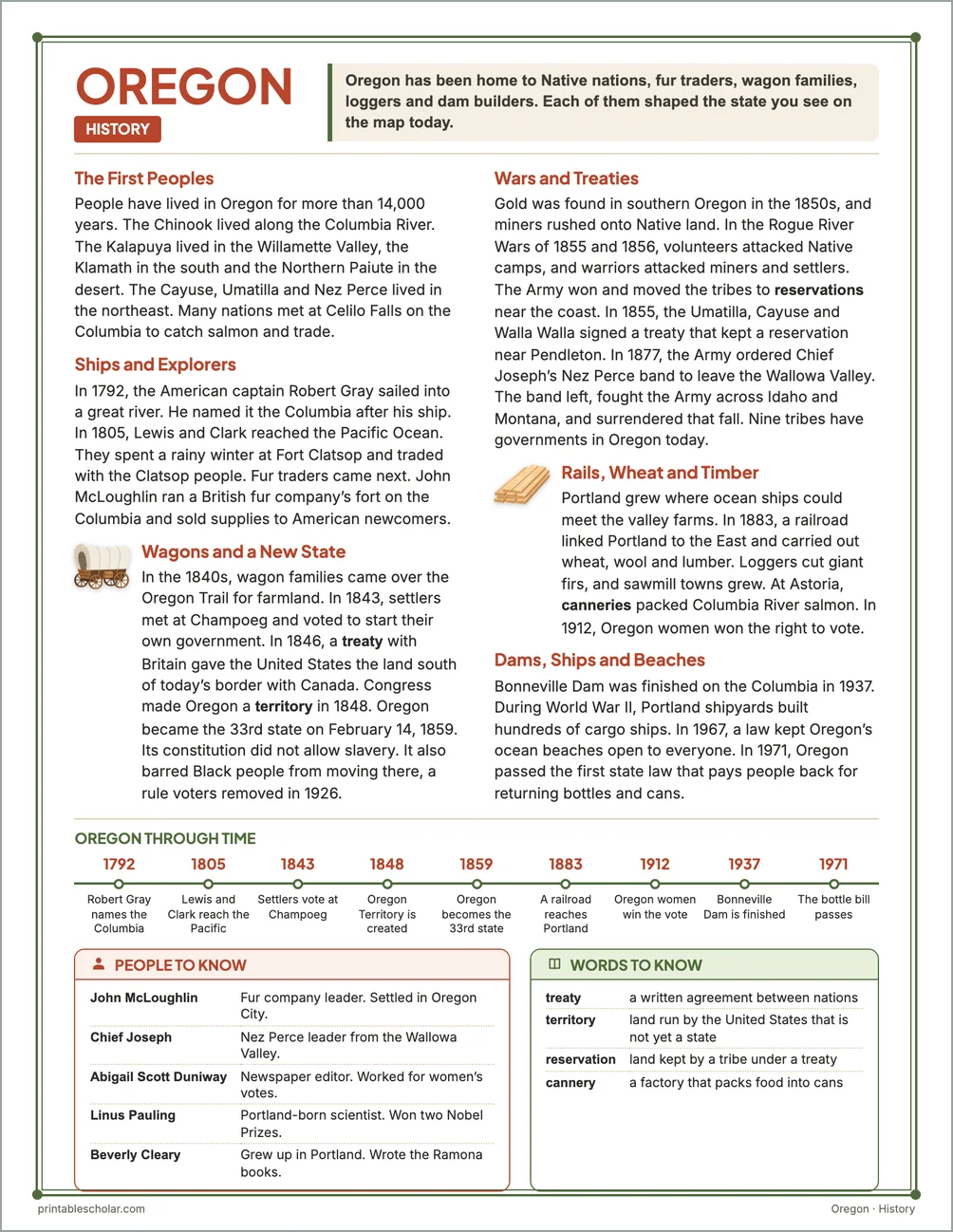
The First Peoples
People have lived in Oregon for more than 14,000 years. The Chinook lived along the Columbia River. The Kalapuya lived in the Willamette Valley, the Klamath in the south and the Northern Paiute in the desert. The Cayuse, Umatilla and Nez Perce lived in the northeast. Many nations met at Celilo Falls on the Columbia to catch salmon and trade.
Ships and Explorers
In 1792, the American captain Robert Gray sailed into a great river. He named it the Columbia after his ship. In 1805, Lewis and Clark reached the Pacific Ocean. They spent a rainy winter at Fort Clatsop and traded with the Clatsop people. Fur traders came next. John McLoughlin ran a British fur company’s fort on the Columbia and sold supplies to American newcomers.
Wagons and a New State
In the 1840s, wagon families came over the Oregon Trail for farmland. In 1843, settlers met at Champoeg and voted to start their own government. In 1846, a treaty with Britain gave the United States the land south of today’s border with Canada. Congress made Oregon a territory in 1848. Oregon became the 33rd state on February 14, 1859. Its constitution did not allow slavery. It also barred Black people from moving there, a rule voters removed in 1926.
Wars and Treaties
Gold was found in southern Oregon in the 1850s, and miners rushed onto Native land. In the Rogue River Wars of 1855 and 1856, volunteers attacked Native camps, and warriors attacked miners and settlers. The Army won and moved the tribes to reservations near the coast. In 1855, the Umatilla, Cayuse and Walla Walla signed a treaty that kept a reservation near Pendleton. In 1877, the Army ordered Chief Joseph’s Nez Perce band to leave the Wallowa Valley. The band left, fought the Army across Idaho and Montana, and surrendered that fall. Nine tribes have governments in Oregon today.
Rails, Wheat and Timber
Portland grew where ocean ships could meet the valley farms. In 1883, a railroad linked Portland to the East and carried out wheat, wool and lumber. Loggers cut giant firs, and sawmill towns grew. At Astoria, canneries packed Columbia River salmon. In 1912, Oregon women won the right to vote.
Dams, Ships and Beaches
Bonneville Dam was finished on the Columbia in 1937. During World War II, Portland shipyards built hundreds of cargo ships. In 1967, a law kept Oregon’s ocean beaches open to everyone. In 1971, Oregon passed the first state law that pays people back for returning bottles and cans.
Oregon through time
- 1792 Robert Gray names the Columbia
- 1805 Lewis and Clark reach the Pacific
- 1843 Settlers vote at Champoeg
- 1848 Oregon Territory is created
- 1859 Oregon becomes the 33rd state
- 1883 A railroad reaches Portland
- 1912 Oregon women win the vote
- 1937 Bonneville Dam is finished
- 1971 The bottle bill passes
People to know
- John McLoughlin: Fur company leader. Settled in Oregon City.
- Chief Joseph: Nez Perce leader from the Wallowa Valley.
- Abigail Scott Duniway: Newspaper editor. Worked for women’s votes.
- Linus Pauling: Portland-born scientist. Won two Nobel Prizes.
- Beverly Cleary: Grew up in Portland. Wrote the Ramona books.
Free Oregon maps
Each of these maps is free to print on its own page. The kit puts them in one file with the reading pages and the booklet.