
Oklahoma State Report Kit
Everything a student needs to research and write a report on Oklahoma: the reading, the maps and the pages to fill in. Nothing else to look up.
- 3 reading pages: Oklahoma fun facts, History, and Land and Work
- 5 maps: landmarks, cities, county, outline, and rivers and lakes
- An 8-page My State Report booklet, from fast facts to a trip plan and a license plate to design
- A pennant to cut out and hang, two map skills sheets and a 10-question reading quiz
- Answer keys for the quiz, the fast facts and the map sheets
- One print-ready PDF, 23 pages, black and white, US Letter
Teaching all 50 states? Get every kit for $39.
Look inside
Read it, map it, write it.
The reading pages and maps hold every answer the booklet asks for. About one third of the booklet is looking things up. The rest asks students to choose, plan and explain.

What is in the Oklahoma kit
To read and study
- Oklahoma fun facts: six short true stories, By the Numbers and Did You Know
- History: the state’s story in order, with a timeline, people to know and words to know
- Land and Work: the land and climate, what the state grows, makes and mines, and how one leads to the other
- Five maps, including a rivers, lakes and neighbors map with a letter key
To fill in and make
- My State Report booklet: cover, Fast Facts, My Map, State Symbols, My Trip, Think Like a Geographer, Design a License Plate and Dig Deeper
- A pennant with the state’s name and outline, to color, cut out and hang
- Name the Cities and Name the Rivers and Lakes sheets, each with a word bank
- A 10-question reading quiz, with answer keys for everything that has one right answer
Free: the Oklahoma History reading page
One page on the history of Oklahoma for grades 3 to 5, free to print in color or black and white. It is the second reading page in the kit.
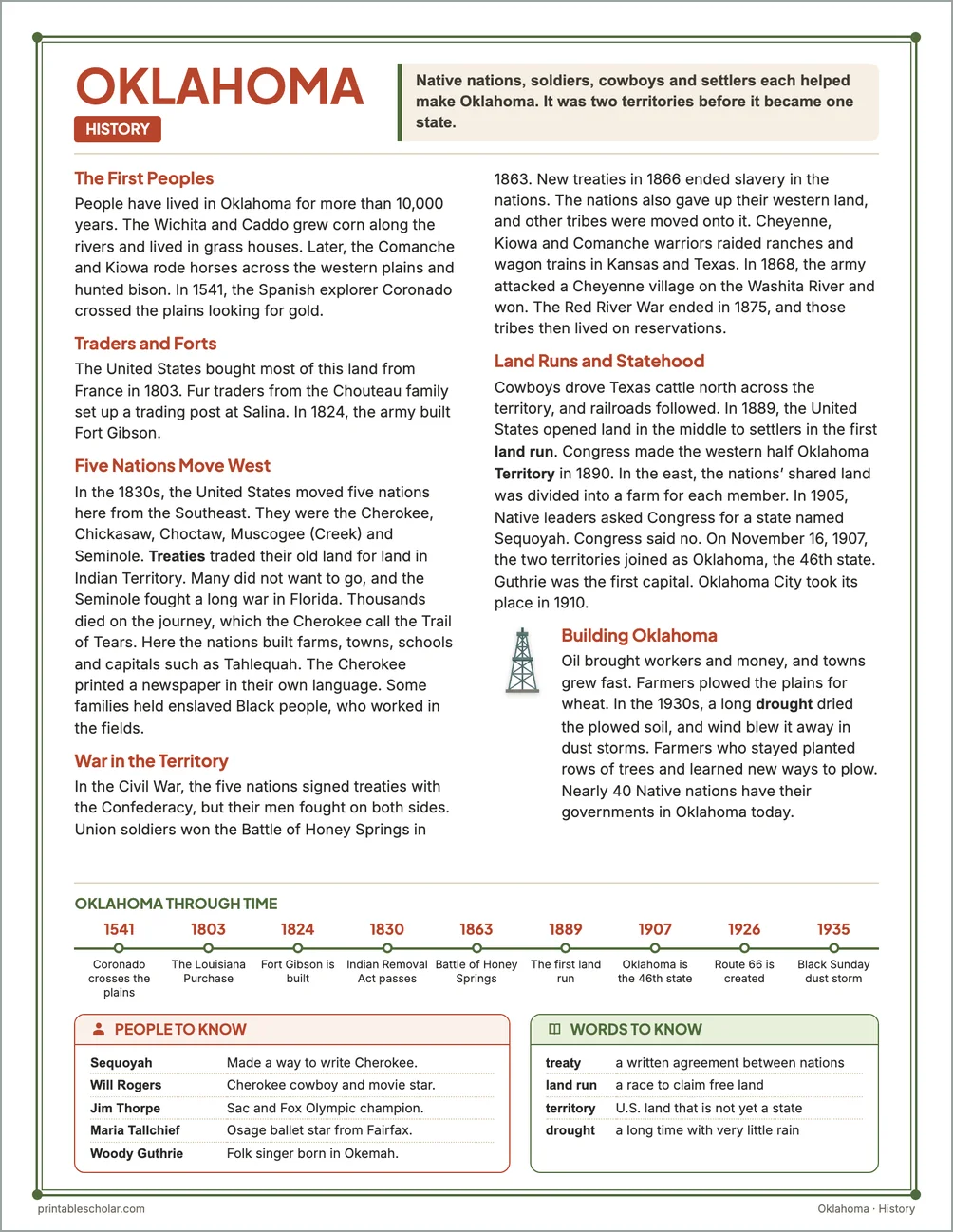
The First Peoples
People have lived in Oklahoma for more than 10,000 years. The Wichita and Caddo grew corn along the rivers and lived in grass houses. Later, the Comanche and Kiowa rode horses across the western plains and hunted bison. In 1541, the Spanish explorer Coronado crossed the plains looking for gold.
Traders and Forts
The United States bought most of this land from France in 1803. Fur traders from the Chouteau family set up a trading post at Salina. In 1824, the army built Fort Gibson.
Five Nations Move West
In the 1830s, the United States moved five nations here from the Southeast. They were the Cherokee, Chickasaw, Choctaw, Muscogee (Creek) and Seminole. Treaties traded their old land for land in Indian Territory. Many did not want to go, and the Seminole fought a long war in Florida. Thousands died on the journey, which the Cherokee call the Trail of Tears. Here the nations built farms, towns, schools and capitals such as Tahlequah. The Cherokee printed a newspaper in their own language. Some families held enslaved Black people, who worked in the fields.
War in the Territory
In the Civil War, the five nations signed treaties with the Confederacy, but their men fought on both sides. Union soldiers won the Battle of Honey Springs in 1863. New treaties in 1866 ended slavery in the nations. The nations also gave up their western land, and other tribes were moved onto it. Cheyenne, Kiowa and Comanche warriors raided ranches and wagon trains in Kansas and Texas. In 1868, the army attacked a Cheyenne village on the Washita River and won. The Red River War ended in 1875, and those tribes then lived on reservations.
Land Runs and Statehood
Cowboys drove Texas cattle north across the territory, and railroads followed. In 1889, the United States opened land in the middle to settlers in the first land run. Congress made the western half Oklahoma Territory in 1890. In the east, the nations’ shared land was divided into a farm for each member. In 1905, Native leaders asked Congress for a state named Sequoyah. Congress said no. On November 16, 1907, the two territories joined as Oklahoma, the 46th state. Guthrie was the first capital. Oklahoma City took its place in 1910.
Building Oklahoma
Oil brought workers and money, and towns grew fast. Farmers plowed the plains for wheat. In the 1930s, a long drought dried the plowed soil, and wind blew it away in dust storms. Farmers who stayed planted rows of trees and learned new ways to plow. Nearly 40 Native nations have their governments in Oklahoma today.
Oklahoma through time
- 1541 Coronado crosses the plains
- 1803 The Louisiana Purchase
- 1824 Fort Gibson is built
- 1830 Indian Removal Act passes
- 1863 Battle of Honey Springs
- 1889 The first land run
- 1907 Oklahoma is the 46th state
- 1926 Route 66 is created
- 1935 Black Sunday dust storm
People to know
- Sequoyah: Made a way to write Cherokee.
- Will Rogers: Cherokee cowboy and movie star.
- Jim Thorpe: Sac and Fox Olympic champion.
- Maria Tallchief: Osage ballet star from Fairfax.
- Woody Guthrie: Folk singer born in Okemah.
Free Oklahoma maps
Each of these maps is free to print on its own page. The kit puts them in one file with the reading pages and the booklet.