
Ohio State Report Kit
Everything a student needs to research and write a report on Ohio: the reading, the maps and the pages to fill in. Nothing else to look up.
- 3 reading pages: Ohio fun facts, History, and Land and Work
- 5 maps: landmarks, cities, county, outline, and rivers and lakes
- An 8-page My State Report booklet, from fast facts to a trip plan and a license plate to design
- A pennant to cut out and hang, two map skills sheets and a 10-question reading quiz
- Answer keys for the quiz, the fast facts and the map sheets
- One print-ready PDF, 23 pages, black and white, US Letter
Teaching all 50 states? Get every kit for $39.
Look inside
Read it, map it, write it.
The reading pages and maps hold every answer the booklet asks for. About one third of the booklet is looking things up. The rest asks students to choose, plan and explain.

What is in the Ohio kit
To read and study
- Ohio fun facts: six short true stories, By the Numbers and Did You Know
- History: the state’s story in order, with a timeline, people to know and words to know
- Land and Work: the land and climate, what the state grows, makes and mines, and how one leads to the other
- Five maps, including a rivers, lakes and neighbors map with a letter key
To fill in and make
- My State Report booklet: cover, Fast Facts, My Map, State Symbols, My Trip, Think Like a Geographer, Design a License Plate and Dig Deeper
- A pennant with the state’s name and outline, to color, cut out and hang
- Name the Cities and Name the Rivers and Lakes sheets, each with a word bank
- A 10-question reading quiz, with answer keys for everything that has one right answer
Free: the Ohio History reading page
One page on the history of Ohio for grades 3 to 5, free to print in color or black and white. It is the second reading page in the kit.
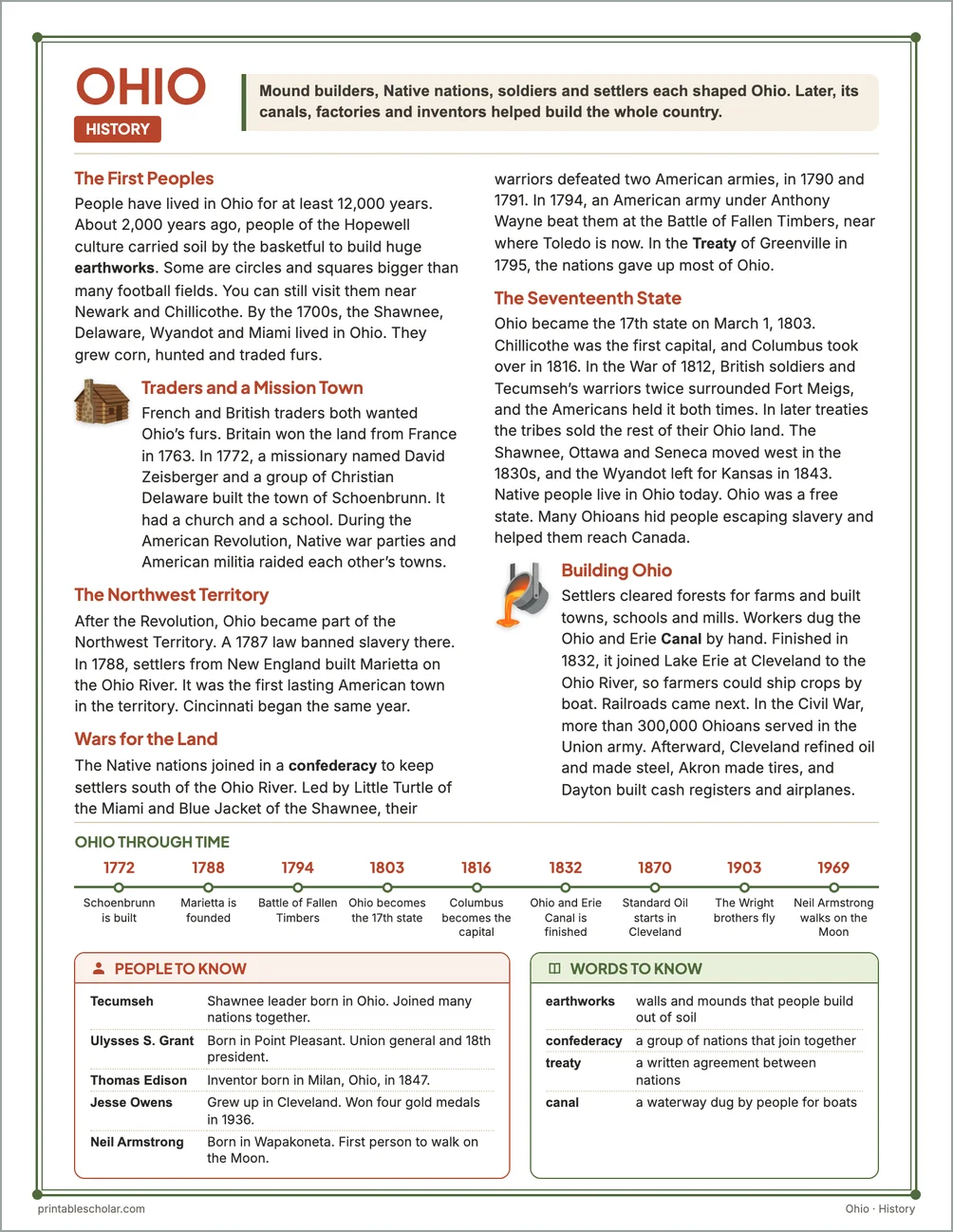
The First Peoples
People have lived in Ohio for at least 12,000 years. About 2,000 years ago, people of the Hopewell culture carried soil by the basketful to build huge earthworks. Some are circles and squares bigger than many football fields. You can still visit them near Newark and Chillicothe. By the 1700s, the Shawnee, Delaware, Wyandot and Miami lived in Ohio. They grew corn, hunted and traded furs.
Traders and a Mission Town
French and British traders both wanted Ohio’s furs. Britain won the land from France in 1763. In 1772, a missionary named David Zeisberger and a group of Christian Delaware built the town of Schoenbrunn. It had a church and a school. During the American Revolution, Native war parties and American militia raided each other’s towns.
The Northwest Territory
After the Revolution, Ohio became part of the Northwest Territory. A 1787 law banned slavery there. In 1788, settlers from New England built Marietta on the Ohio River. It was the first lasting American town in the territory. Cincinnati began the same year.
Wars for the Land
The Native nations joined in a confederacy to keep settlers south of the Ohio River. Led by Little Turtle of the Miami and Blue Jacket of the Shawnee, their warriors defeated two American armies, in 1790 and 1791. In 1794, an American army under Anthony Wayne beat them at the Battle of Fallen Timbers, near where Toledo is now. In the Treaty of Greenville in 1795, the nations gave up most of Ohio.
The Seventeenth State
Ohio became the 17th state on March 1, 1803. Chillicothe was the first capital, and Columbus took over in 1816. In the War of 1812, British soldiers and Tecumseh’s warriors twice surrounded Fort Meigs, and the Americans held it both times. In later treaties the tribes sold the rest of their Ohio land. The Shawnee, Ottawa and Seneca moved west in the 1830s, and the Wyandot left for Kansas in 1843. Native people live in Ohio today. Ohio was a free state. Many Ohioans hid people escaping slavery and helped them reach Canada.
Building Ohio
Settlers cleared forests for farms and built towns, schools and mills. Workers dug the Ohio and Erie Canal by hand. Finished in 1832, it joined Lake Erie at Cleveland to the Ohio River, so farmers could ship crops by boat. Railroads came next. In the Civil War, more than 300,000 Ohioans served in the Union army. Afterward, Cleveland refined oil and made steel, Akron made tires, and Dayton built cash registers and airplanes.
Ohio through time
- 1772 Schoenbrunn is built
- 1788 Marietta is founded
- 1794 Battle of Fallen Timbers
- 1803 Ohio becomes the 17th state
- 1816 Columbus becomes the capital
- 1832 Ohio and Erie Canal is finished
- 1870 Standard Oil starts in Cleveland
- 1903 The Wright brothers fly
- 1969 Neil Armstrong walks on the Moon
People to know
- Tecumseh: Shawnee leader born in Ohio. Joined many nations together.
- Ulysses S. Grant: Born in Point Pleasant. Union general and 18th president.
- Thomas Edison: Inventor born in Milan, Ohio, in 1847.
- Jesse Owens: Grew up in Cleveland. Won four gold medals in 1936.
- Neil Armstrong: Born in Wapakoneta. First person to walk on the Moon.
Free Ohio maps
Each of these maps is free to print on its own page. The kit puts them in one file with the reading pages and the booklet.