
New Jersey State Report Kit
Everything a student needs to research and write a report on New Jersey: the reading, the maps and the pages to fill in. Nothing else to look up.
- 3 reading pages: New Jersey fun facts, History, and Land and Work
- 5 maps: landmarks, cities, county, outline, and rivers and lakes
- An 8-page My State Report booklet, from fast facts to a trip plan and a license plate to design
- A pennant to cut out and hang, two map skills sheets and a 10-question reading quiz
- Answer keys for the quiz, the fast facts and the map sheets
- One print-ready PDF, 23 pages, black and white, US Letter
Teaching all 50 states? Get every kit for $39.
Look inside
Read it, map it, write it.
The reading pages and maps hold every answer the booklet asks for. About one third of the booklet is looking things up. The rest asks students to choose, plan and explain.

What is in the New Jersey kit
To read and study
- New Jersey fun facts: six short true stories, By the Numbers and Did You Know
- History: the state’s story in order, with a timeline, people to know and words to know
- Land and Work: the land and climate, what the state grows, makes and mines, and how one leads to the other
- Five maps, including a rivers, lakes and neighbors map with a letter key
To fill in and make
- My State Report booklet: cover, Fast Facts, My Map, State Symbols, My Trip, Think Like a Geographer, Design a License Plate and Dig Deeper
- A pennant with the state’s name and outline, to color, cut out and hang
- Name the Cities and Name the Rivers and Lakes sheets, each with a word bank
- A 10-question reading quiz, with answer keys for everything that has one right answer
Free: the New Jersey History reading page
One page on the history of New Jersey for grades 3 to 5, free to print in color or black and white. It is the second reading page in the kit.
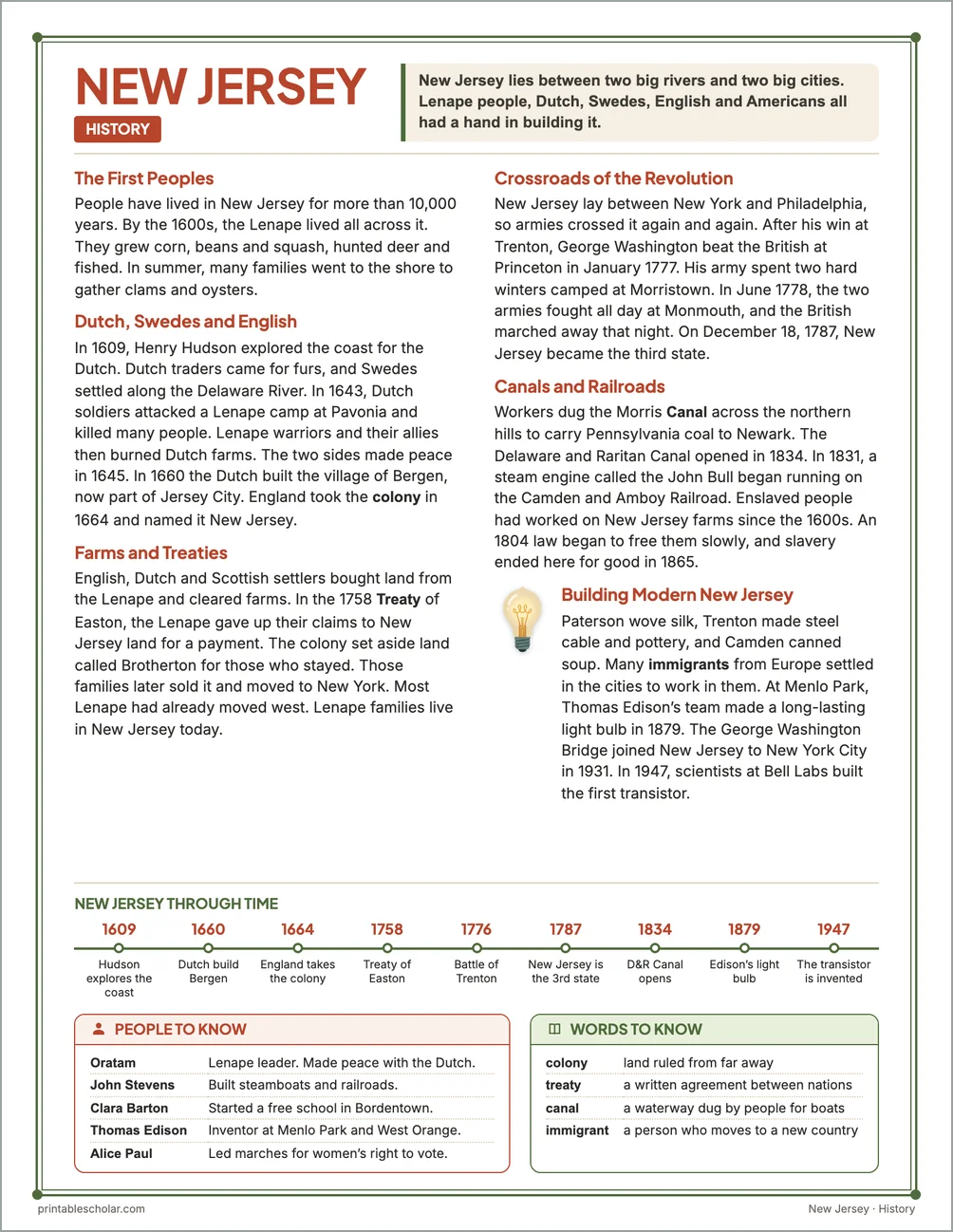
The First Peoples
People have lived in New Jersey for more than 10,000 years. By the 1600s, the Lenape lived all across it. They grew corn, beans and squash, hunted deer and fished. In summer, many families went to the shore to gather clams and oysters.
Dutch, Swedes and English
In 1609, Henry Hudson explored the coast for the Dutch. Dutch traders came for furs, and Swedes settled along the Delaware River. In 1643, Dutch soldiers attacked a Lenape camp at Pavonia and killed many people. Lenape warriors and their allies then burned Dutch farms. The two sides made peace in 1645. In 1660 the Dutch built the village of Bergen, now part of Jersey City. England took the colony in 1664 and named it New Jersey.
Farms and Treaties
English, Dutch and Scottish settlers bought land from the Lenape and cleared farms. In the 1758 Treaty of Easton, the Lenape gave up their claims to New Jersey land for a payment. The colony set aside land called Brotherton for those who stayed. Those families later sold it and moved to New York. Most Lenape had already moved west. Lenape families live in New Jersey today.
Crossroads of the Revolution
New Jersey lay between New York and Philadelphia, so armies crossed it again and again. After his win at Trenton, George Washington beat the British at Princeton in January 1777. His army spent two hard winters camped at Morristown. In June 1778, the two armies fought all day at Monmouth, and the British marched away that night. On December 18, 1787, New Jersey became the third state.
Canals and Railroads
Workers dug the Morris Canal across the northern hills to carry Pennsylvania coal to Newark. The Delaware and Raritan Canal opened in 1834. In 1831, a steam engine called the John Bull began running on the Camden and Amboy Railroad. Enslaved people had worked on New Jersey farms since the 1600s. An 1804 law began to free them slowly, and slavery ended here for good in 1865.
Building Modern New Jersey
Paterson wove silk, Trenton made steel cable and pottery, and Camden canned soup. Many immigrants from Europe settled in the cities to work in them. At Menlo Park, Thomas Edison’s team made a long-lasting light bulb in 1879. The George Washington Bridge joined New Jersey to New York City in 1931. In 1947, scientists at Bell Labs built the first transistor.
New Jersey through time
- 1609 Hudson explores the coast
- 1660 Dutch build Bergen
- 1664 England takes the colony
- 1758 Treaty of Easton
- 1776 Battle of Trenton
- 1787 New Jersey is the 3rd state
- 1834 D&R Canal opens
- 1879 Edison’s light bulb
- 1947 The transistor is invented
People to know
- Oratam: Lenape leader. Made peace with the Dutch.
- John Stevens: Built steamboats and railroads.
- Clara Barton: Started a free school in Bordentown.
- Thomas Edison: Inventor at Menlo Park and West Orange.
- Alice Paul: Led marches for women’s right to vote.
Free New Jersey maps
Each of these maps is free to print on its own page. The kit puts them in one file with the reading pages and the booklet.