
Nevada State Report Kit
Everything a student needs to research and write a report on Nevada: the reading, the maps and the pages to fill in. Nothing else to look up.
- 3 reading pages: Nevada fun facts, History, and Land and Work
- 5 maps: landmarks, cities, county, outline, and rivers and lakes
- An 8-page My State Report booklet, from fast facts to a trip plan and a license plate to design
- A pennant to cut out and hang, two map skills sheets and a 10-question reading quiz
- Answer keys for the quiz, the fast facts and the map sheets
- One print-ready PDF, 23 pages, black and white, US Letter
Teaching all 50 states? Get every kit for $39.
Look inside
Read it, map it, write it.
The reading pages and maps hold every answer the booklet asks for. About one third of the booklet is looking things up. The rest asks students to choose, plan and explain.

What is in the Nevada kit
To read and study
- Nevada fun facts: six short true stories, By the Numbers and Did You Know
- History: the state’s story in order, with a timeline, people to know and words to know
- Land and Work: the land and climate, what the state grows, makes and mines, and how one leads to the other
- Five maps, including a rivers, lakes and neighbors map with a letter key
To fill in and make
- My State Report booklet: cover, Fast Facts, My Map, State Symbols, My Trip, Think Like a Geographer, Design a License Plate and Dig Deeper
- A pennant with the state’s name and outline, to color, cut out and hang
- Name the Cities and Name the Rivers and Lakes sheets, each with a word bank
- A 10-question reading quiz, with answer keys for everything that has one right answer
Free: the Nevada History reading page
One page on the history of Nevada for grades 3 to 5, free to print in color or black and white. It is the second reading page in the kit.
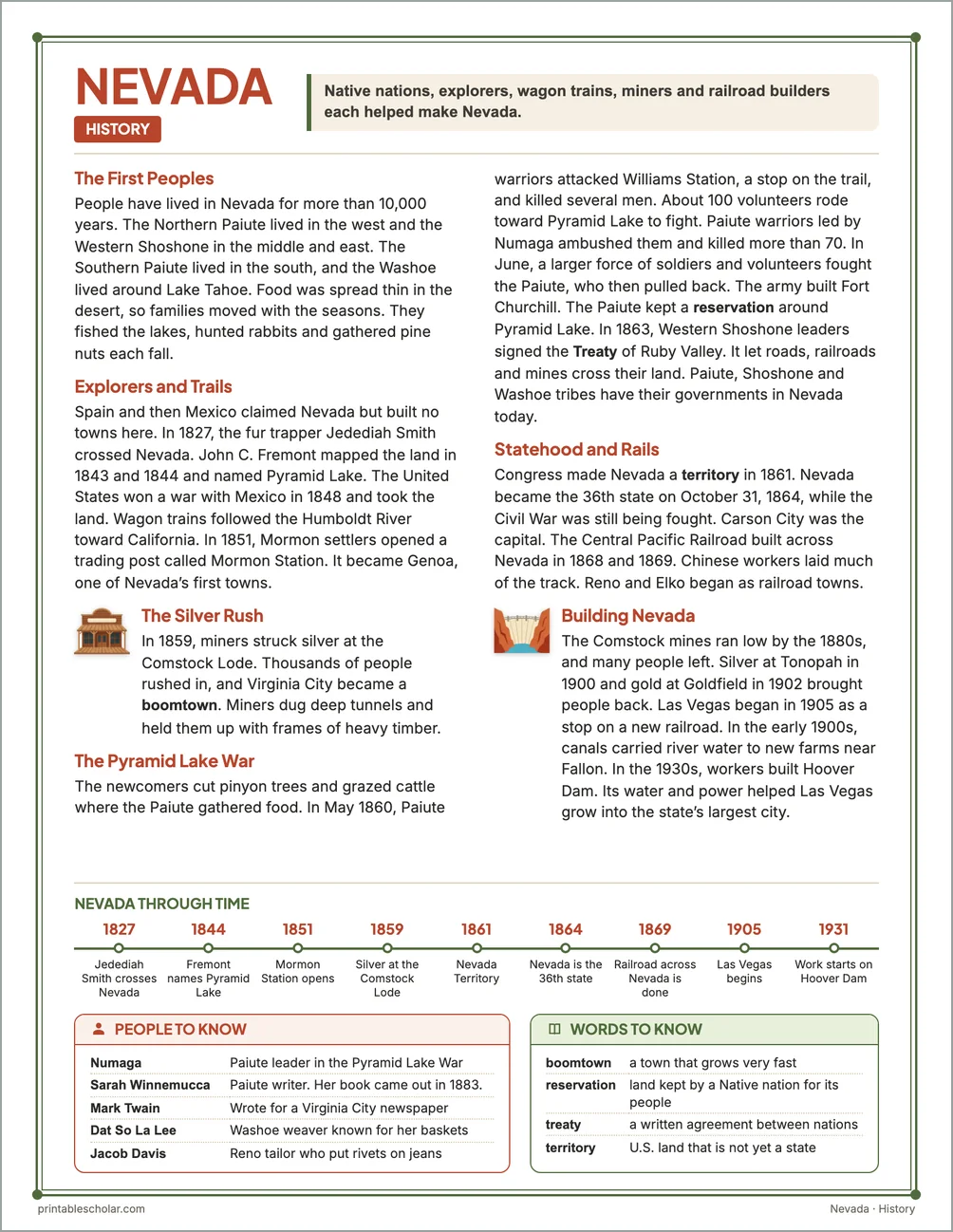
The First Peoples
People have lived in Nevada for more than 10,000 years. The Northern Paiute lived in the west and the Western Shoshone in the middle and east. The Southern Paiute lived in the south, and the Washoe lived around Lake Tahoe. Food was spread thin in the desert, so families moved with the seasons. They fished the lakes, hunted rabbits and gathered pine nuts each fall.
Explorers and Trails
Spain and then Mexico claimed Nevada but built no towns here. In 1827, the fur trapper Jedediah Smith crossed Nevada. John C. Fremont mapped the land in 1843 and 1844 and named Pyramid Lake. The United States won a war with Mexico in 1848 and took the land. Wagon trains followed the Humboldt River toward California. In 1851, Mormon settlers opened a trading post called Mormon Station. It became Genoa, one of Nevada’s first towns.
The Silver Rush
In 1859, miners struck silver at the Comstock Lode. Thousands of people rushed in, and Virginia City became a boomtown. Miners dug deep tunnels and held them up with frames of heavy timber.
The Pyramid Lake War
The newcomers cut pinyon trees and grazed cattle where the Paiute gathered food. In May 1860, Paiute warriors attacked Williams Station, a stop on the trail, and killed several men. About 100 volunteers rode toward Pyramid Lake to fight. Paiute warriors led by Numaga ambushed them and killed more than 70. In June, a larger force of soldiers and volunteers fought the Paiute, who then pulled back. The army built Fort Churchill. The Paiute kept a reservation around Pyramid Lake. In 1863, Western Shoshone leaders signed the Treaty of Ruby Valley. It let roads, railroads and mines cross their land. Paiute, Shoshone and Washoe tribes have their governments in Nevada today.
Statehood and Rails
Congress made Nevada a territory in 1861. Nevada became the 36th state on October 31, 1864, while the Civil War was still being fought. Carson City was the capital. The Central Pacific Railroad built across Nevada in 1868 and 1869. Chinese workers laid much of the track. Reno and Elko began as railroad towns.
Building Nevada
The Comstock mines ran low by the 1880s, and many people left. Silver at Tonopah in 1900 and gold at Goldfield in 1902 brought people back. Las Vegas began in 1905 as a stop on a new railroad. In the early 1900s, canals carried river water to new farms near Fallon. In the 1930s, workers built Hoover Dam. Its water and power helped Las Vegas grow into the state’s largest city.
Nevada through time
- 1827 Jedediah Smith crosses Nevada
- 1844 Fremont names Pyramid Lake
- 1851 Mormon Station opens
- 1859 Silver at the Comstock Lode
- 1861 Nevada Territory
- 1864 Nevada is the 36th state
- 1869 Railroad across Nevada is done
- 1905 Las Vegas begins
- 1931 Work starts on Hoover Dam
People to know
- Numaga: Paiute leader in the Pyramid Lake War
- Sarah Winnemucca: Paiute writer. Her book came out in 1883.
- Mark Twain: Wrote for a Virginia City newspaper
- Dat So La Lee: Washoe weaver known for her baskets
- Jacob Davis: Reno tailor who put rivets on jeans
Free Nevada maps
Each of these maps is free to print on its own page. The kit puts them in one file with the reading pages and the booklet.