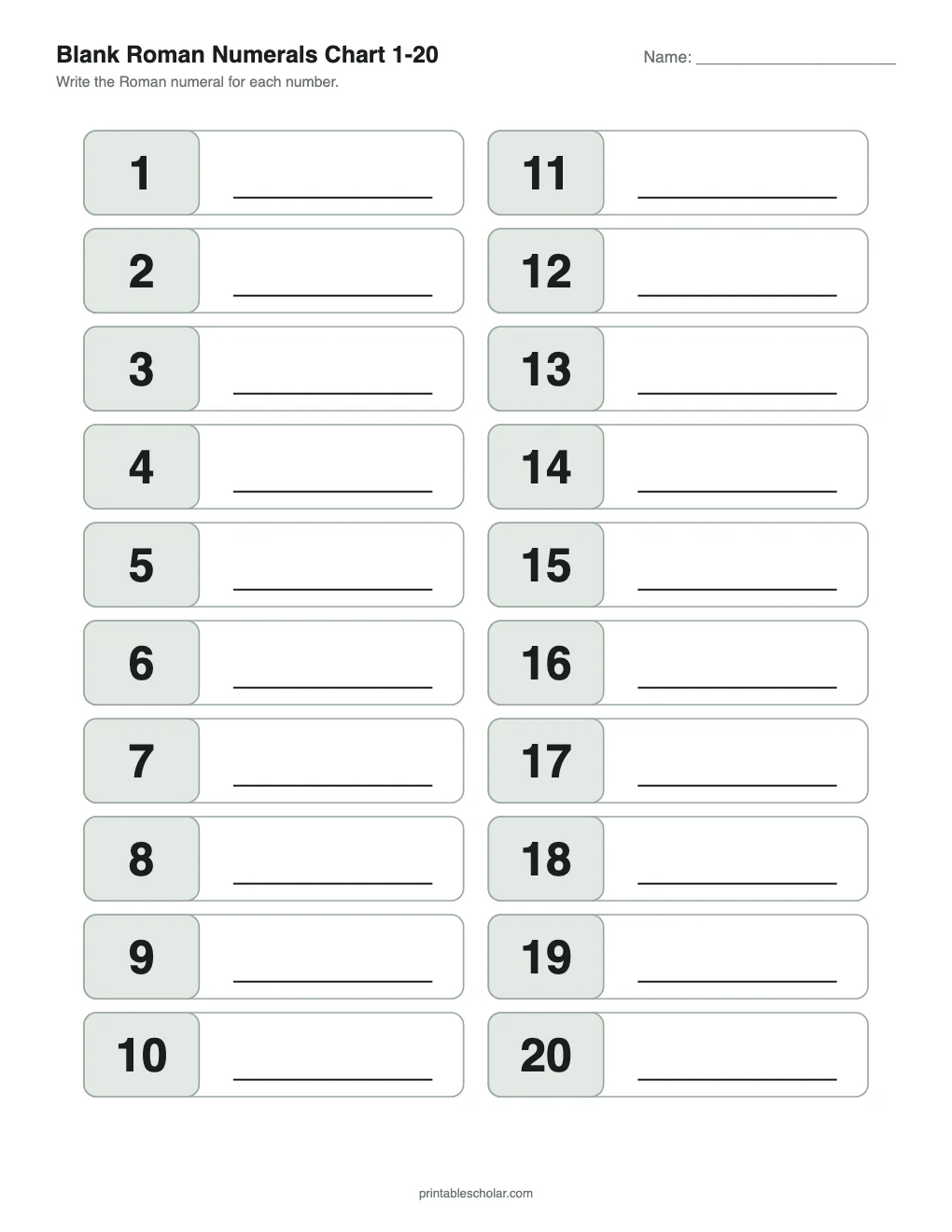
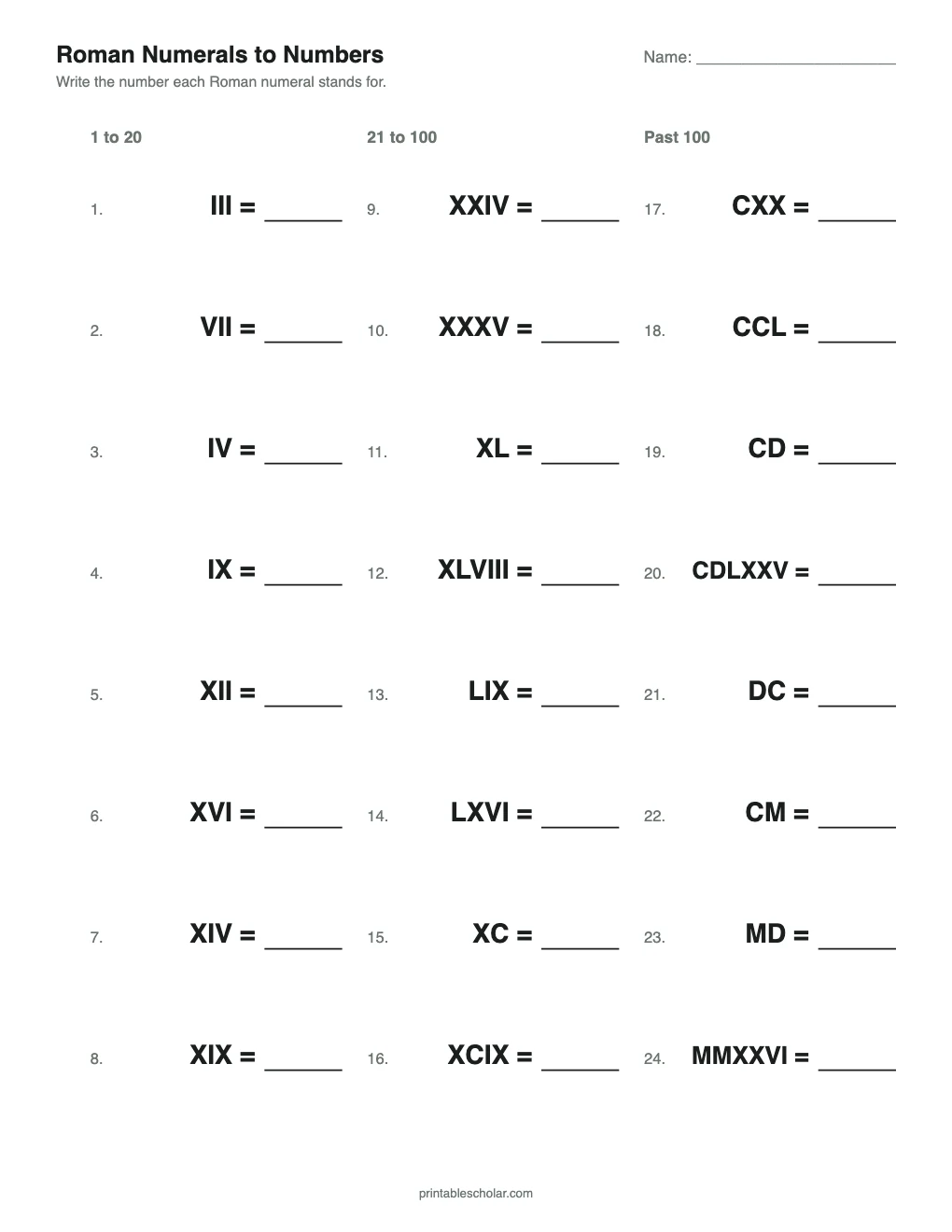
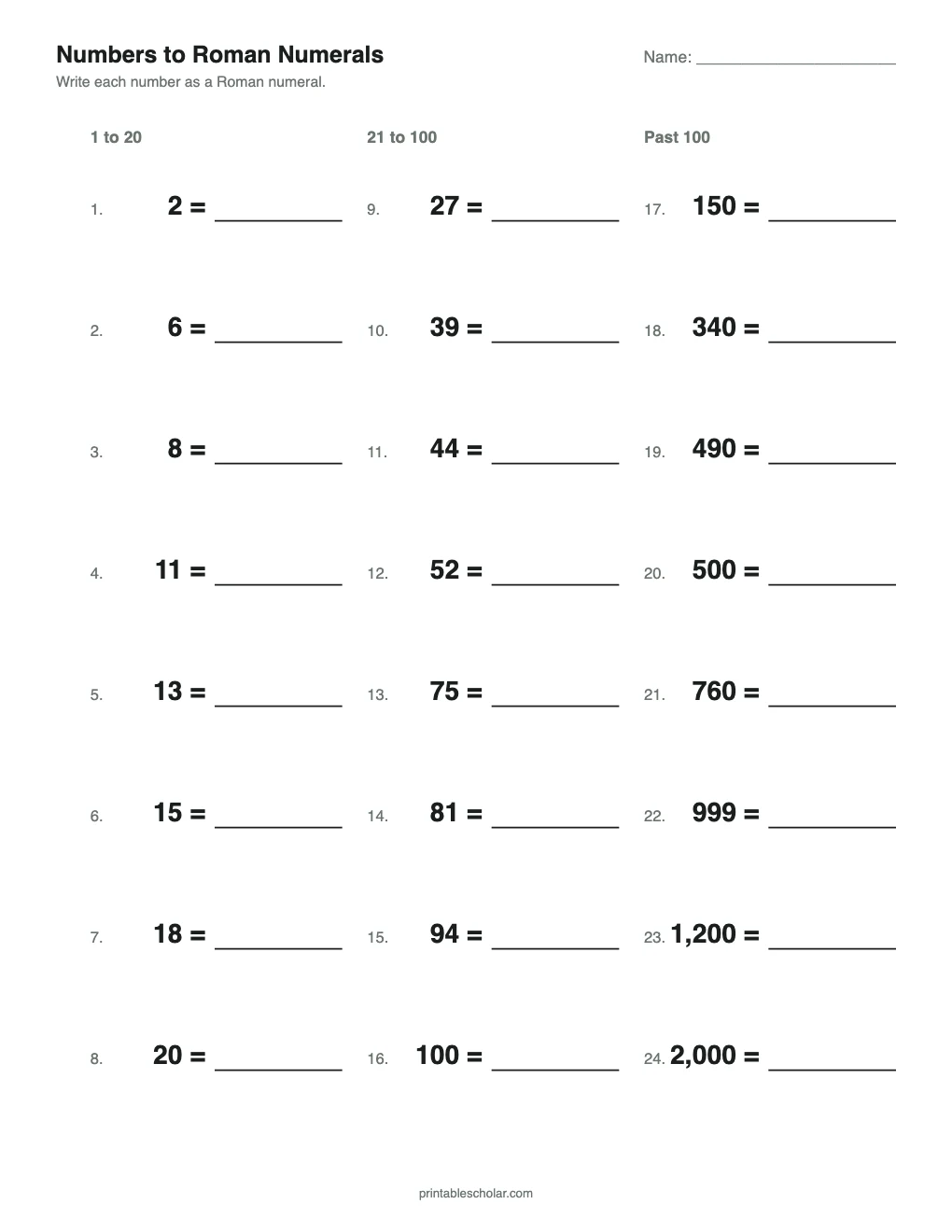
About the Roman Numerals Chart
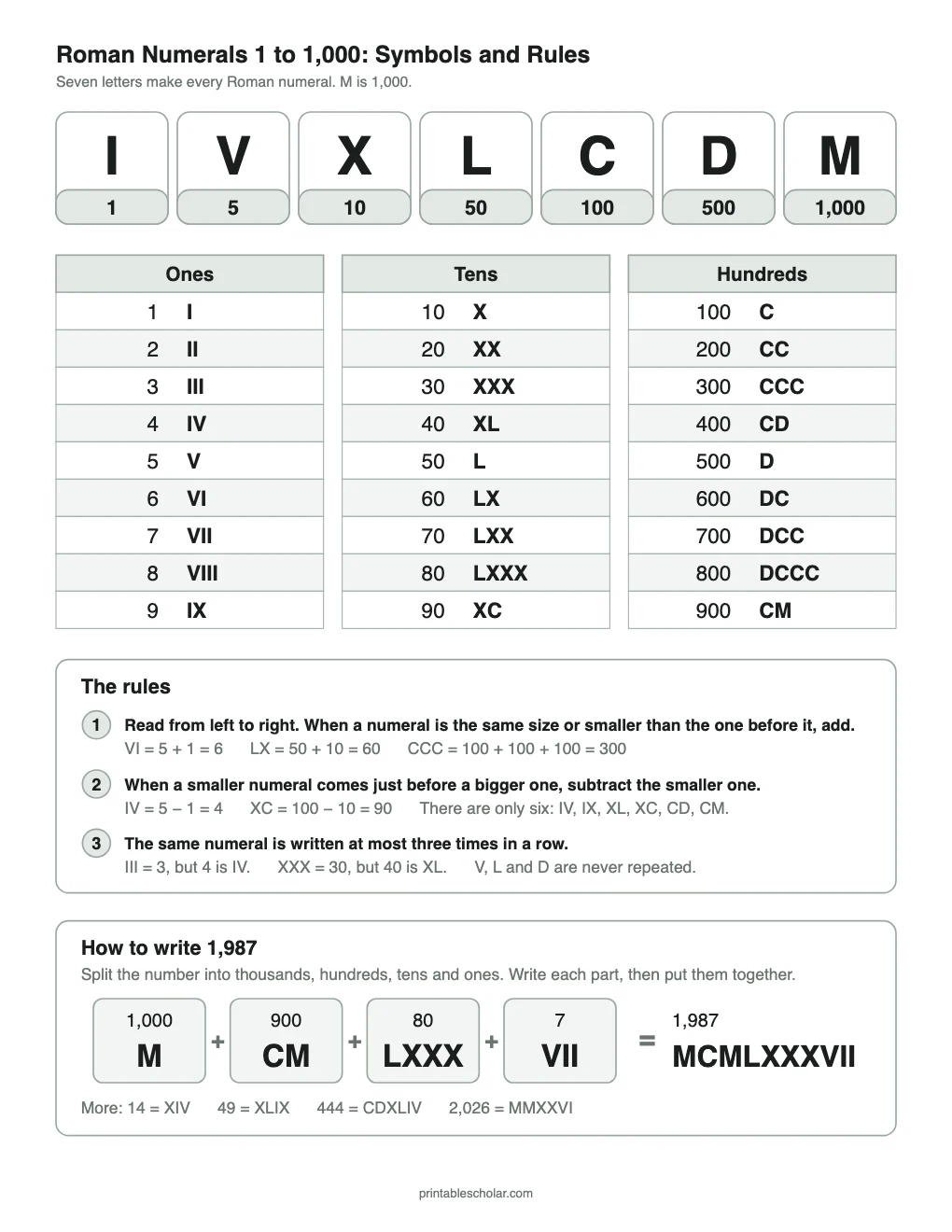
Roman numerals use seven letters: I is 1, V is 5, X is 10, L is 50, C is 100, D is 500 and M is 1,000. Every other number is made by putting those letters side by side. There is no zero and no place value, which is why 38 takes seven letters (XXXVIII) and 40 takes two (XL).
Two rules do most of the work. When a numeral is followed by one that is the same size or smaller, add: VI is 5 + 1, and LX is 50 + 10. When a smaller numeral comes just before a bigger one, subtract: IV is 5 − 1, and XC is 100 − 10. Only six pairs subtract: IV (4), IX (9), XL (40), XC (90), CD (400) and CM (900).
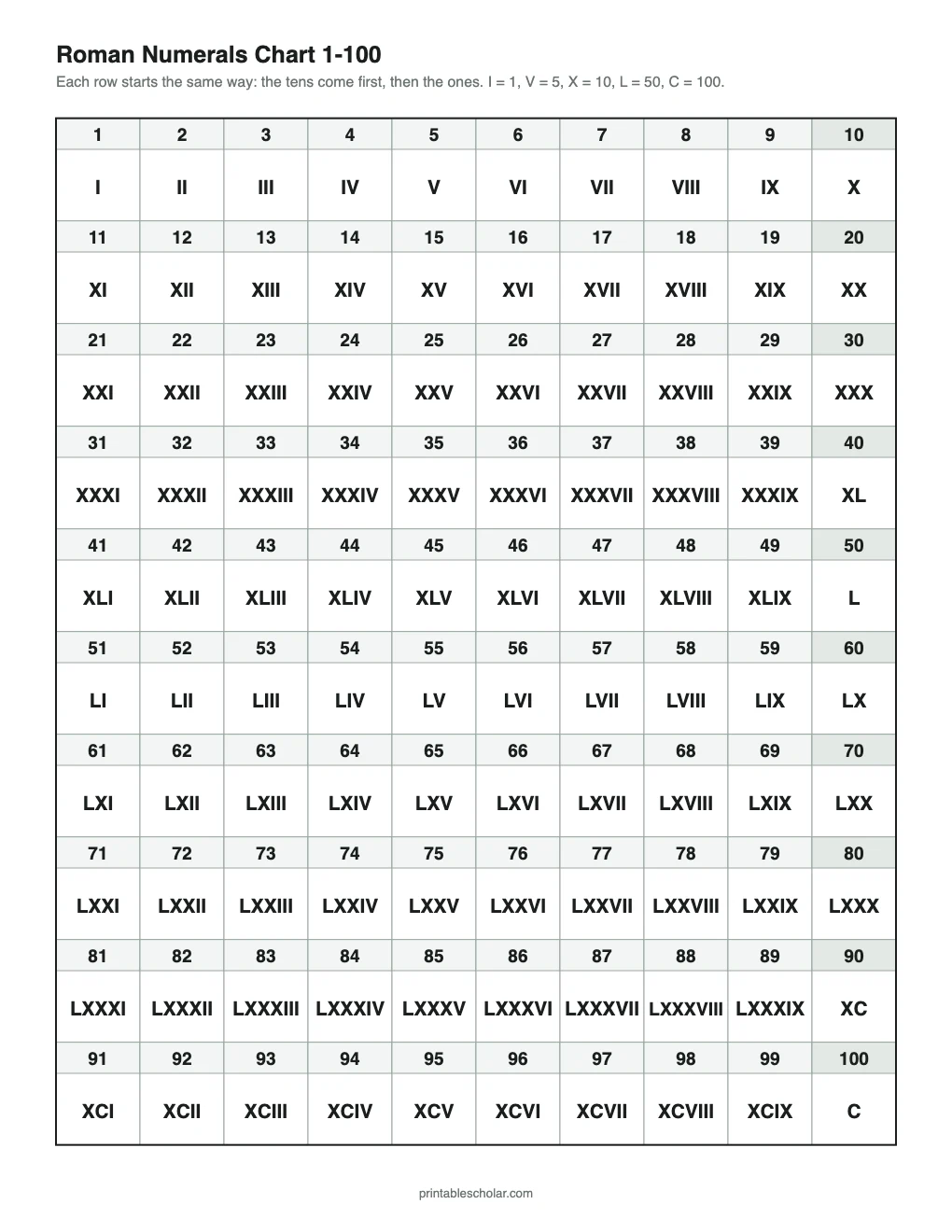
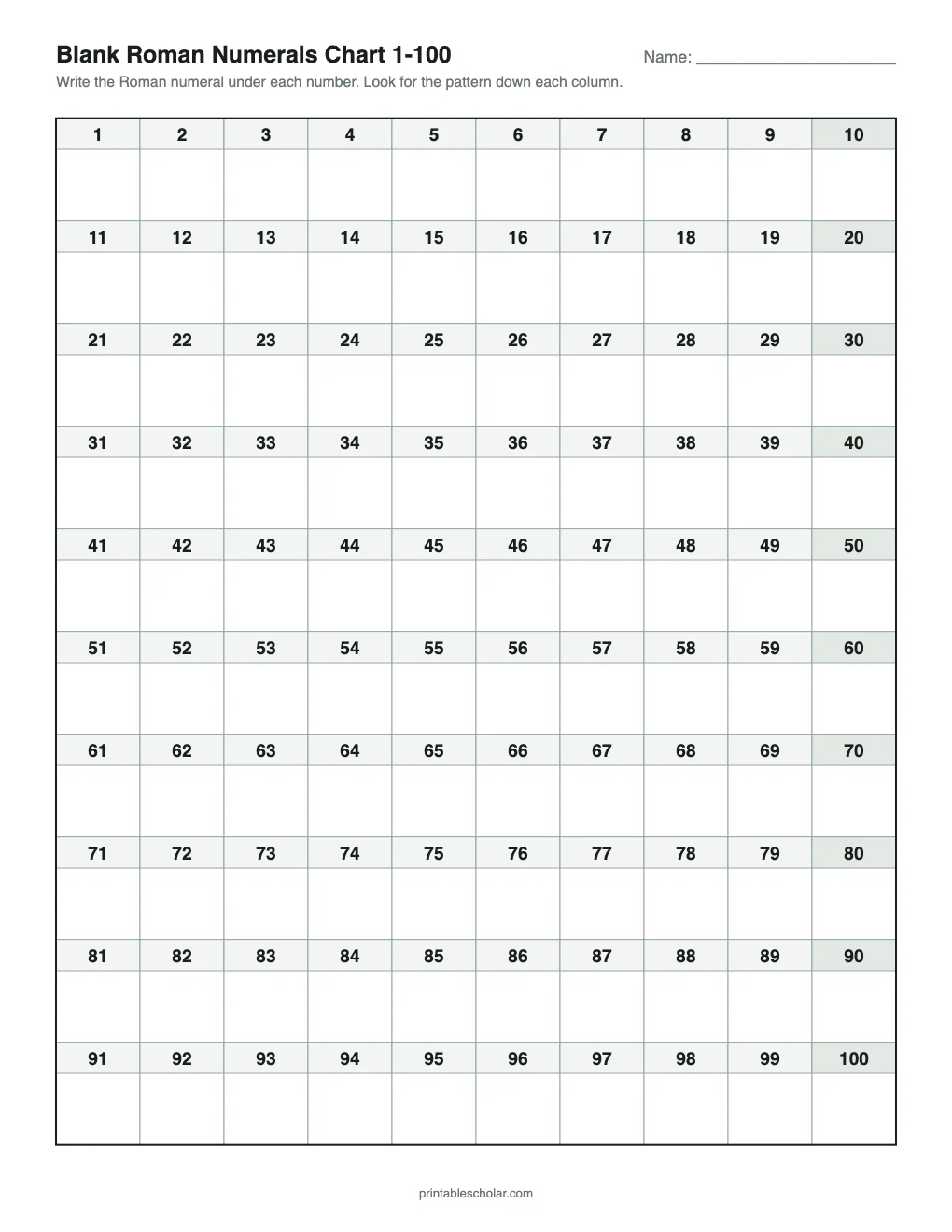
The 1-100 chart is laid out ten to a row, like a hundreds chart. Read down a column and the ending stays the same while the tens change. Read across a row and the tens stay the same while the ones count up. Students who notice this stop memorizing and start building numerals from two parts.
To write a larger number, split it into thousands, hundreds, tens and ones and write each part in turn. For 1,987 that is M, then CM, then LXXX, then VII: MCMLXXXVII. The symbols and rules chart shows this, with the ones, tens and hundreds listed side by side.
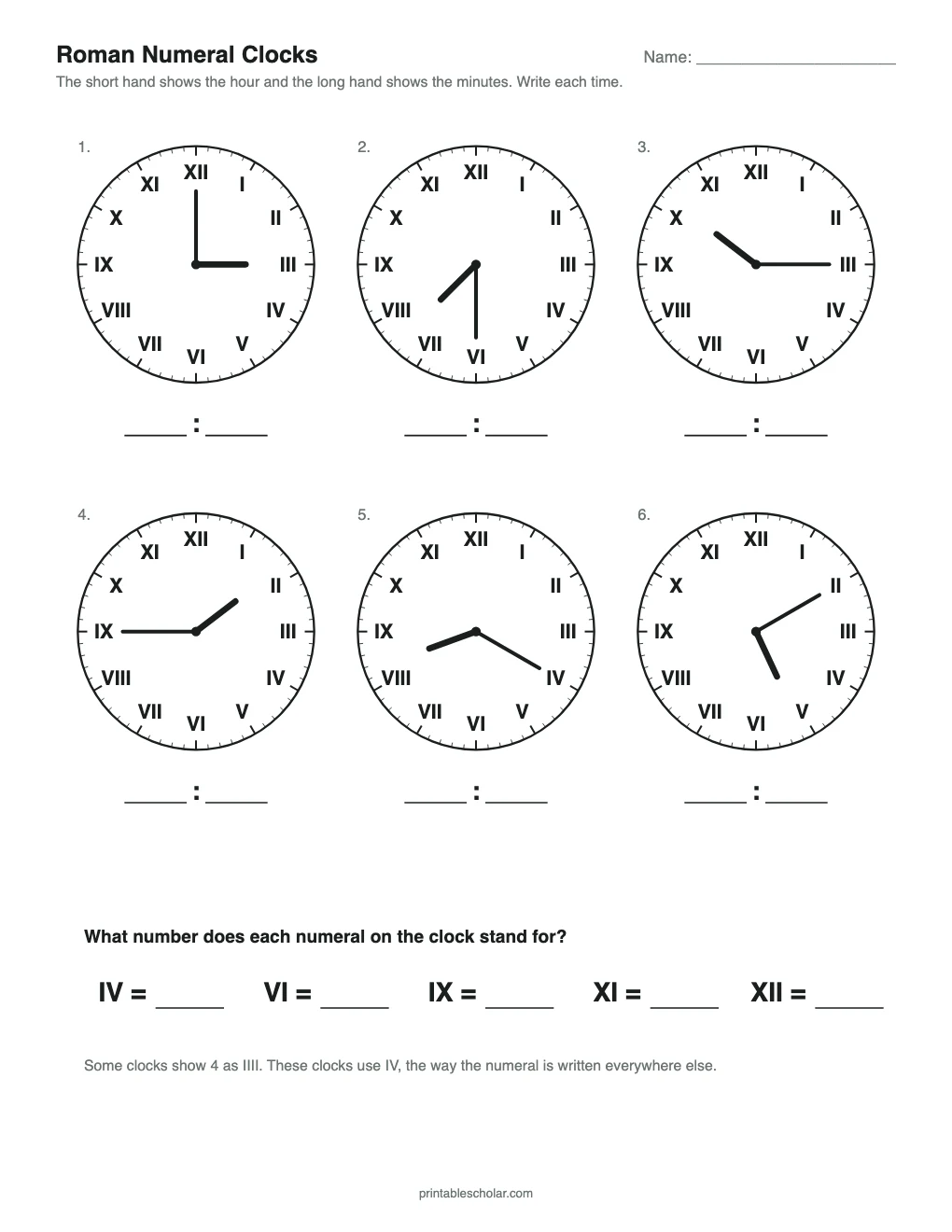
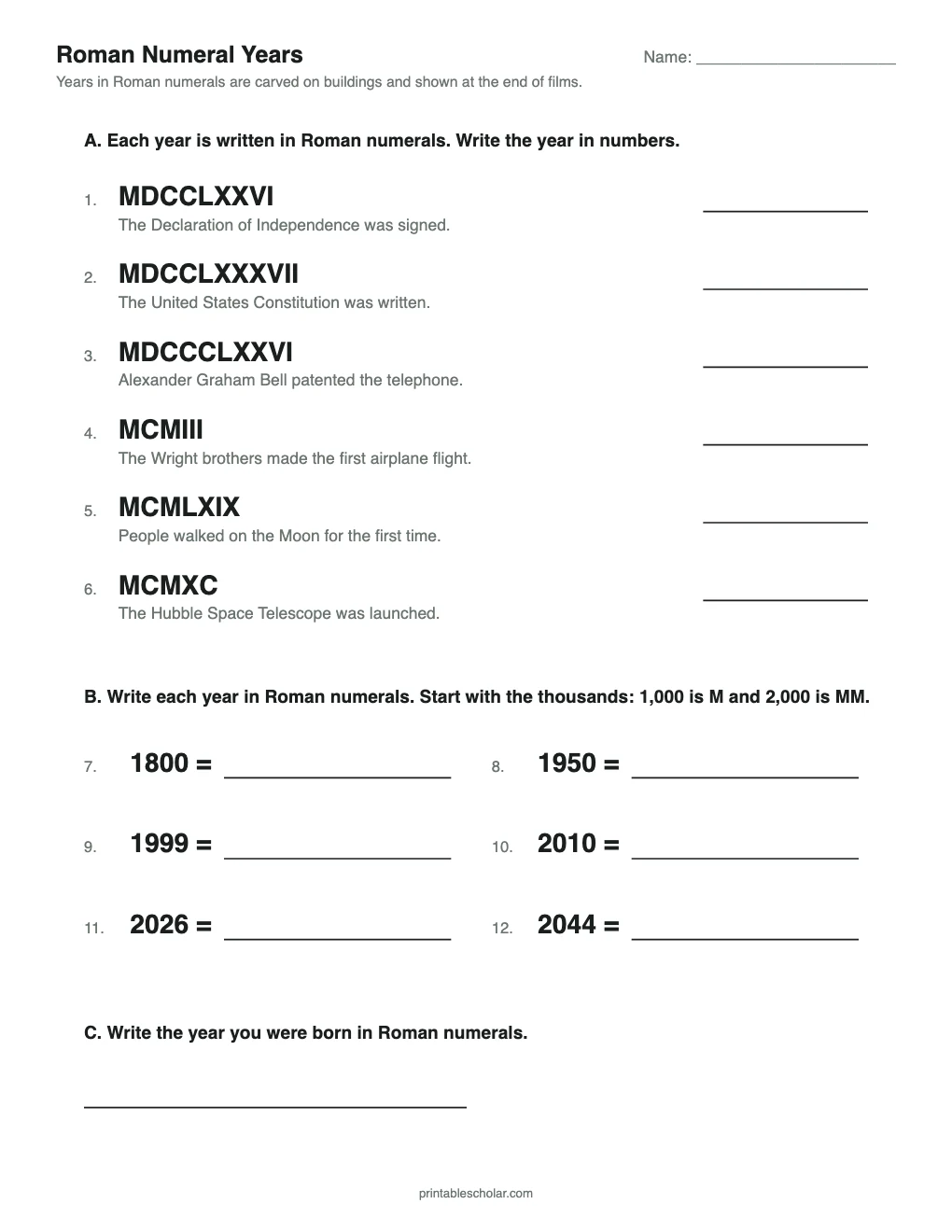
The four worksheets start with numerals up to 20 and work up past 1,000. The clock sheet pairs well with the telling time worksheets, and the hundreds chart and place value chart are useful for comparing the two number systems.
Frequently Asked Questions
What are the Roman numerals from 1 to 10?
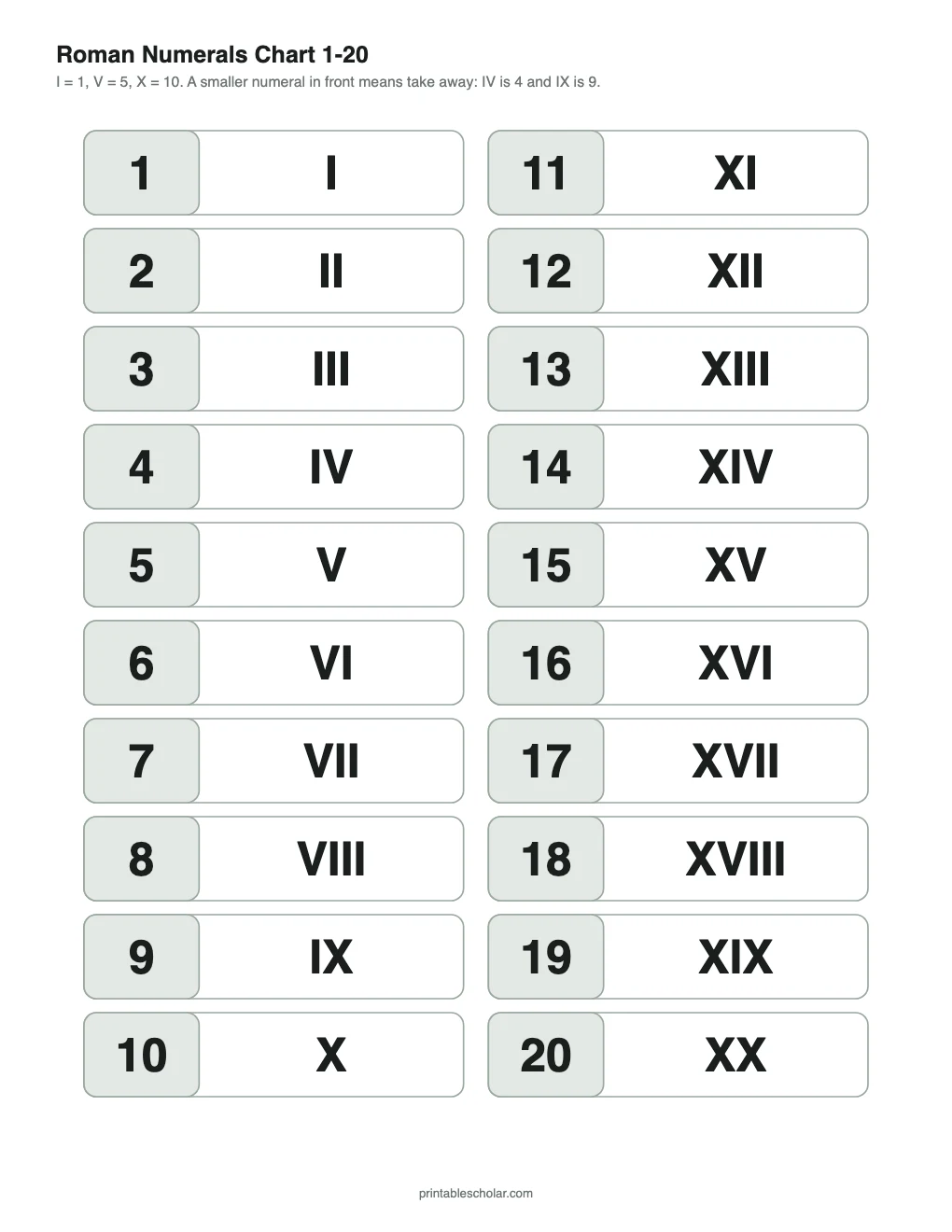
I, II, III, IV, V, VI, VII, VIII, IX and X. I is 1, V is 5 and X is 10. The rest are made by adding I after a numeral or putting I before V or X to subtract.
What are the seven Roman numeral symbols?
I is 1, V is 5, X is 10, L is 50, C is 100, D is 500 and M is 1,000. Every Roman numeral is written with these seven letters.
How do you write 4 and 9 in Roman numerals?
4 is IV and 9 is IX. A smaller numeral written just before a bigger one is subtracted, so IV is 5 minus 1 and IX is 10 minus 1. The same pattern gives XL for 40, XC for 90, CD for 400 and CM for 900.
What is 100 in Roman numerals?
100 is C. 50 is L, 500 is D and 1,000 is M. So 150 is CL, 400 is CD, 900 is CM and 2,000 is MM.
How do you write the year 2026 in Roman numerals?
2026 is MMXXVI. MM is 2,000, XX is 20 and VI is 6.
Why do some clocks show IIII instead of IV?
Many clock and watch faces use IIII for 4. It is an old custom of clockmakers, and one common explanation is that IIII balances the VIII on the other side of the face. Everywhere else, 4 is written IV. The clocks on the worksheet use IV.
Is there a zero in Roman numerals?
No. The Roman system has no symbol for zero and no place value. Each letter always stands for the same amount wherever it is written.
What grade learns Roman numerals?
Roman numerals are usually taught in 3rd or 4th grade, often with telling time. They are not in the Common Core standards, so the grade depends on the school or curriculum.