Why Kids Reverse b and d (And When to Worry)
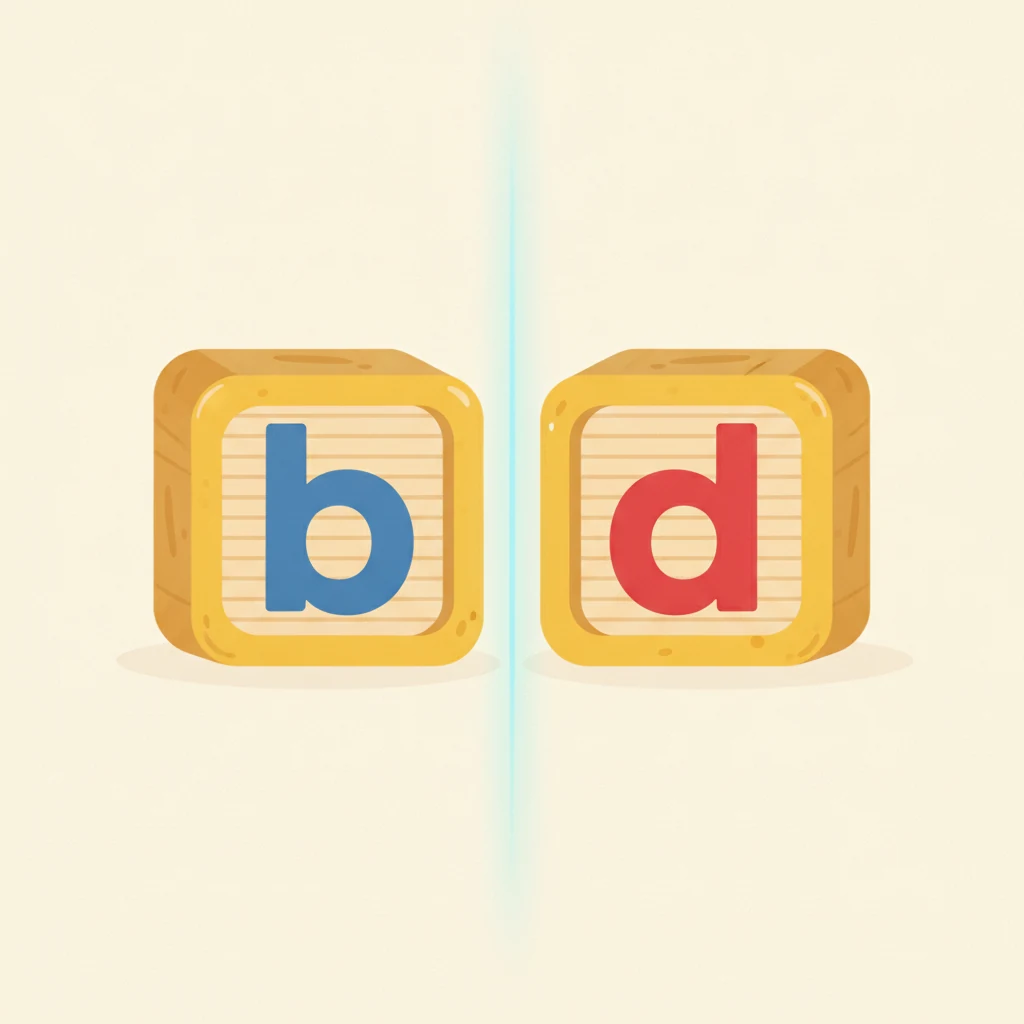
Your six-year-old writes "dad" as "bab," flips a 3, and turns "saw" into "was." It looks like a warning light. For most kids that age, it isn't. Reversing letters — especially b and d — is one of the most normal things a beginning writer does, and it stays normal for longer than most parents expect.
The useful question isn't "are the reversals there?" Almost every young child reverses something. The useful questions are how old is the child, how often does it happen, and is anything else about reading and writing also hard? Get those three right and you can tell a passing phase apart from a sign worth acting on — without either panicking or ignoring a real problem.
Why it's almost always b and d
There's a reason these two letters dominate the reversal problem and, say, "m" and "k" don't. Lowercase b and d are mirror images of each other: the same circle and the same tall line, with only the side flipped. So are p and q. A child who has the shapes right but hasn't locked in the direction will land on the wrong one roughly half the time — not because anything is wrong with their eyes, but because they're guessing at a 50/50 choice they haven't automated yet.
This is the single most misunderstood thing about reversals. They are not a sign that a child "sees letters backwards." As the experts at Reading Rockets put it, "there is no evidence that dyslexic children actually see letters and words backwards." The child's visual perception of the letter is usually fine. What's still developing is the memory for how to form it — which way the belly of the letter faces, and which direction the pencil travels. Understood.org describes it as "a weak memory for how to form letters" together with directionality. That distinction changes everything about how you fix it: you're training a motor habit, not correcting eyesight.
What's normal — and what "normal" actually means
Reading Rockets notes that it's "common for students to reverse letters (b, d, j, g, c) and some numbers (5, 2, 4) in first grade." Understood puts the upper edge a little later: reversing letters is "typical and fairly common up until second grade," and "most kids outgrow reversing as they get stronger at reading and writing." Put those together and you get a working timeline:
| Age / stage | What's typical |
|---|---|
| Preschool – Kindergarten (4–5) | Frequent reversals of letters and numbers. Completely expected — the child is still learning the shapes at all. |
| First grade (6–7) | Reversals still common, especially b/d and p/q, and on numbers like 3, 5, 7. Usually getting less frequent over the year. |
| End of second grade (7–8) | Reversals should be occasional at most and fading. This is the soft deadline — frequent reversals that are not shrinking here are worth a closer look. |
The word doing the heavy lifting in that table is frequency. "Normal until 7" is not a switch that flips on a birthday. A second-grader who flips a b once on a tired Friday is in a completely different situation than one who reverses on most words, every day, with no sign of improvement. Think of it as a fading dial, not an on/off light: through age 7 the dial should be turning down on its own. A dial that's stuck — or pointed at "constant" well into second grade — is the pattern that earns a second look, not any single mistake.
Reversing letters when writing vs. flipping words when reading
Parents often lump two different things together, and it's worth separating them because they point in different directions.
Writing reversals — drawing a b for a d — are mostly a handwriting and motor-memory issue, the kind this article is about. Reading reversals — reading "was" as "saw," or "on" as "no" — are more about how a child is processing the order and identity of sounds in a word. Both are common in early readers. But if the thing you're seeing is consistently on the reading side — losing track of letter order, struggling to blend sounds into words — that leans toward the language-and-sound skills that underpin reading, which is a different conversation than letter formation. If reading is where the struggle lives, our walkthrough of how to teach phonics at home and plenty of phonics practice will do more than handwriting drills ever could.
When letter reversals are worth a closer look
Here's the part the internet gets wrong in both directions. One half of the internet tells you reversals mean dyslexia (they don't, on their own). The other half tells you to relax and ignore them (also wrong, if other things are stacking up). The honest answer is that reversals matter as a companion symptom, not a standalone one. Reading Rockets is blunt that reversals are "not a sure sign of dyslexia" — the real marker of dyslexia is difficulty with the sounds of spoken language (phonological processing), not how letters look on the page.
So watch for the cluster, not the reversal alone. It's worth talking to your child's teacher or a reading specialist if frequent reversals persist past the end of second grade and you're seeing several of these alongside them:
- Trouble hearing or playing with sounds — rhyming, clapping syllables, telling you the first sound in "dog."
- Slow, effortful recall of letter sounds (not just names), well after classmates have them down.
- Reading that stays slow and laborious — sounding out the same small words over and over without them sticking.
- Trouble retrieving familiar words quickly (names of colors, numbers, objects) even though the child clearly knows them.
- A family history of dyslexia or reading difficulty, which meaningfully raises the odds.
That combination — persistent reversals plus sound-and-reading struggles — is the signal that warrants a professional look, whether that's a school reading screening, an evaluation by a speech-language pathologist, or an occupational therapist for the handwriting side. None of this is a diagnosis you make at the kitchen table: it's general guidance, and if you're worried, the people who can actually assess your child are their teacher, a reading specialist, or an OT. Acting early on a genuine reading difficulty is one of the highest-leverage things a parent can do, so "wait and see" is the wrong move when the cluster is there. If that sounds like your child, our guide to worksheets that work for dyslexic and ADHD kids covers how to set practice up so it helps instead of frustrates.
The fix that actually works
For garden-variety b/d reversals — the common, no-other-flags kind — the goal is simple: build a reliable motor habit so the right direction becomes automatic. A few principles do most of the work.
Teach correct formation from the start, every time. The most powerful lever is consistent, correct letter formation: same starting point, same stroke direction, on repeat. A child who always starts b with the tall line down and then the belly is far less likely to flip it than one who draws the circle first and guesses where the stick goes. This is exactly what good letter tracing worksheets are for — they bake the correct path into muscle memory before bad habits set in, and a few minutes of handwriting practice a day beats a long, frustrated session once a week.
Use a memory hook for b vs. d. The classic "bed" trick works because it's spatial, not abstract: make two fists with thumbs up, and your hands form the word "bed" — the left hand is a b, the right is a d, and the bed has a headboard and footboard in the right spots. When your child hesitates, they can check against their own hands. It's a crutch, and that's fine — crutches come off once the motor habit is solid.
Make it multisensory. Forming letters in shaving cream, sand, or with a finger traced on sandpaper adds touch and movement to the visual, which helps the direction stick faster than worksheets alone. The point isn't novelty — it's that more channels into the same motor pattern means a stronger memory.
What not to do
A few well-meant instincts tend to backfire:
- Don't drill isolated flashcards expecting the reversal to vanish. Reversals are a formation habit; you fix them by practicing correct formation, not by quizzing recognition.
- Don't cover the page in red corrections. Shaming a developmentally-normal error teaches a child to dread writing, which is the opposite of what you want. Calmly model the right one and move on.
- Don't assume dyslexia from reversals alone — and don't assume it away, either, if the sound-and-reading cluster above is present. Reversals are one data point, not the verdict.
- Don't panic over a kindergartner or first-grader. At that age, reversals are the expected cost of learning to write, not a problem to solve overnight.
Frequently Asked Questions
At what age should letter reversals stop?
Occasional reversals are typical through about age 7 and fade through second grade. By the end of second grade, most children reverse letters rarely or not at all. Frequent reversals that persist past that point are worth discussing with a teacher — especially alongside reading or sound difficulties.
Does reversing b and d mean my child has dyslexia?
Not by itself. Reversals are common in all early writers, dyslexic or not, and there's no evidence that dyslexic children see letters backwards. Dyslexia shows up mainly as difficulty with the sounds of language and with decoding. Reversals matter as a possible companion sign, not as a standalone test.
Why does my child mix up b and d but not other letters?
Because b and d are mirror images — same shape, opposite direction. The child has the shape right and is still automating which way it faces, so they land on the wrong one about half the time until the motor habit sets.
What's the fastest way to fix b/d reversals?
Consistent correct formation — same start point and stroke direction every time — plus a spatial memory hook like the "bed" trick, practiced a few minutes daily. Tracing and multisensory practice (sand, shaving cream) help the direction stick. Isolated flashcards generally don't.
Should I try vision therapy for letter reversals?
Not as a first step for ordinary reversals, which are a motor-memory issue rather than an eyesight one. Vision therapy is appropriate only when a specialist has diagnosed an actual visual or eye-movement problem.