What Letters to Teach First (Hint: Not Their Name)
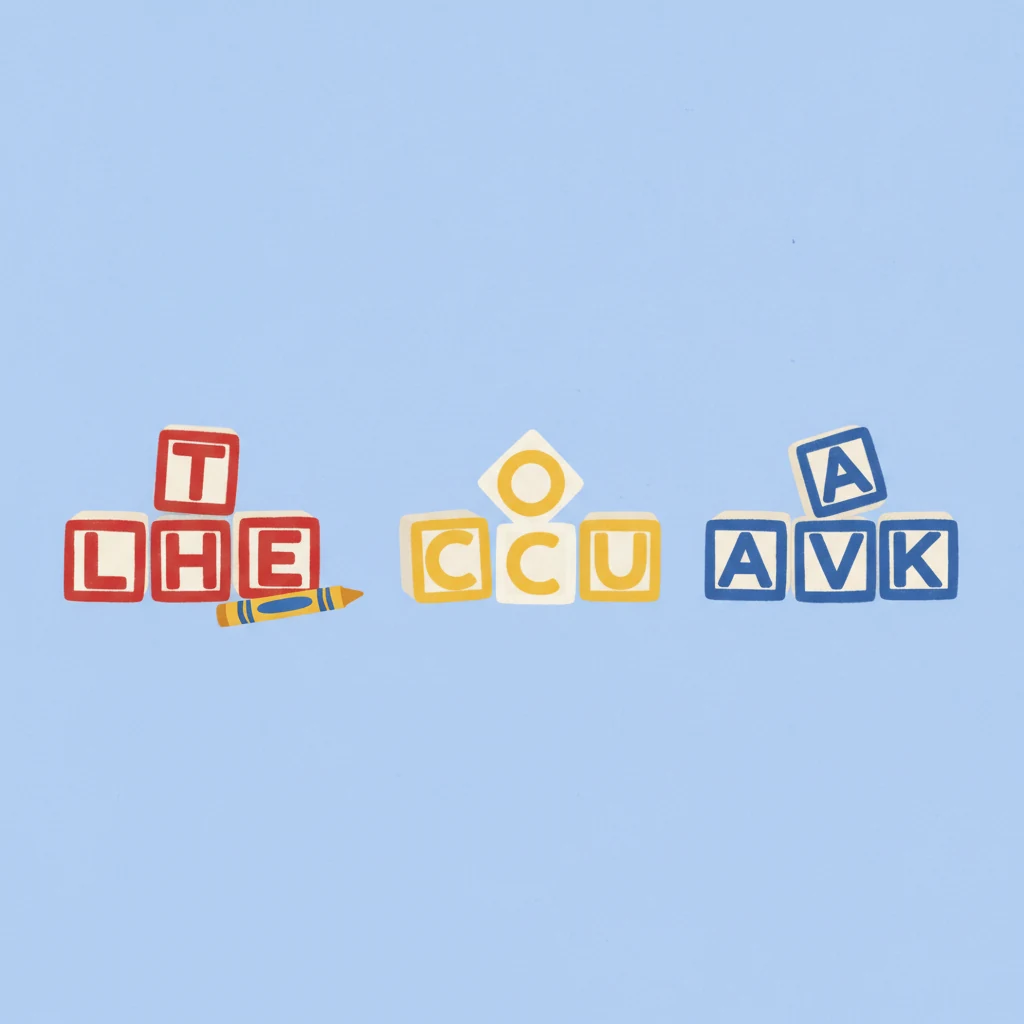
The first letters a preschooler should learn to write are L, T, H, E, F and I. Not A, and usually not the letters of their own name. Those six capitals are built from nothing but straight up-and-down and side-to-side lines, which are the first two strokes a small hand can control. A capital A needs two slanted lines that meet at a point, and most children cannot draw a slanted line on purpose until they are four and a half or older.
That gap is the whole argument of this post. The usual advice is "start with the letters in their name," and it is good advice for recognizing letters. For writing them, it hands a three-year-old called Max the three hardest shapes in the alphabet on day one.
Letters are made of strokes, and strokes arrive in a set order
Children learn to draw lines in a predictable sequence, and the sequence does not care what order the alphabet is in. Occupational therapists track it with a short set of shapes a child is asked to copy, taken from the Beery test of visual-motor integration. The ages below are the commonly cited ones for copying each shape from a picture. Individual children run months early or late, and different charts differ by a few months, so read them as an order rather than a deadline.
| Stroke | Typical age to copy it | Capitals it finishes |
|---|---|---|
| Vertical line | About 2 to 3 | I (as a plain stick) |
| Horizontal line | About 2½ to 3 | L, T, H, F, E |
| Circle | About 3 | O, C, and later Q, G, U, J, S |
| Cross (+) | About 4 | Confirms lines can meet where the child intends |
| Square | About 4½ | Corners: D, P, B, and neater E and F |
| Slanted line ( / and \ ) | About 4½ | V, A, N, Z |
| X | Just under 5 | X, K, Y, W, M |
| Triangle | A little after 5 | Clean points on A, V, M, W |
The slanted line is the late arrival, and it is late for a reason. Up-and-down and side-to-side movements each use one direction at a time. A slant asks the hand to move in both directions at once and hold the angle, and an X asks it to do that twice and cross in the middle.
The 26 capitals, sorted by the strokes they need
Sorting the alphabet by stroke gives three groups, and the groups are the teaching order. Start with capitals: they are all the same height, they all start at the top, and none of them dips below the line. Handwriting Without Tears, the program many occupational therapists use, teaches capitals before lowercase for the same reasons.
| Group | Letters | When to start |
|---|---|---|
| 1. Straight lines | L, T, I, H, F, E | When your child can copy a vertical line, a horizontal line and a rough cross |
| 2. Curves | O, C, Q, G, U, J, D, P, B, S | When circles close and a square has four recognizable corners |
| 3. Slants | V, X, A, N, Z, K, Y, W, M, R | When your child can copy an X |
Inside each group, go from fewest strokes to most. L before E, O before B, V before M. S sits at the end of the curve group because it changes direction halfway, and R sits with the slants because of its kicked leg, even though it starts like a P.
Ten of the 26 capitals are in the slant group. That is why "just go A to Z" stalls so often: the very first letter is one of the late ones.
A two-minute check before you print anything
You can find your child's group with a pencil and a blank sheet. Draw one shape at a time, slowly, and ask them to make one like yours underneath. Don't correct, don't guide the hand, and stop at the first shape that falls apart.
- A cross (+). If the two lines cross somewhere near the middle, group 1 is ready.
- A square. If it has four sides and something like corners rather than a lumpy circle, group 2 is ready.
- An X. If both lines slant and they cross, group 3 is ready. If it comes out as a cross or a pair of vertical lines, slants are not there yet.
This is a guide for choosing practice sheets, not a test. If a child of five or six cannot copy a cross or a square and you are worried, that is a conversation for their teacher or pediatrician, not something a worksheet settles.
There is research behind using these shapes as the gate. Two studies of kindergartners in the American Journal of Occupational Therapy found that children who could copy the first nine Beery shapes, the set that ends with the X and the triangle, copied noticeably more letters legibly than children who could not (Weil & Amundson, 1994) (Daly, Kelley & Krauss, 2003). The shapes are not a warm-up to skip. They are the parts the letters are made from.
So what about their name?
The name is still the most motivating word a child owns, and nothing here says to hide it. Read it, point to it, build it with magnets, find its first letter on cereal boxes. All of that is recognition, and recognition does not depend on hand control.
Writing it is different, and how different depends on the name. Sort its letters into the three groups above and you know what you are asking for.
| Name | Letters by group | What to do |
|---|---|---|
| ELI, THEO, LEO | All group 1 and 2 | Go ahead. The name is a fine first tracing sheet. |
| EMMA, NOAH, LILY | Mixed | Teach the easy letters as letters first. Add the slanted ones when the X arrives. |
| MAX, ZARA, KAYA | Mostly group 3 | Wait on tracing. Practise the first letter big, in sand or with a finger, and keep the pencil work on group 1. |
A child who is made to trace a name full of slants before their hand can make a slant does not learn the name faster. They learn a workaround: lines drawn bottom-up, an M built from four separate sticks, a K that is really an H. Those workarounds are the habits that have to be undone later, and fixing letter formation at six is slower than waiting four months at four.
When the name is ready, write it in capitals first. Lowercase adds letters that hang below the line and pairs that mirror each other, which is its own stage and the source of most b and d reversals.
How to practise each group
Practice should match the group the child is in, and for group 1 that means bigger than a worksheet. Start with a finger in a tray of salt, chalk on the driveway, or a fat marker on an easel. Paper comes after the movement is there, and pencil grip is still developing at this age, so short crayons and short sessions beat a full page.
When you do move to paper, print only the letters your child is working on. On the letter tracing worksheets page, choose Custom, type the group into the "Name or Word to Trace" box, for example LTIHFE, and pick the large Pre-K size. Each letter gets its own row, so you print a sheet of exactly those six letters instead of a page that opens with A. Do the same with OCQGU when the curves are ready.
For the name itself, the name tracing worksheets have a "Practice Each Letter" style in uppercase. Use it once the check above says the name's letters are within reach.
Between groups, slants can be practised without any letters at all. Zigzags, roofs on houses, slides, and the diagonal turns in simple mazes all build the same movement with no right or wrong shape to hit.
This is the order for writing, not for sounds
Writing order and reading order are two separate lists, and they do not have to match. Phonics programs introduce letter sounds in an order chosen so that children can build words quickly, which is why so many start with s, a, t and p. That order is about the ear and the eye. A child can learn the sound of A months before they can write one.
If the sound order is the question you came with, the guide to teaching phonics covers it. Run the two side by side: sounds in phonics order, pencil work in stroke order.
Frequently asked questions
My three-year-old insists on writing their name. Should I stop them? No. Let them write it however it comes out and enjoy it. The point is not to turn a name full of slanted letters into a daily tracing drill. Free attempts do no harm; repeated practice of a workaround does.
Should I teach capital or lowercase letters first? For writing, capitals. They are the same height, start at the top and use simpler strokes. Lowercase comes once the capitals are comfortable, usually in kindergarten, and is best taught in groups that share a starting movement.
What if my child can copy an X but still struggles with K and M? That is normal. K and M each join several slants at exact points, so they come at the end of the slant group. Stay with V, X and A for a while, then N and Z, and leave K, Y, W, M and R for last.
Is tracing or copying better? Tracing shows where the lines go; copying shows whether the child can make them without the path. Use tracing to introduce a letter, then ask for one copy next to it. If the copy falls apart, the letter is from a group that is not ready yet.