Cursive vs. Print: Which Should You Teach First?
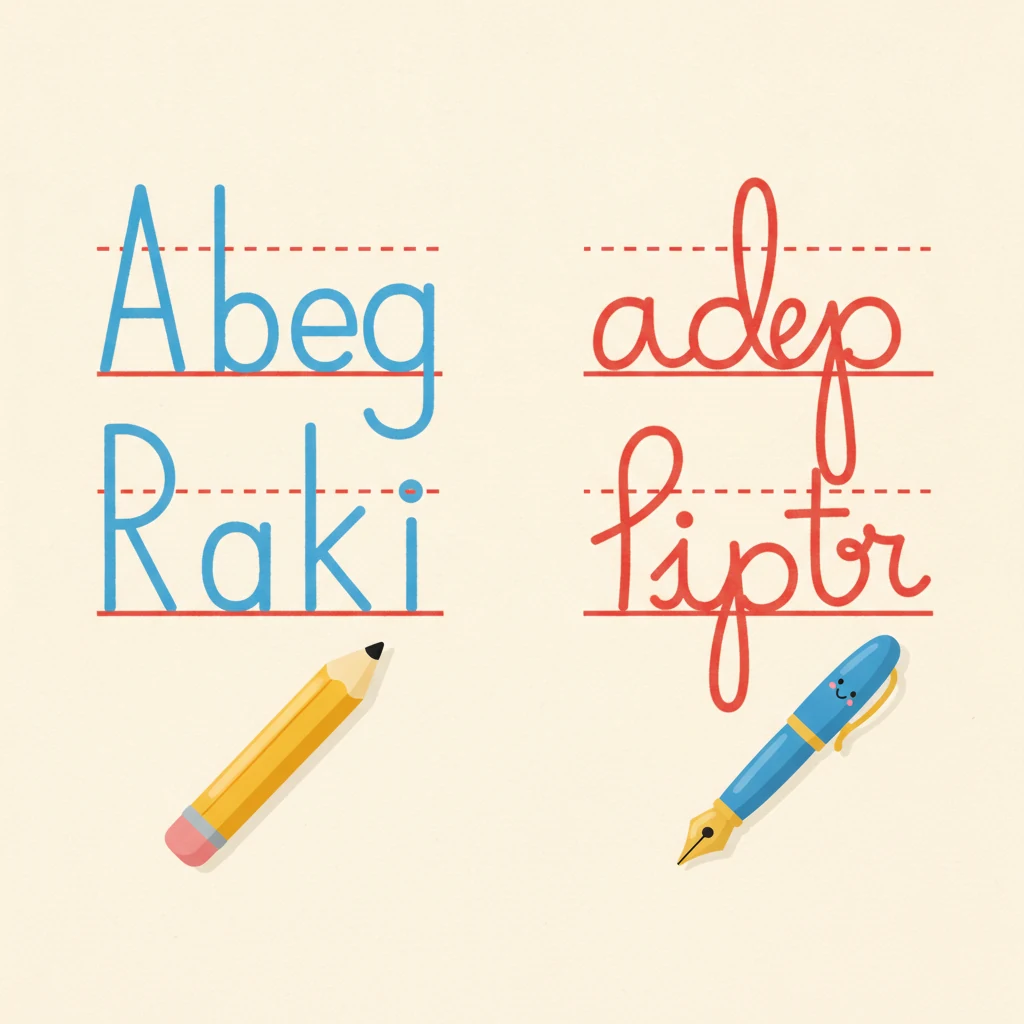
Neither print nor cursive is objectively "better" — that framing is a trap. But when the question is which one comes first, the answer for most children is print (manuscript) in kindergarten through second grade, then cursive around third grade. The reason isn't that cursive is inferior. It's that your child reads in print, and the single worst thing you can do is teach both writing systems at the same time.
That's the whole decision in two sentences. The rest of this page is the evidence behind it — plus the exceptions where cursive-first is a legitimate choice, and why this question suddenly matters again for a generation of parents whose own schools had quietly dropped cursive.
Why print earns the first slot
The strongest argument for print-first isn't about handwriting at all — it's about reading. Children learn to recognize letters in the print forms they see in books, on signs, and on screens. When a child forms those same letters by hand, the motor act reinforces the visual memory of the letter, tightening what researchers call reading–writing reciprocity: the two skills feed each other.
Neuroimaging backs this up. In a well-known study, Karin James and colleagues found that forming letters by hand — not typing them, and not tracing a pre-drawn shape — activated a distinctive "reading circuit" in the brains of young children.1 Free-form production, where the child has to generate the letter themselves, is what does the work. Because kids read print, print is the form worth practicing first.
The research everyone misquotes
You'll see claims online that "studies prove print is better than cursive." That overstates what the research actually shows. The most-cited finding is subtler and more useful: children who get sustained handwriting instruction in a single style during grades 1–2 outperform children who get split instruction (print in first grade, cursive in second) on measures of writing fluency and spelling accuracy.2
Read that carefully. The penalty comes from switching writing systems mid-development, not from cursive itself. A beginner has limited attention to spend, and asking them to master two motor systems at once splits it. Print wins the default slot because it matches reading — but the real, transferable lesson is: pick one system, teach it until it's automatic, then add the other.
Where tracing fits in
If free-form production is what builds the reading circuit, does tracing worksheets even help? Yes — as long as you understand what tracing is for. Tracing is a motor scaffold, not the finish line. A four- or five-year-old often can't yet control a pencil well enough to produce a letter from scratch. Tracing builds the fine-motor pathway — grip, pressure, direction — so that the child can later execute the free-form letters that carry the cognitive payoff.
In other words, tracing and independent writing aren't rivals; they're sequential. Start with letter tracing worksheets to build control, then move to independent print handwriting practice where the child forms letters without a guide. If pencil grip is the sticking point, our guide on how to hold a pencil walks through the grip progression by age.
What cursive is actually good for
Cursive is worth teaching — just for the right reasons. Here's the honest split between the evidence-backed benefits and the claims that get oversold on social media.
| Claim about cursive | What the evidence supports |
|---|---|
| Builds fine-motor skill and hand control | Supported. The continuous, looping movements are good motor practice. |
| Reduces b/d reversals | Plausible. Connected strokes and a consistent left-to-right flow remove the "which way does it face" decision. See why kids reverse b and d. |
| Lets kids write faster | Partly. Cursive can increase fluidity, but the fastest legible hand is usually a personal hybrid — print letterforms with a few natural joins — not pure cursive. |
| Helps memory when taking notes | Supported for older students. Handwriting notes (print or cursive) beats typing for retention; this isn't unique to cursive. |
| "Boosts IQ" / makes kids smarter | Not supported. There's no credible evidence cursive raises general intelligence. |
Notice the pattern: most of cursive's genuine benefits are benefits of handwriting in general. The additional advantage of cursive over print is real but modest, and the research on it is mixed. Teach cursive because it's a useful, increasingly-required skill — not because a viral post promised it would rewire your child's brain.
The exceptions: when cursive-first makes sense
Two situations flip the default, and both are legitimate:
Dyslexia and letter reversals. Some Orton-Gillingham practitioners teach cursive first because the connected strokes force a single left-to-right direction and remove the pencil-lift decision that fuels reversals. Treat this as a mechanical workaround, not a cure — cursive doesn't treat dyslexia, but for a child who reverses letters constantly, the continuous flow can reduce a specific source of friction. It's a reasonable choice made with a specialist, not a blanket rule.
Montessori classrooms. Cursive-first is a longstanding Montessori tradition, taught with tactile sandpaper letters and continuous movements from the start. It works partly because it's committed: the whole curriculum sustains one system, so it never pays the split-instruction penalty. If you're running a Montessori-style program, cursive-first is coherent — just don't half-adopt it alongside print.
Why this question is suddenly everywhere
If you're only now wondering about cursive, there's a reason. The 2010 Common Core State Standards did not require cursive — they emphasized keyboarding instead, expecting students to type at least a page by fourth grade.3 Cursive quietly fell out of many classrooms for a decade.
Now it's swinging back. As of 2026, more than 25 states mandate or strongly encourage cursive instruction, up from roughly 14 a decade ago.4 Recent examples give a sense of the wave: California's AB 446 (effective January 2024) requires handwriting including cursive in grades 1–6; Kentucky's SB 167 phases cursive in from the 2025–26 school year; and 2026 saw new laws take effect or pass in Pennsylvania (grades 2–3), New Jersey (grades 3–5), and Florida (mastery by grade 5). Specifics shift year to year, so check your own state's current standard — but the direction is clear.
The good news: the print-first, cursive-around-grade-3 sequence lines up neatly with how most of these mandates are written. Following the developmental order keeps you compliant without cramming.
A sequence you can actually follow
- Ages 3–5 (pre-writing): build hand control with tracing and pre-writing strokes. Don't rush letters.
- Grades K–2 (print): teach print letters, then words, then sentences with print handwriting worksheets. Aim for automatic, comfortable letter formation.
- Grade 3+ (cursive): once print is fluent, introduce cursive with cursive practice sheets, letter by letter, then joins.
- Ongoing: let a natural hybrid emerge. The goal is legible, comfortable, reasonably fast writing — not allegiance to one script.
Print first because your child reads print. Cursive next because it's a real skill worth having and, increasingly, one your state requires. And never both at once — that's the one mistake the research is clear about.
Sources
- James, K. H., & Engelhardt, L. (2012). "The effects of handwriting experience on functional brain development in pre-literate children." Trends in Neuroscience and Education. NIH / PMC
- Limpo, T., & Graham, S. (2020), and related handwriting-instruction research on sustained vs. split instruction. Summary via Reading Rockets. readingrockets.org
- Common Core State Standards — Writing / Production & Distribution (keyboarding expectations, grade 4+). thecorestandards.org
- State cursive-mandate counts and recent legislation (CA AB 446; KY SB 167; PA, NJ, FL 2026 laws), as of 2026. Education Week
Frequently asked questions
At what age should a child start cursive?
Usually around grade 3 (age 8), once print handwriting is fluent. Some schools introduce it late in second grade. The readiness signal is that the child forms print letters automatically, without concentrating on each stroke.
Is it bad to teach cursive and print at the same time?
For beginners, yes — the research points to a penalty from splitting early instruction across two systems. Teach one until it's automatic, then add the other. This is the clearest single takeaway.
My state now requires cursive. Did I miss the window for print?
No. Most mandates expect cursive proficiency by grade 4 or 5, which leaves plenty of time to teach print first in K–2 and add cursive in grade 3. The developmental order and the mandates are compatible.
Should a dyslexic child learn cursive first?
It can help some children by reducing letter reversals and pencil-lift confusion, and it's a common Orton-Gillingham choice. It's a mechanical support, not a treatment — make the call with a specialist rather than as a default.