 Printable Scholar
Parts of the Brain Diagram
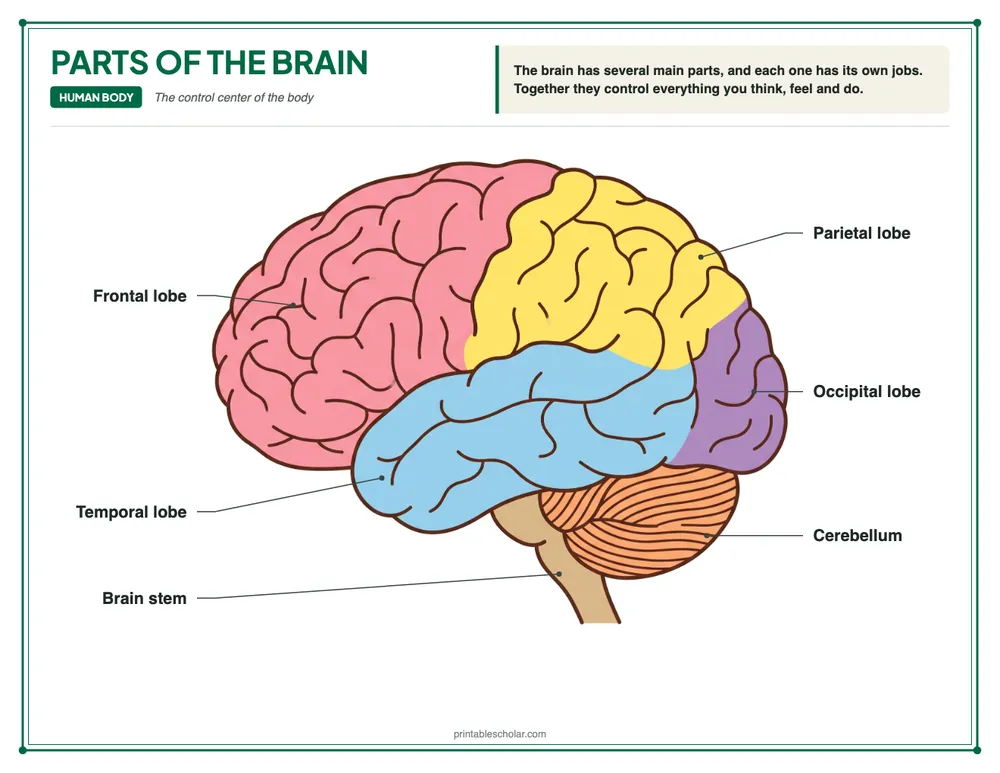
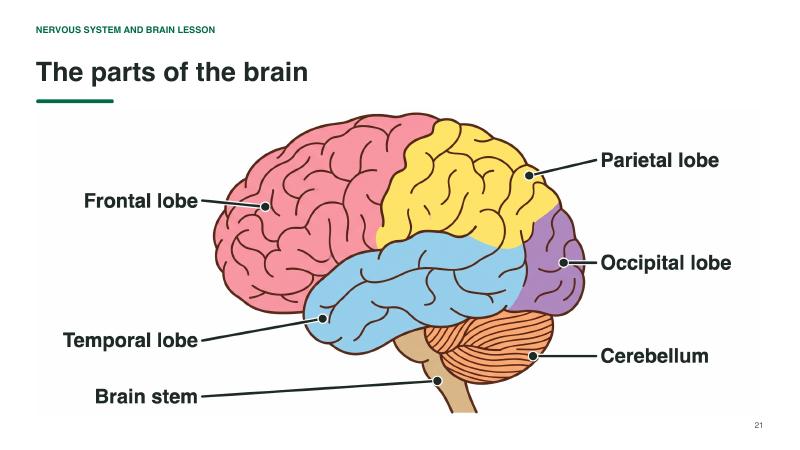
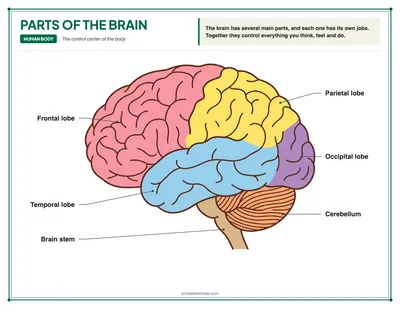
Free printable parts of the brain diagram — a labeled illustration of the frontal, parietal, occipital and temporal lobes, cerebellum and brain stem. Download PDF or PNG for Letter paper.
Part of the Nervous System and Brain teaching pack for grades 4 to 6: 26 lesson slides and 11 printables with answer keys. The diagrams are free.
Teaching ideas for Nervous System and Brain
Pick the ideas that suit your class, then follow the plan or use the sheets in any order.
- Catch the ruler. One student drops a ruler between a partner’s open fingers and the partner tries to catch it. The signal has to go from eyes to brain to hand.
- Pass the squeeze. Stand in a circle holding hands. Pass a squeeze around the circle like a signal moving along a nerve. Each student is one neuron.
- Test your balance. Students stand on one foot, then try it with their eyes closed. The cerebellum is working the whole time to keep them balanced.
- Which part is working?. Call out things like hearing a bell, seeing a picture, feeling something cold or planning a move. Students point to that part on the brain diagram.
A plan for the week
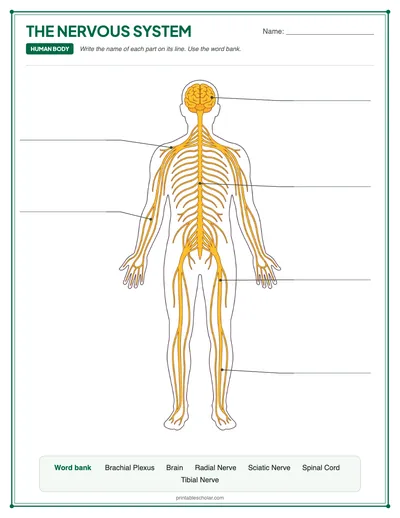
| Day 1 | Open with one of the ideas above. Teach the lesson with the slides while students fill in the guided notes. Then students label the blank diagram. | Lesson slides (PowerPoint) (in the pack) Nervous System and Brain Guided Notes (in the pack) Nervous System Diagram Blank Nervous System |
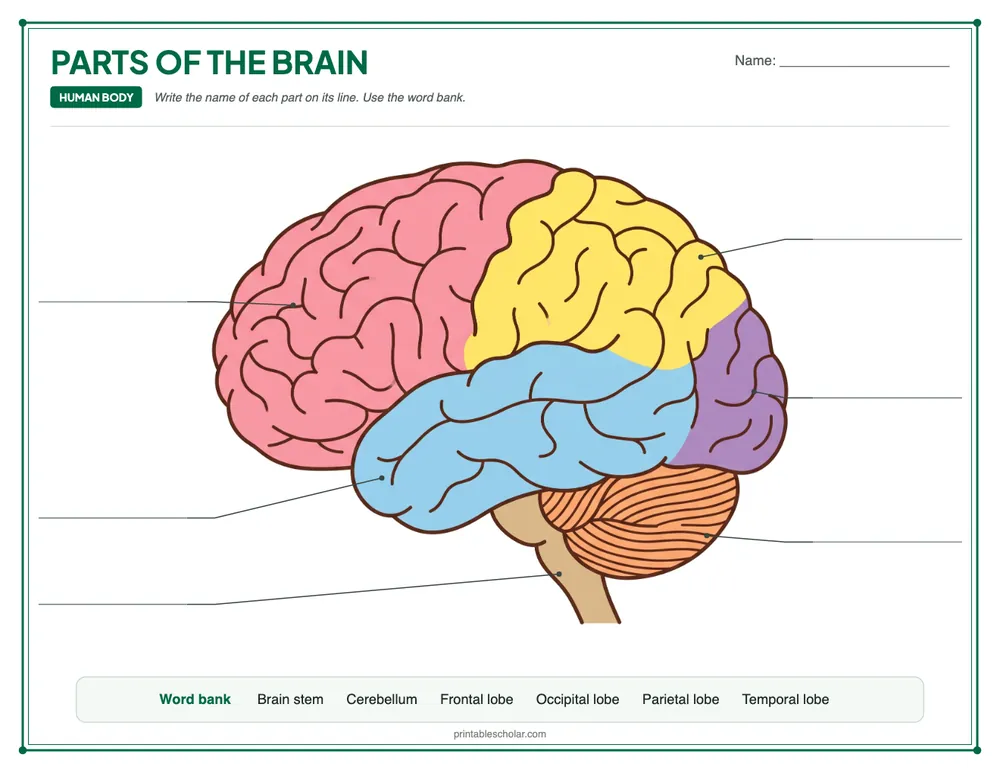
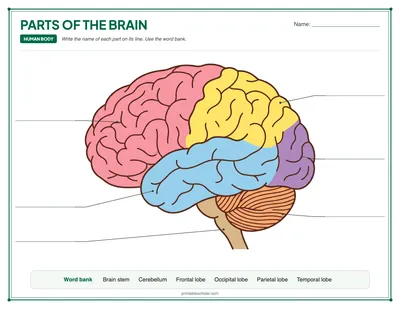
| Day 2 | Teach the six parts of the brain from the labeled diagram. Students label the blank one. | Parts of the Brain Diagram Blank Parts of the Brain |
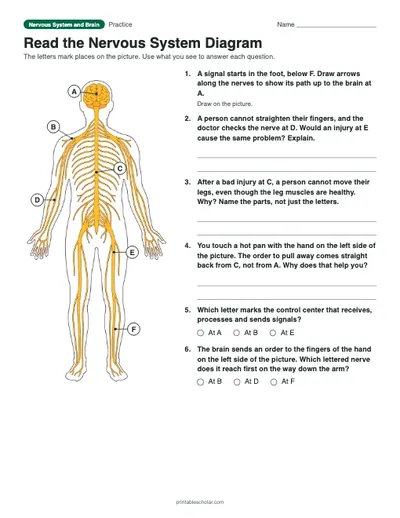
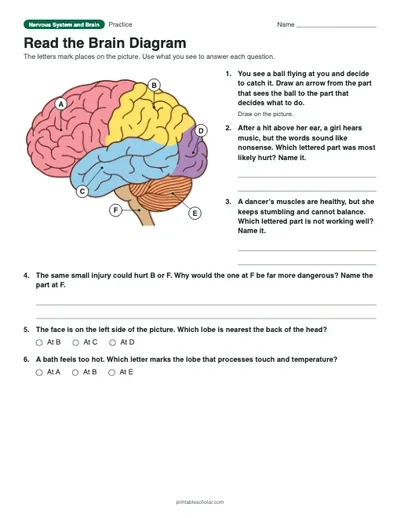
| Day 3 | Students work out what is happening on the nervous system picture on “Read the Nervous System Diagram”: the path of a signal from the foot to the brain. Then they do the same for the brain on “Read the Brain Diagram”. | Read the Nervous System Diagram (in the pack) Read the Brain Diagram (in the pack) |
| Day 4 | Read “Your Body’s Control Network” and answer the questions. Then put the steps of “The Path of a Reflex” in order. | Your Body’s Control Network (in the pack) The Path of a Reflex (in the pack) |
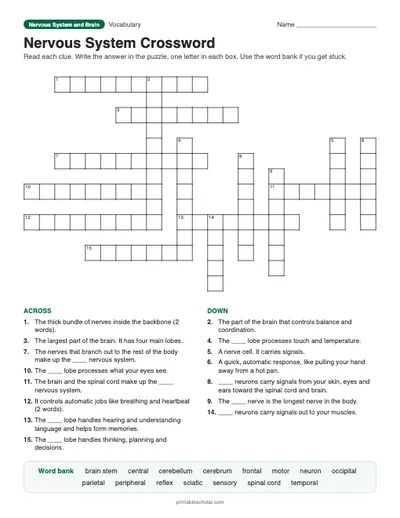
| Day 5 | Review with the crossword, then give the quiz. | Nervous System Crossword (in the pack) Nervous System and Brain Quiz (in the pack) |
The sheets marked “in the pack” are in the Nervous System and Brain teaching pack below.
NGSS standards
- Aligned to 4-LS1-2: Use a model to describe that animals receive different types of information through their senses, process the information in their brain, and respond to the information in different ways.
- Supports 4-LS1-1: Construct an argument that plants and animals have internal and external structures that function to support survival, growth, behavior, and reproduction.
- Supports MS-LS1-8: Gather and synthesize information that sensory receptors respond to stimuli by sending messages to the brain for immediate behavior or storage as memories.
Nervous System and Brain teaching pack
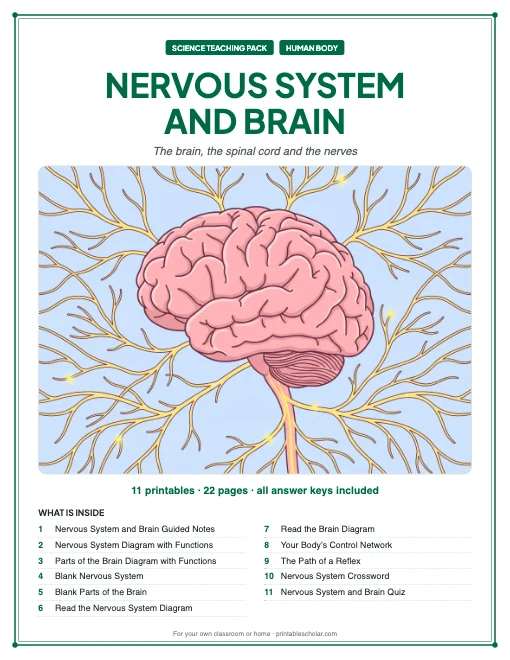
Teaching the nervous system and the brain? Here is a ready-to-teach lesson. 26 slides and 11 printables that cover the whole topic, from the guided notes to the quiz. Present the slides while students fill in the guided notes, then use the worksheets, crossword and quiz, with every answer key.
Free on this page: 4 of the 11 printables, marked Download below. The whole pack is $7: 22 pages in one print-ready file, the 26 lesson slides, the practice sheets, the crossword, the quiz and every answer key.
OnlineThe pack also comes as an online lesson for Google Classroom: every part on screen for students, plus a self-grading Google Forms quiz.
One-time purchase. Instant download. Secure checkout by Stripe. Want to see a whole pack first? The Skeletal System pack is free.See all 31 packs in the bundle
- The Microscope
- Photosynthesis
- Parts of a Plant and Flower
- Life Cycle of a Plant
- Life Cycles of a Butterfly and a Frog
- Food Chains and Food Webs
- The Water Cycle
- Human Body Organs
- Skeletal System
- Muscular System
- Digestive System
- Respiratory System
- Heart and Circulation
- Nervous System and Brain (this pack)
- Eye and Ear
- Parts of a Tooth
- Inside the Earth and Volcanoes
- Rocks and the Rock Cycle
- Layers of the Atmosphere
- Types of Clouds
- Weathering, Erosion and Deposition
- Types of Landforms
- The Solar System
- The Seasons
- Moon Phases and Eclipses
- States of Matter
- Electric Circuits
- Forms of Energy
- Scientific Method
- Simple Machines
- Magnets and Magnetic Fields
Teach Nervous System and Brain with 26 ready-made slides
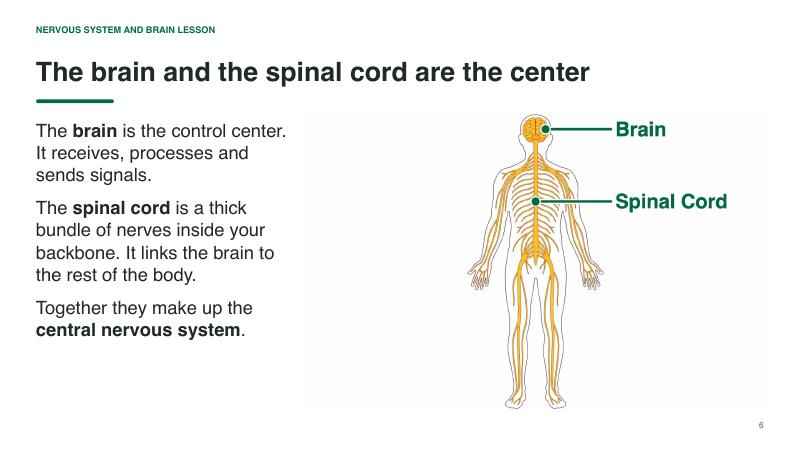
Open the PowerPoint and teach: an opening question, the parts one at a time on the diagram, quick checks and an exit question. Students fill in the guided notes sheet as you go.
Every slide comes with teacher notes: what to say, what to ask, and sample answers.
The slides (PowerPoint and a PDF copy) and the guided notes sheet come with the pack.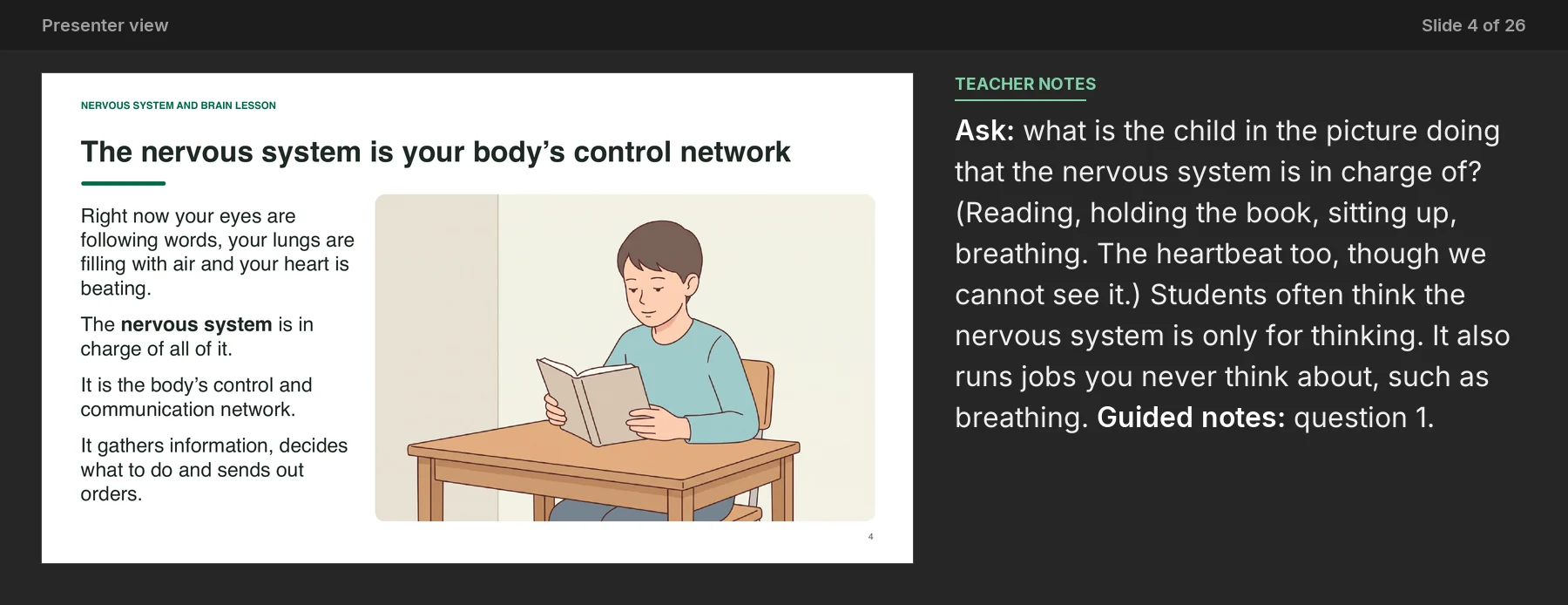
What is in the pack, in teaching order
 In the pack
1. TeachLesson Slides26 slides to present, with your notes for each one.In the $7 pack
 In the pack
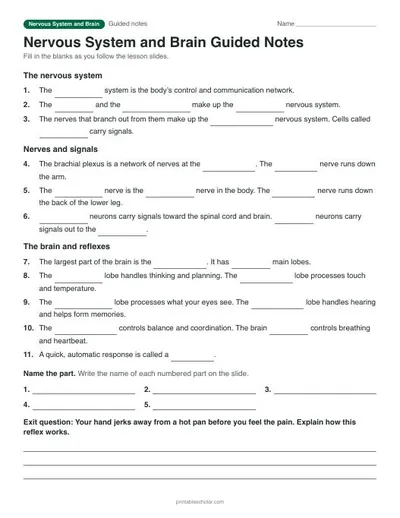
1. TeachNervous System and Brain Guided NotesStudents fill in the blanks as you present. With answer key.In the $7 pack
 Free
 Free
 Free
 Free
 In the pack
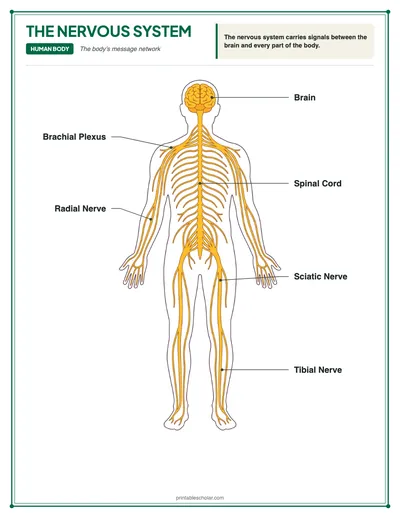
3. ReasonRead the Nervous System DiagramRead the nervous system picture: trace the path of a signal from the foot to the brain and work out which nerves and parts do which jobs.In the $7 pack
 In the pack
3. ReasonRead the Brain DiagramRead the brain picture: work out which lettered part is at work in everyday jobs and which injury would be most serious.In the $7 pack
 In the pack
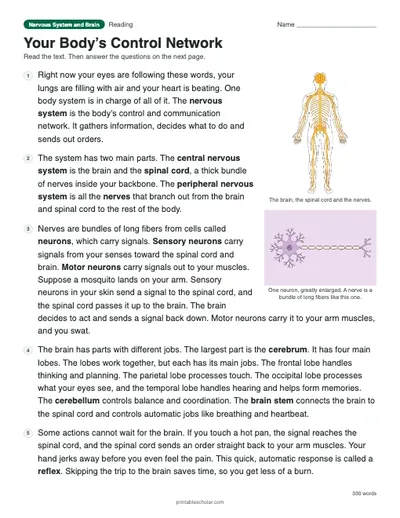
4. ReadYour Body’s Control NetworkA one-page text on the brain, the spinal cord, nerves and reflexes, with eight questions.In the $7 pack
 In the pack
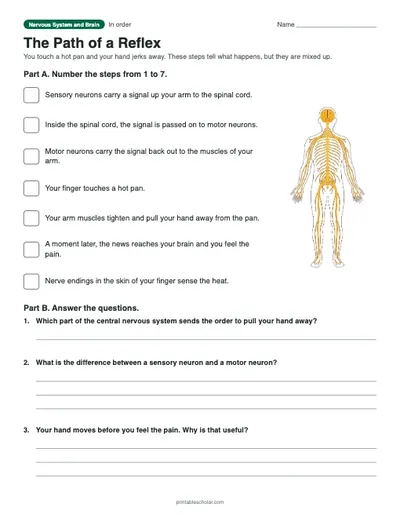
5. OrderThe Path of a ReflexPut the seven steps of a reflex in order, then answer three questions.In the $7 pack
 In the pack
6. ReviewNervous System CrosswordFifteen nervous system and brain words with clues and a word bank.In the $7 pack
 In the pack
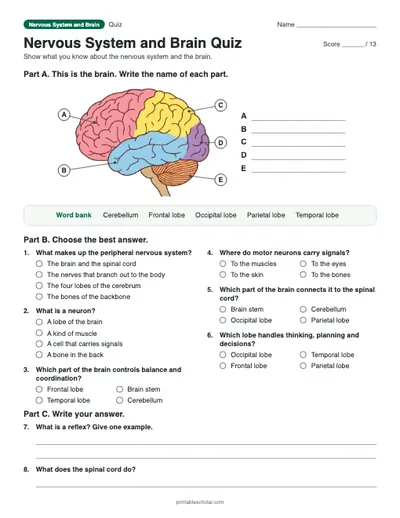
7. CheckNervous System and Brain QuizLabel five parts of the brain, six multiple choice and two written answers. Scored out of 13.In the $7 pack
Nervous System and Brain worksheets, crossword and quiz
The Nervous System and Brain teaching pack is 26 lesson slides (PowerPoint and PDF) and 11 printables with answer keys for grades 4 to 6, in the order you would teach them: the guided notes for the lesson slides, 4 diagram sheets, then “Read the Nervous System Diagram” (a worksheet), “Read the Brain Diagram” (a worksheet), “Your Body’s Control Network” (a reading passage), “The Path of a Reflex” (a sequencing worksheet), a vocabulary crossword and a quiz.
The sheets are in a suggested teaching order: teach the lesson, have students label the blank diagrams, then work through the practice sheets and finish with the quiz. Use them all over a week or pick the ones you need. The answer keys are together at the back.
The diagrams are free to download on this page. The other sheets come with the pack ($7), which is also in the Elementary Science bundle (grades 3 to 6).
The parts of the brain
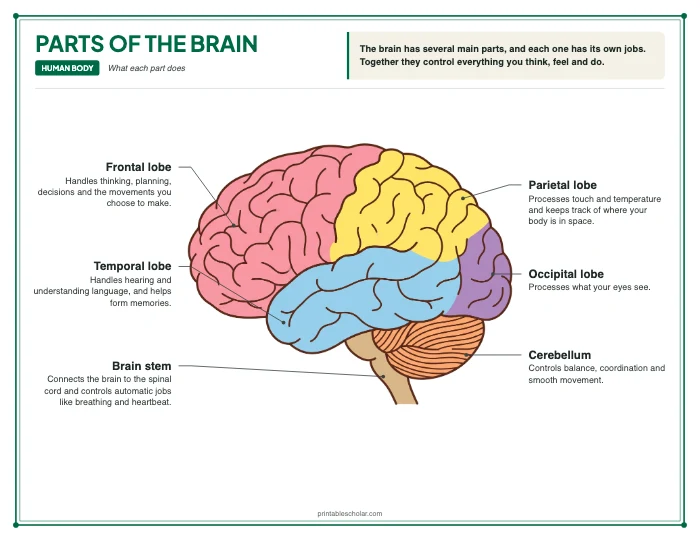
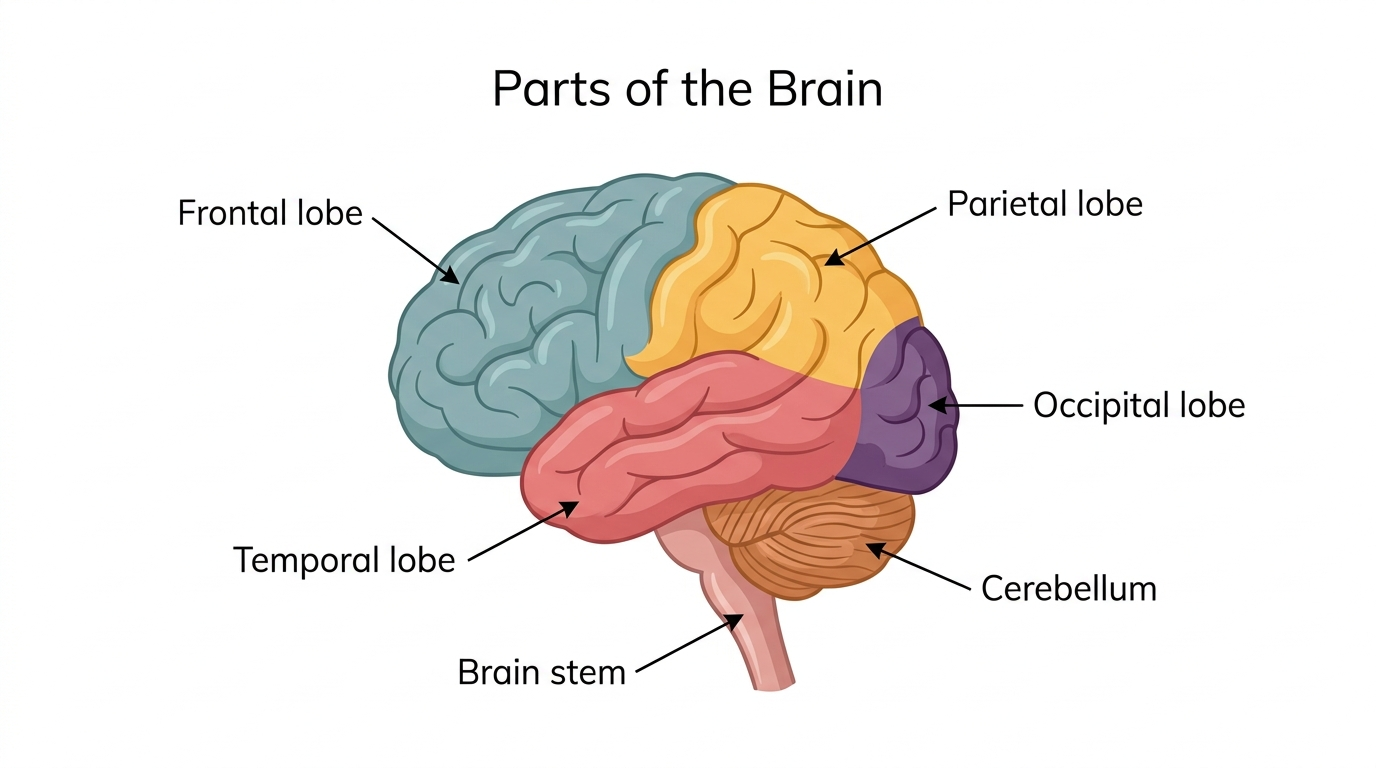
The brain is the control center of the body, and each part has its own job. Here is what happens at each labeled part of the diagram:
| Part | What it does | Why it matters |
|---|---|---|
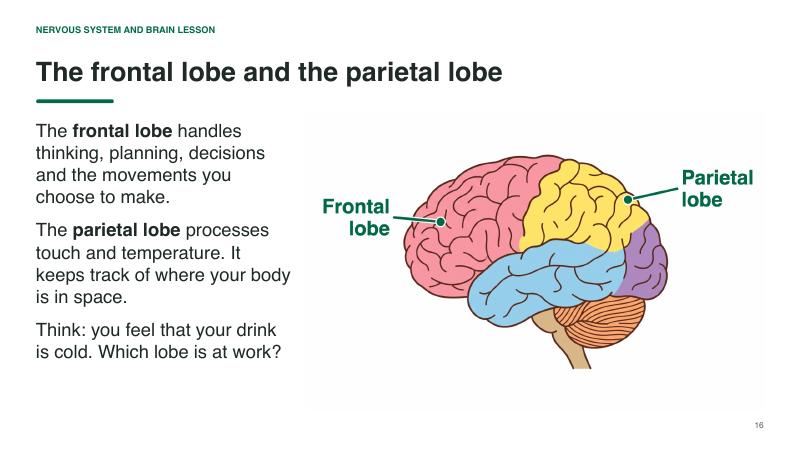
| Frontal lobe | Handles thinking, planning, decisions and voluntary movement. | This is the part that lets you stop and think before you act — without it, controlling impulses and making plans would be nearly impossible. It's also one of the last parts of the brain to fully develop, which is why careful decision-making keeps improving all the way into your mid-twenties. |
| Parietal lobe | Processes touch, temperature and where your body is in space. | Reach into a bag and identify a key by touch alone — that's your parietal lobe at work, building a three-dimensional map of the world from your skin and joints. Without it, you'd struggle to know where your own hands and feet were without looking at them. |
| Occipital lobe | Processes what your eyes see. | Your eyes don't actually "see" — they just collect light. It's the occipital lobe that turns those raw signals into the shapes, colors, and faces you recognize. Damage here can cause blindness even when the eyes themselves are perfectly healthy. |
| Temporal lobe | Handles hearing, memory and understanding language. | Every word you've ever learned to understand lives here. The temporal lobe is also where the brain stamps experiences into long-term memory, which is why damage to it can leave someone unable to form new memories even while their older ones stay intact. |
| Cerebellum | Controls balance, coordination and smooth movement. | Learning to ride a bike or catch a ball would be nearly impossible without the cerebellum, which fine-tunes every movement your body makes. Although it makes up only about ten percent of the brain's volume, it contains more than half of all its nerve cells. |
| Brain stem | Connects the brain to the spinal cord and controls automatic jobs like breathing and heartbeat. | You never have to remember to breathe or keep your heart beating because the brain stem handles those jobs automatically, even while you sleep. It's the oldest part of the brain in evolutionary terms, and no other region can take over its duties if it's seriously injured. |
How to print
Choose Download PDF for a ready-to-print file that fits US Letter paper (8.5 × 11") in landscape, or Download PNG for the high-resolution image.
Frequently asked questions
What are the main parts of the brain?
The main parts shown here are the four lobes (frontal, parietal, occipital and temporal), the cerebellum and the brain stem.
What does the cerebellum do?
The cerebellum controls balance, coordination and smooth, precise movements.
What paper size should I print this on?
The diagram is sized for standard US Letter paper (8.5 × 11") in landscape orientation. Use "Download PDF" for a print-ready file that fits the page automatically.
Are there Nervous System and Brain worksheets to go with the diagram?
Yes. The Nervous System and Brain teaching pack, for grades 4 to 6, has 26 lesson slides and 11 printables with answer keys: the guided notes for the lesson slides, 4 diagram sheets, then “Read the Nervous System Diagram” (a worksheet), “Read the Brain Diagram” (a worksheet), “Your Body’s Control Network” (a reading passage), “The Path of a Reflex” (a sequencing worksheet), a vocabulary crossword and a quiz. The diagrams are free to download on this page. The other sheets come with the pack ($7), which is also in the Elementary Science bundle (grades 3 to 6).