The Greenhouse Effect
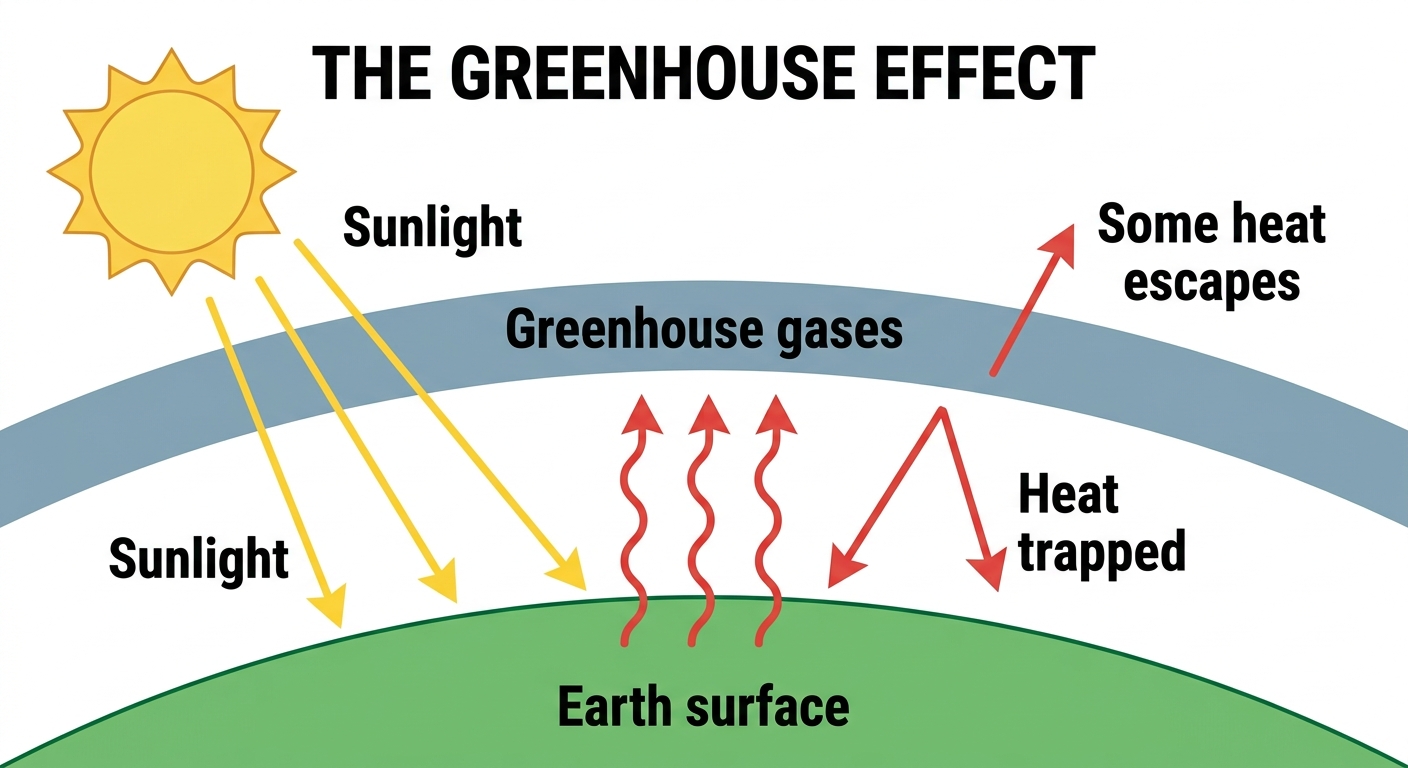
Free printable greenhouse effect diagram — showing how sunlight warms the Earth and greenhouse gases trap some of the heat, with labels. Download a high-resolution PDF or PNG for Letter paper.
Heat is energy, and like all energy, it moves — traveling from hot places toward cooler ones until something stops it. The greenhouse effect is what stops just enough of the Sun's heat from escaping Earth, the same way a glass greenhouse traps warmth so plants can grow through a cold night. Without it, Earth's average temperature would drop to about -18°C (0°F) — far too cold for oceans, forests, or people. The catch is that certain gases control how much heat stays, and the balance is surprisingly delicate.
How the greenhouse effect works
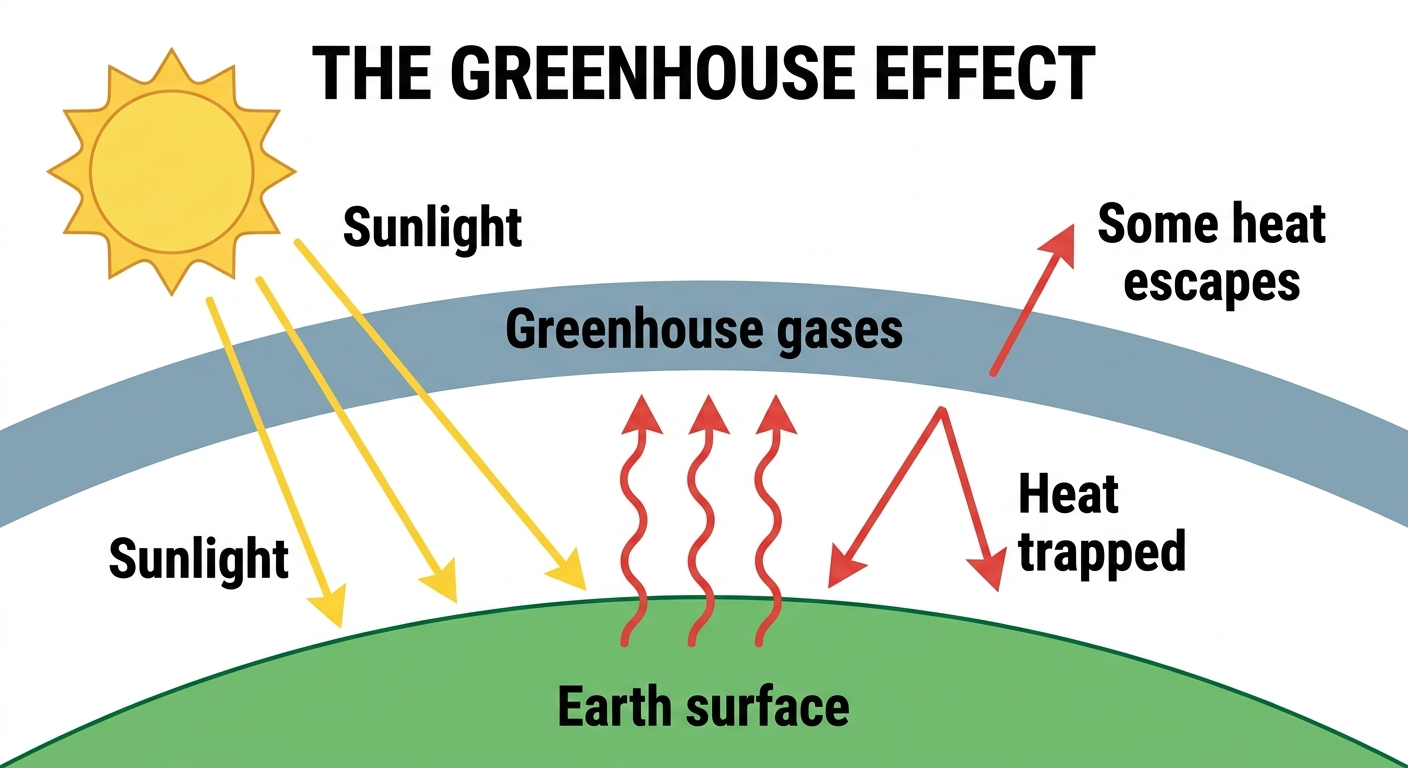
The greenhouse effect is the way certain gases in the atmosphere trap heat from the Sun, keeping the Earth warm enough for living things. Here is what happens at each labeled part of the diagram:
| Step | What it does | Why it matters |
|---|---|---|
| Sunlight arrives | Energy from the Sun travels through the atmosphere and reaches the Earth's surface. | All the energy that powers life on Earth — from photosynthesis to weather to your own body heat — starts with this single delivery. If the atmosphere blocked sunlight entirely instead of letting most of it through, the surface would never warm at all. |
| The ground warms up | The surface absorbs the sunlight, warms up, and then gives off heat. | Surfaces don't just soak up sunlight and stop — they re-emit it as invisible infrared heat, which is what greenhouse gases can actually capture. This step is what converts the Sun's visible light into the slower, outward-moving heat that gets trapped. |
| Greenhouse gases trap heat | Gases such as carbon dioxide absorb some of the rising heat and send it back down, keeping the Earth warm. | This is the mechanism that makes Earth livable: without water vapor, carbon dioxide, and methane acting as a heat blanket, the warmth would rush straight into space every night. Adding more of these gases — which burning fossil fuels does — turns up the blanket, raising global temperatures. |
| Some heat escapes | The rest of the heat passes through the atmosphere and escapes into space. | A planet that only absorbed heat and never released any would keep warming without limit, like a car with the heater stuck on. This escape valve is what keeps the greenhouse effect a balance rather than a runaway spiral — at least when the gas concentrations stay stable. |
Companion worksheet
A free fill-in worksheet with an answer key, built from the labels above — students match each step to its description, then answer a couple of short questions. Great for a quick check after using the diagram.
How to print
Choose Download PDF for a ready-to-print file that fits US Letter paper (8.5 × 11") in landscape, or Download PNG for the high-resolution image.
Frequently asked questions
What is the greenhouse effect?
It is the process by which gases in the atmosphere trap some of the Sun's heat, keeping the Earth warm enough to support life. Too much greenhouse gas traps extra heat and warms the planet.
What are greenhouse gases?
Gases in the atmosphere that trap heat, such as carbon dioxide, methane and water vapor.
What paper size should I print this on?
The diagram is sized for standard US Letter paper (8.5 × 11") in landscape orientation. Use "Download PDF" for a print-ready file that fits the page automatically.